Tasmania housing supply statistics: why the state is falling behind its 2029 target
After the first five quarters of the National Housing Accord, Tasmania had built about 12% of its 26,000-home target. The NHSAC March 2026 quarterly report projects that Tasmania will not deliver its full share until September 2033, more than four years after the June 2029 deadline. Detached houses accounted for 95% of new dwelling approvals in 2024-25, the highest detached-house approval share of any state.
Accord target
26,000
New dwellings by 30 June 2029. Tasmania's population-share allocation of the national 1.2 million target.
Approvals, 12m to March 2026
2,441
Approximately 47% of the 5,200-a-year pace required to hit the Accord target on time.
Projected delivery
Sept 2033
NHSAC's March 2026 outlook puts Tasmania more than four years behind the June 2029 deadline.
SECTION 01 · THE HOUSING TARGET
The housing target: how far behind is Tasmania?
Tasmania needs to complete 5,200 homes a year for five straight years to meet its Accord share. The state has not reached that pace in any recent financial year. Even at the peak of the HomeBuilder boom, Tasmania approved 4,292 dwellings in 2020-21 and completed 3,582 dwellings in 2021-22. The Accord pace is about 45% higher than Tasmania's strongest recent completion year and more than double its 2024-25 completion rate.
Tasmania Housing Accord progress
Cumulative progress against the target of 26,000 homes by June 2029, as at the latest NHSAC quarterly scorecard.
Accord startJun 2029
Accord deadline
% of 26,000
% of 26,000
Expected target completion: September 2033
NHSAC projects that Tasmania will reach its 26,000-home target in September 2033, more than four years after the Accord deadline. Only the Northern Territory is projected to finish later.
How Tasmania compares with other states
Every jurisdiction is behind the Accord pace, but Tasmania and the Northern Territory are the only ones projected to finish more than four years late. Western Australia, Victoria and the ACT are projected to finish within one quarter of September 2029. Across most progress measures, Tasmania and the Northern Territory sit near the bottom of the national table.
| State / territory | 5-yr target | Annual target | FY24-25 completions | % of annual target |
|---|---|---|---|---|
| New South Wales | 376,000 | 75,200 | 42,072 | 56% |
| Victoria | 306,000 | 61,200 | 55,808 | 91% |
| Queensland | 246,000 | 49,200 | 33,611 | 68% |
| South Australia | 84,000 | 16,800 | 12,803 | 76% |
| Western Australia | 129,000 | 25,800 | 22,655 | 88% |
| Tasmania | 26,000 | 5,200 | 2,499 | 48% |
| Northern Territory | 11,000 | 2,200 | 407 | 19% |
| ACT | 21,000 | 4,200 | 4,115 | 98% |
| Australia | 1,200,000 | 240,000 | 173,946 | 72% |
Methodology: 5-year target apportioned by population share (Dec 2022 estimates), per NHSAC. FY24-25 completions = Sep 2024 to Jun 2025 from ABS Building Activity Table 39. Share approved and share built are cumulative against the full 5-year target at March 2026. Sources: NHSAC Quarterly Report, March 2026; ABS Building Activity, Australia, December Quarter 2025, Table 39.
SECTION 02 · HOBART VS OTHER CAPITALS
How Hobart compares with other capitals
Hobart approved 3.5 dwellings per 1,000 residents in 2024-25, the second-lowest rate of any Australian capital and less than half the rate recorded in Melbourne, Brisbane, Perth and Adelaide. Greater Hobart also grew by only 542 residents over the year, the slowest population growth of any capital city.
Hobart's approval rate changes depending on the population measure used. Measured per existing resident, only Darwin approved fewer dwellings per 1,000 people. Measured per new resident, Hobart recorded a higher ratio because its population growth was very low in 2024-25. This means approvals per existing resident and approvals per new resident show different parts of the housing supply picture.
| Capital | Population (Jun 2025) | Pop. growth 2024-25 | Dwelling approvals 2024-25 | Per 1,000 residents |
|---|---|---|---|---|
| Melbourne | 5,435,590 | +105,030 | 46,530 | 8.6 |
| Sydney | 5,638,830 | +75,230 | 33,573 | 6 |
| Brisbane | 2,833,524 | +58,223 | 21,588 | 7.6 |
| Perth | 2,452,765 | +58,088 | 19,458 | 7.9 |
| Adelaide | 1,491,015 | +18,647 | 11,837 | 7.9 |
| Canberra | 484,630 | +6,200 | 2,831 | 5.8 |
| Darwin | 159,284 | +2,719 | 364 | 2.3 |
| Hobart | 255,250 | +542 | 885 | 3.5 |
Badges indicate approvals per 1,000 residents: green = above 7, amber = 4-7, red = below 4. Source: ABS Regional Population 2024-25 (cat. 3218.0), released 31 March 2026; ABS Building Approvals (cat. 8731.0), Table 10, 2024-25.
Hobart's low population growth changes how approval rates are read
Per existing resident, Melbourne, Brisbane, Perth and Adelaide all approved more than twice as many dwellings as Hobart in 2024-25. Sydney approved 6.0 dwellings per 1,000 residents, about 72% higher than Hobart's 3.5.
Per new resident, Hobart approved 1,633 dwellings for every 1,000 people added to the population, roughly 3.5 times the rate of Sydney, Melbourne and Canberra. This reflects Hobart's very low population growth in 2024-25, rather than a direct measure of surplus housing supply. The Accord target of 26,000 was set using December 2022 population figures, before Greater Hobart's 2024-25 population growth slowed to 542 people.
SECTION 03 · APPROVALS
Tasmania dwelling approvals remain below the Housing Accord pace
Tasmania approved 2,341 dwellings in 2024-25, equal to 45% of the 5,200 dwellings a year needed to match its Housing Accord target.
Over the rolling 12 months to March 2026, the total rose slightly to 2,441, about 2% higher than the previous 12-month period. That was well below the growth recorded in South Australia, at around 20%, New South Wales, at around 19%, Queensland, at around 13%, and Western Australia, at around 13%.
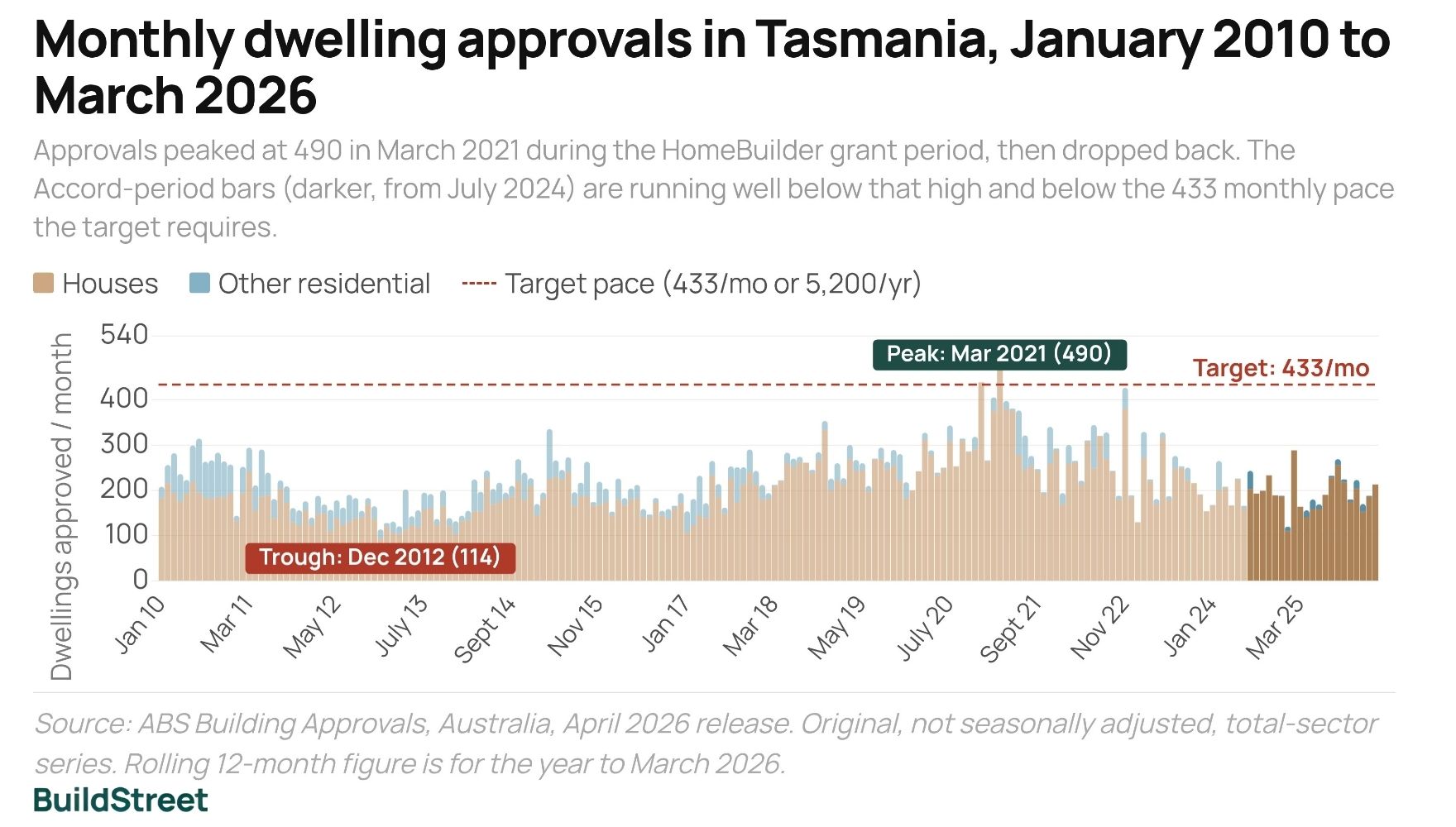
Monthly dwelling approvals in Tasmania, January 2010 to March 2026
Approvals peaked at 490 in March 2021 during the HomeBuilder grant period, then dropped back. The Accord-period bars (darker, from July 2024) are running well below that high and below the 433 monthly pace the target requires.
Source: ABS Building Approvals, Australia, April 2026 release. Original, not seasonally adjusted, total-sector series. Rolling 12-month figure is for the year to March 2026.
Factors linked to Tasmania's low approval numbers
Three factors help explain the approval trend:
- The 2024-25 total of 2,341 approvals was the lowest since 2016-17, excluding the COVID-era HomeBuilder period. Approvals rose quickly in 2020-21 during the HomeBuilder grant period, then declined as housing market and construction conditions changed.
- Tasmania's new dwelling approvals remain heavily weighted toward detached houses. The General Residential Zone requires a minimum lot size of 450m² in most councils, which limits many forms of medium-density housing on existing residential land.
- The value of residential building work approved fell in real terms during 2024, alongside higher borrowing costs and weaker conditions for multi-unit projects.
SECTION 04 · COMMENCEMENTS & COMPLETIONS
Tasmania completed 2,499 dwellings in 2024-25
Tasmania completed 2,499 dwellings in 2024-25, its lowest annual result since 2017-18. That was down 30% from the post-HomeBuilder peak of 3,582 completions in 2021-22.
At that pace, the state was completing about 7 homes per day and 208 per month. To match its Housing Accord target, Tasmania would need to complete about 433 homes per month.
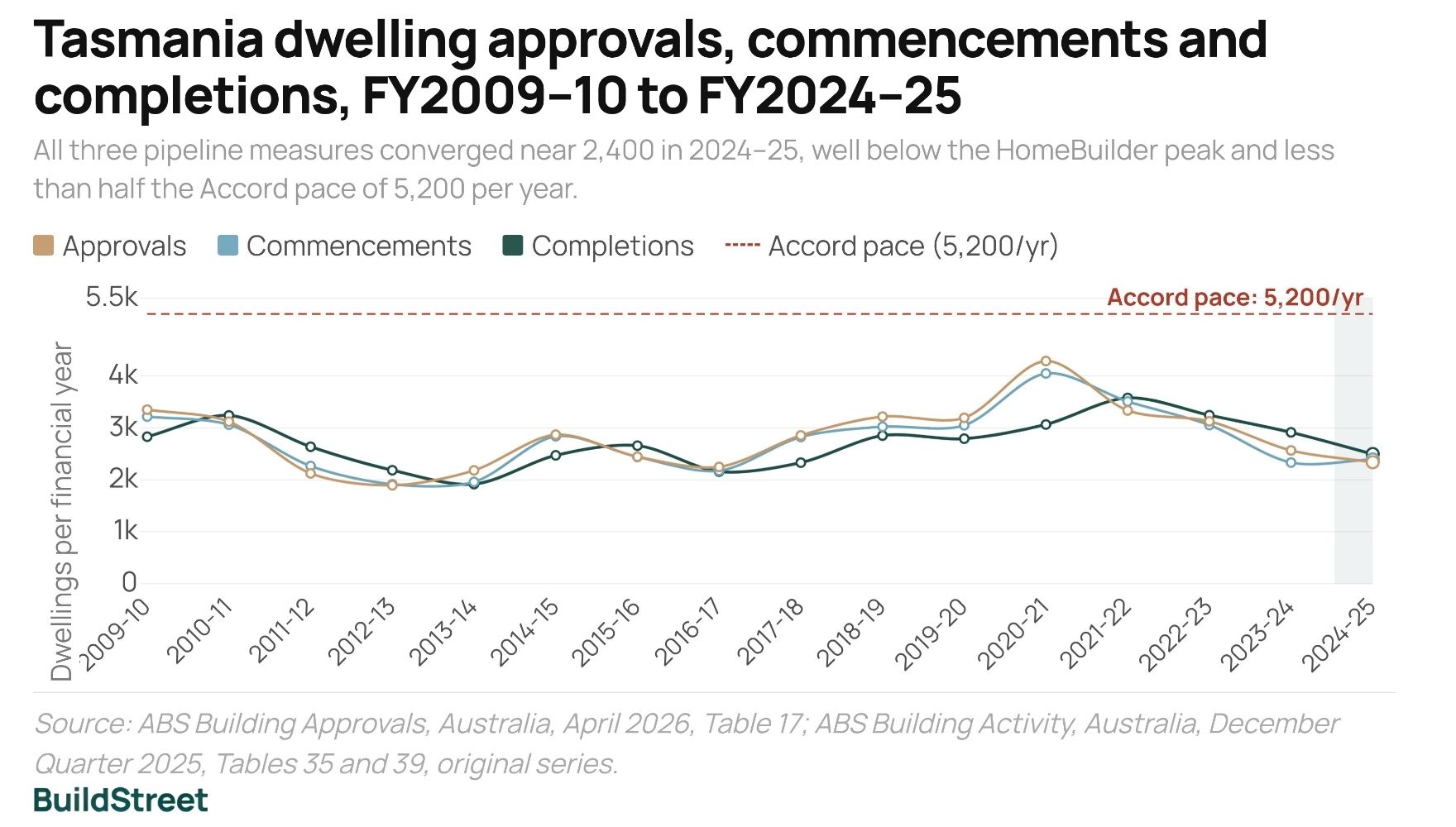
Approvals, commencements and completions were closely aligned in 2024-25, at 2,341, 2,397 and 2,499 dwellings respectively. This shows the pipeline was running at a similar volume across approvals, starts and finishes, but still well below the Accord pace.
Approvals, 2024-25
2,341
vs 4,292 peak (2020-21)
Commencements, 2024-25
2,397
vs 4,053 peak (2020-21)
Completions, 2024-25
2,499
vs 3,582 peak (2021-22)
Under construction (Dec 2025)
2,155
total dwellings active on site
Approved, not yet started
547
dwellings in the pre-construction queue
Accord pace needed
5,200
completions per year to meet June 2029
Tasmania dwelling approvals, commencements and completions, FY2009-10 to FY2024-25
All three pipeline measures converged near 2,400 in 2024-25, well below the HomeBuilder peak and less than half the Accord pace of 5,200 per year.
Source: ABS Building Approvals, Australia, April 2026, Table 17; ABS Building Activity, Australia, December Quarter 2025, Tables 35 and 39, original series.
Why completions matter for housing supply
Completions are the only pipeline measure that directly adds to housing stock. Approvals can lapse, and commencements can stall.
Rolling four-quarter completions fell 15% in the year to September 2025, even as approvals edged higher. This may reflect longer construction times, trade capacity constraints or earlier approvals that did not progress to completion.
Average new house build time by state, 2024-25
Tasmania sits in the middle of the pack nationally, taking 3.95 quarters from approval to completion. Build times have lengthened in every state since 2019-20.
Source: ABS Building Activity (cat. 8752.0), House Building Times by State, 2024-25.
SECTION 05 · DWELLING MIX
Detached houses accounted for 95% of Tasmania's new dwelling approvals
Detached houses accounted for 95% of Tasmania's total dwelling approvals in 2024-25, the highest detached-house share of any state. Across the full financial year, Tasmania approved 2,224 detached houses and 98 other residential dwellings, along with 19 alterations and conversions that created new dwellings.
Source: ABS Building Approvals (cat. 8731.0), Table 17, 2024-25. Share of total dwelling approvals, original total-sector basis.
How this compares with other states
Tasmania is the most detached-house-heavy market in the country. In every other jurisdiction, attached housing makes up at least one in five new approvals. The ACT approves around three apartments or townhouses for every detached house. New South Wales approved more attached than detached dwellings in 2024-25. Only Western Australia (81%) comes within 15 percentage points of Tasmania's 95%.
Detached house share of new dwelling approvals by state, 2024-25
Tasmania stands apart, with a 95% detached share roughly double the national average. The ACT sits at the opposite extreme at 25%.
Source: ABS Building Approvals (cat. 8731.0), Table 17, 2024-25.
SECTION 06 · HOBART VS REGIONAL TASMANIA
Most Tasmanian dwelling approvals are outside Greater Hobart
Only 38% of Tasmania's dwelling approvals came from Greater Hobart in 2024-25. The remaining 62% were approved across regional Tasmania.
This is different from the pattern in many larger states, where capital cities account for most new housing approvals. In Tasmania, more homes were approved outside the capital than within it. Greater Hobart's share has also fallen over time, from 52% in 2018-19 to 38% in 2024-25.
Greater Hobart accounted for a larger share of Tasmania's apartment-style supply. About 56% of the state's other residential approvals came from Greater Hobart in 2024-25, even though the area accounted for 38% of total dwelling approvals.
Greater Hobart vs regional Tasmania dwelling approvals, 2015-16 to 2024-25
Hobart's share has fallen from 52% in 2018-19 to 38% in 2024-25, as regional approvals have held up better through the post-HomeBuilder downturn.
2024–25 Breakdown
Greater Hobart: 37.8%
(885 dwellings)
Rest of Tasmania: 62.2%
(1,456 dwellings)
Hobart non-house share
about 56%
of Tasmania's other residential approvals originated in Greater Hobart in 2024–25, well above its 38% share of total approvals
Source: ABS Building Approvals April 2026 release. Greater Hobart GCCSA total; rest of state derived as state total minus Greater Hobart.
Which councils are approving the most homes?
Launceston recorded the highest number of dwelling approvals of any Tasmanian council in 2024-25, with 241 approvals. Clarence followed with 232 approvals, while Sorell recorded 171. The top five councils accounted for around 40% of all dwelling approvals in Tasmania.
Top Tasmanian councils by dwelling approvals, 2024-25
Launceston leads the state, with regional councils taking four of the top five spots. Greater Hobart councils are shown in slate.
All new dwelling approvals by local government area, 2024-25. Greater Hobart GCCSA includes Brighton, Clarence, Derwent Valley, Glenorchy, Hobart, Kingborough and Sorell. Source: ABS Building Approvals, Tasmania LGA data cube 2024-25.
SECTION 07 · STRUCTURAL BARRIERS
Why is Tasmania's housing pipeline smaller than other states?
Tasmania's housing pipeline is smaller than most other states because of its population size, approval mix, construction capacity and project costs. Some constraints relate to scale, while others are linked to planning settings, labour availability and infrastructure timing.
- Population scale. Tasmania makes up just 2.2% of Australia's population, so even at the Accord pace, the target of 5,200 homes a year is a fraction of what NSW or Victoria need to build.
- Zoning and dwelling mix. Tasmania's new dwelling approvals are heavily weighted toward detached houses. The General Residential Zone generally requires a minimum lot size of 450 square metres across suburban residential land, which can make medium-density projects harder to deliver on existing lots.
- Freight and construction costs. Construction materials shipped to Tasmania can carry additional freight costs across Bass Strait. This may add to project costs, particularly for smaller developments where fixed costs are spread across fewer dwellings.
- Trades capacity. Tasmania has a smaller construction workforce than the mainland states. Industry forecasts have pointed to a multi-thousand-worker shortfall across the Accord period, which may limit how quickly approved projects can move through to completion.
- Construction productivity. National construction productivity has been under pressure over the long term. In a smaller market such as Tasmania, weaker productivity can be harder to offset because there are fewer large projects, firms and workers available to absorb delays.
What the April 2026 Tasmania housing package includes
In April 2026, the Commonwealth and Tasmanian Governments agreed in principle to a $165 million housing package. The package includes $115 million in concessional Housing Australia loans and $50 million in grants. It is designed to support up to 4,000 new dwellings, with up to 2,101 reserved for first-home buyers.
The package has two main streams.
- Enabling infrastructure. This stream includes a $35 million loan and $50 million in grants for water, sewer and road works in Brighton, Sorell and Meander Valley. The funding is expected to unlock around 2,700 homes, with almost 1,100 reserved for first-home buyers.
- First-home buyer loans. A further $80 million in concessional loans is intended to support more than 2,000 homes around Hobart, Launceston, Devonport and Burnie.
The first homes supported by the package are not expected to reach the market until 2027-28. That means the package is not yet visible in the approvals, commencements or completions data used in this article.
SECTION 08 · EXISTING-STOCK PRESSURE
Short-stay rentals in Tasmania and their impact on housing supply
There were 3,918 non-primary-residence short-stay listings across Tasmania in the July to September 2024 quarter, up 26% from the 2019 baseline of 3,112. These listings represent existing dwellings used for commercial short-stay accommodation rather than as primary residences. Tasmania approved 2,341 new homes in 2024-25, meaning its commercial short-stay stock was 1.7 times that figure.
The concentration varies widely by council. In some coastal areas, short-stay rentals account for more than one in ten dwellings. In Greater Hobart, the share sits around 2% to 3%. Brighton and outer-regional councils are close to zero.
Short-stay rental density by Tasmanian council
Glamorgan-Spring Bay, Tasman and Break O'Day have the highest concentrations, with short-stay rentals making up between 5% and 11% of total dwelling stock.
Source: TasCOSS State of Housing Dashboard, Jul-Sep 2024 reference period, updated April 2026. Based on Tasmanian Government CBOS short-stay accommodation data and ABS dwelling stock estimates.
What the Tasmanian short-stay levy does
Tasmania's Short Stay Levy Bill 2026 passed the House of Assembly on 7 May 2026 and had its first reading in the Legislative Council on 15 May 2026. At the latest parliamentary update, it had not yet completed the upper-house stages or received Royal Assent.
The bill would introduce a 5% levy on short-stay accommodation bookings, with the revenue directed to first-home-buyer support. The levy is proposed to apply to bookings made through short-stay platforms, while owner-occupiers renting out their primary residence would be exempt. Subject to passage through Parliament, the levy is proposed to start on 1 July 2026.
It is not yet clear whether the levy would reduce the number of short-stay properties, be passed on to guests, or shift any homes back into the long-term rental market. The data does not yet show any effect from the proposed levy. In Greater Hobart, the rental vacancy rate was 0.5% in April 2026.
SECTION 09 · THE SHORTFALL
Will Tasmania meet its 2029 Housing Accord target?
Tasmania is projected to deliver around 13,000 of its 26,000-home target by June 2029. That would leave the state about halfway to its target by the deadline. The full target is not expected to be reached until September 2033.
Industry forecasts suggest the shortfall could be as large as 14,000 homes, based on current commencement rates.
Tasmania cumulative completions vs Housing Accord target, July 2024 to June 2029
By December 2025, Tasmania had completed an estimated 3,727 homes against a straight-line target of 7,800, tracking at roughly 48% of the required pace.
Source: ABS Building Activity (cat. 8752.0), Table 39; NHSAC State of the Housing System 2026. Straight-line target = 26,000 ÷ 20 quarters = 1,300/quarter.
About 13,000
Projected shortfall by June 2029
The gap between projected completions of 13,000 and the 26,000 target.
0.5%
Hobart rental vacancy rate
April 2026. A balanced rental market is generally considered to be around 3%.
10.6 yrs
Time to save a deposit
NHSAC estimate for Tasmania, 2025-26, on a 20% deposit at median dwelling prices.
+542
Greater Hobart population growth
Net increase, June 2024 to June 2025. The slowest capital-city growth rate nationally.
+15%
House build time vs 2019-20
3.95 quarters end-to-end in 2024-25, up from 3.42 in 2019-20.
547
Approved but not commenced
Approved but not yet commenced in Tasmania in December 2025.
What the data shows about Tasmania's housing shortfall
Closing a shortfall of around 13,000 homes by June 2029 would require completions to increase well above recent levels. The data points to three constraints: limited medium-density approvals, infrastructure timing and construction workforce capacity.
The April 2026 $165 million state-federal deal helps with part of the second point, but those homes are not expected to settle until 2027-28. Slower population growth eases demand a little, but Tasmania's problem is mostly on the supply side: too few approvals, too few starts, longer build times, and existing homes continuing to move into short-stay accommodation.
SECTION 10 · PIPELINE SUMMARY
Tasmania housing pipeline summary, 2009-10 to 2024-25
Tasmania's dwelling approvals peaked at 4,292 in 2020-21 during the HomeBuilder grant period. Commencements reached 4,053 in the same year, while completions peaked one year later at 3,582 in 2021-22.
Since 2022-23, approvals, commencements and completions have declined toward the 2,300 to 2,500 range. The 2024-25 figures are among Tasmania's lowest annual pipeline results since the global financial crisis.
4,292
Peak annual approvals
2020-21, during the HomeBuilder grant period.
3,582
Peak annual completions
2021-22, the post-HomeBuilder construction wave.
−45%
Approvals vs the 2020-21 peak
2024-25 approvals of 2,341 are well below the COVID-era high.
2,155
Dwellings under construction
Total across Tasmania at end of December 2025.
Full historical data — 17 financial years · pipeline summary
| FY | Approvals | Commencements | Completions | Under construction (EOY) | Approved, not yet started (EOY) |
|---|---|---|---|---|---|
| 2009–10 | 3,355 | 3,221 | 2,833 | 2,282 | 474 |
| 2010–11 | 3,124 | 3,064 | 3,244 | 2,584 | 523 |
| 2011–12 | 2,126 | 2,268 | 2,640 | 2,357 | 590 |
| 2012–13 | 1,897 | 1,917 | 2,187 | 1,932 | 441 |
| 2013–14 | 2,184 | 1,962 | 1,919 | 1,639 | 333 |
| 2014–15 | 2,872 | 2,842 | 2,474 | 1,633 | 334 |
| 2015–16 | 2,448 | 2,443 | 2,661 | 1,971 | 276 |
| 2016–17 | 2,250 | 2,177 | 2,161 | 1,684 | 372 |
| 2017–18 | 2,858 | 2,827 | 2,333 | 1,666 | 326 |
| 2018–19 | 3,221 | 3,026 | 2,855 | 2,101 | 332 |
| 2019–20 | 3,198 | 3,053 | 2,795 | 2,224 | 419 |
| 2020–21 | 4,292 | 4,053 | 3,069 | 2,416 | 489 |
| 2021–22 | 3,339 | 3,512 | 3,582 | 3,248 | 543 |
| 2022–23 | 3,130 | 3,059 | 3,248 | 3,051 | 358 |
| 2023–24 | 2,569 | 2,335 | 2,917 | 2,915 | 609 |
| 2024–25 | 2,341 | 2,397 | 2,499 | 2,331 | 609 |
| 2025–26 YTD | 1,932 | 1,221 | 1,227 | 2,155 | 547 |
* 2025-26 YTD covers nine months of approvals (Jul 2025 to March 2026), two quarters of commencements and completions (Sep + Dec 2025), and EOY stocks at December 2025.
General information only
This article is based on publicly available data from the ABS, NHSAC, TasCOSS, HIA, Master Builders Tasmania and SQM Research. It is general information only and does not constitute financial, investment, planning or legal advice. Figures are drawn from official Australian government data releases, named industry reports and Build Street calculations using those sources.
ABS Building Approvals, Australia, April 2026 (cat. 8731.0)
ABS Building Activity, Australia, December Quarter 2025 (cat. 8752.0)
ABS Regional Population, 2024-25 (cat. 3218.0)
NHSAC State of the Housing System 2026
NHSAC Quarterly Report — March 2026
TasCOSS State of Housing Dashboard
Master Builders Tasmania — Housing Forecast 2026-2029
SQM Research — Hobart residential vacancy rates
Chart Snapshots