How many homes are built in Australia each year?
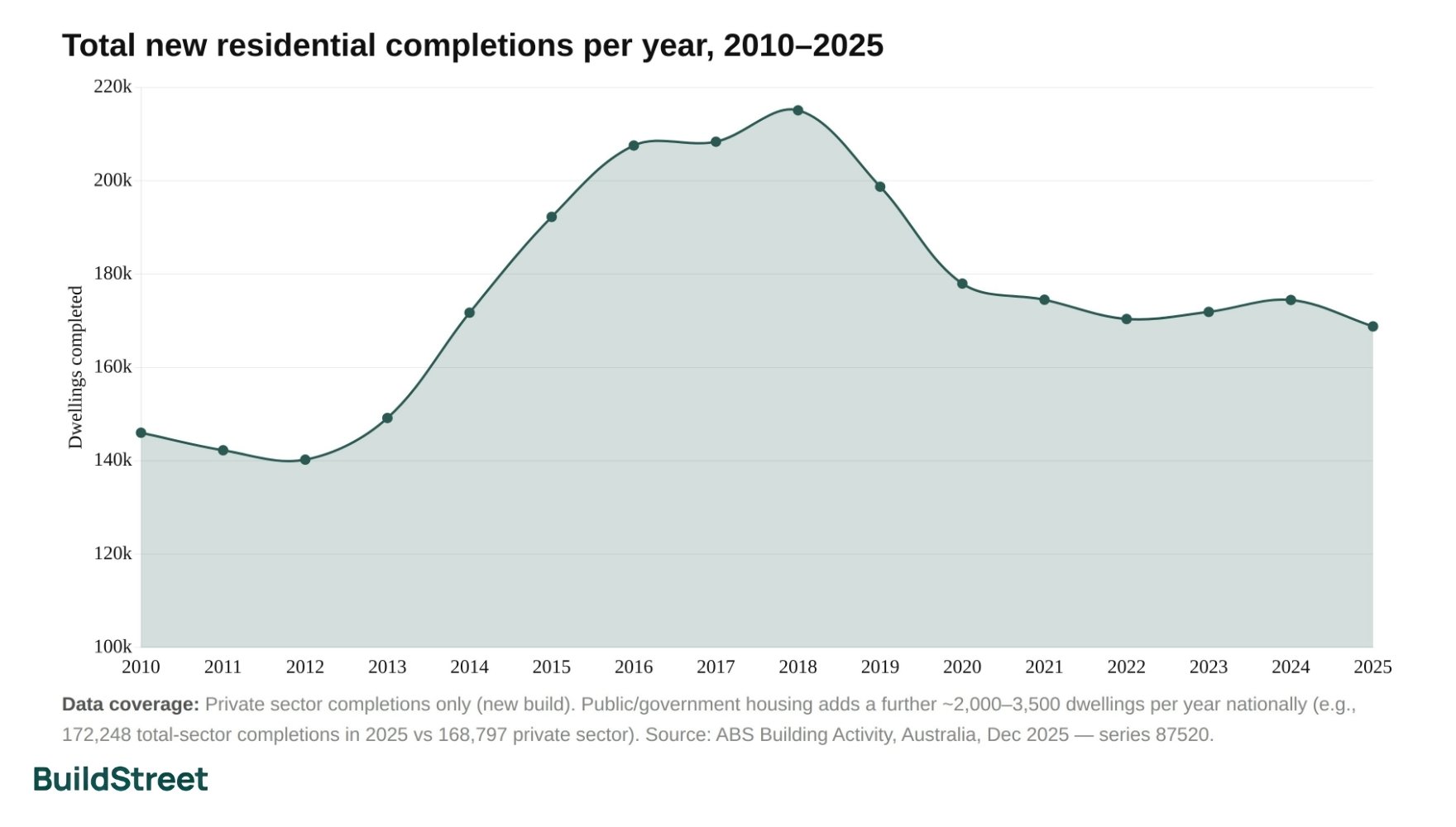
Australia built 168,797 new private sector homes in 2025, or about 172,248 when public and community housing is included. That was down from 174,465 in 2024 and remains well below the pace needed to meet the National Housing Accord target of 1.2 million new homes by June 2029. Since 2010, private sector output has averaged roughly 175,600 dwellings a year, with completions peaking at 215,103 in 2018 before falling back. This slowdown in overall numbers is reflected in the shifting mix of housing types.
Detached houses now dominate new housing completions, making up 64% of the total, while apartments have fallen to just 18%, their lowest share in two decades. Measured against population growth, Australia is building homes at close to its slowest rate in 50 years.
Private sector completions (2025)
168,797
All dwelling types · ~172,248 incl. public sector
Detached houses
108,510
64% of 2025 total
Per 1,000 residents
7.07
Up from 6.13 in 2023
The 1.2 million homes target by June 2029
Australia needs 240,000 new homes a year to reach the National Housing Accord's target of 1.2 million by June 2029. That's roughly 43% more than the 168,797 built in 2025 and a rate the country has never sustained. The NHSAC's March 2026 quarterly report confirmed that completions since the Accord began are running well below the required pace.
Is the 1.2 million target achievable? →Are build times finally improving?
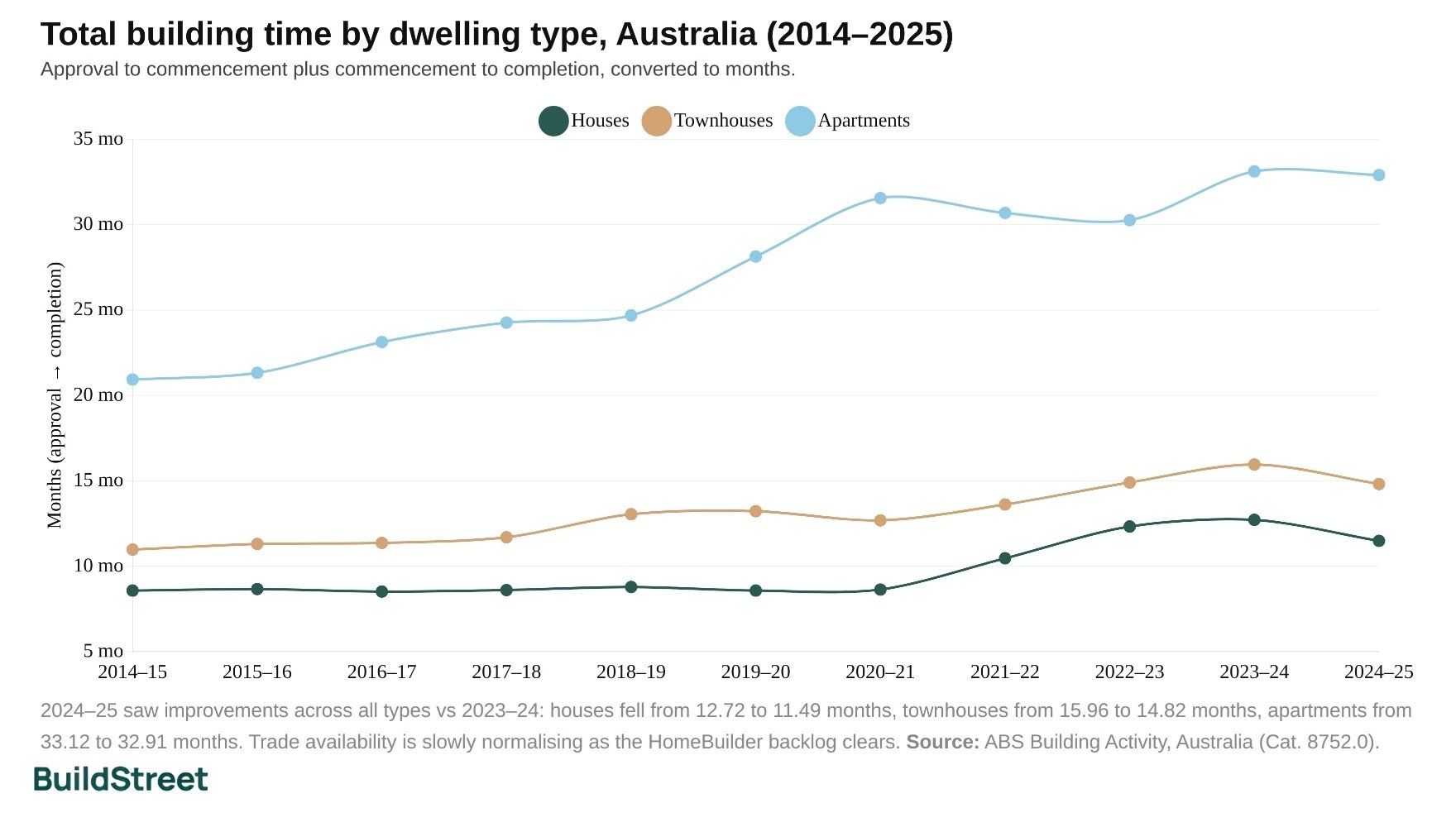
Post-pandemic construction delays pushed build times to record highs, but the wait from approval to handover is getting shorter. By early 2026, detached houses were averaging around 12 to 13 months from approval to completion, down from 17 months in 2022. If that trend holds, completions should start rising through 2026 and 2027.
How long does it take to build a house in Australia? →Dwelling completions in Australia, 2010–2025: boom, bust and gradual recovery
Two distinct cycles have shaped Australia's housing output since 2010:
- 2010–2018 boom: Completions climbed from 146,007 to a record 215,103, driven by high-rise apartment construction in Sydney and Melbourne.
- 2019–2022 retreat: As the apartment pipeline dried up, completions fell to 170,386, a drop of more than 44,000 from peak.
- 2023–2025 recovery: Output has stabilised around 168,000–175,000, with house completions holding steady while apartments remain subdued.
Total new residential completions per year, 2010–2025
| Year | Total | Houses | Townhouses | Apartments |
|---|---|---|---|---|
| 2010 | 146,007 | 108,805 | 16,100 | 21,102 |
| 2011 | 142,254 | 97,364 | 20,246 | 24,643 |
| 2012 | 140,240 | 90,632 | 18,199 | 31,408 |
| 2013 | 149,170 | 94,828 | 19,130 | 35,212 |
| 2014 | 171,729 | 102,018 | 24,390 | 45,321 |
| 2015 | 192,267 | 117,305 | 26,063 | 48,898 |
| 2016 | 207,558 | 112,941 | 30,073 | 64,545 |
| 2017 | 208,375 | 110,866 | 29,982 | 67,529 |
| 2018 | 215,103 | 119,351 | 33,053 | 62,699 |
| 2019 | 198,729 | 108,749 | 29,661 | 60,319 |
| 2020 | 177,966 | 103,317 | 26,139 | 48,510 |
| 2021 | 174,514 | 108,656 | 25,376 | 40,484 |
| 2022 | 170,386 | 113,503 | 25,228 | 31,655 |
| 2023 | 171,905 | 114,388 | 27,068 | 30,451 |
| 2024 | 174,465 | 110,791 | 29,055 | 34,620 |
| 2025 | 168,797 | 108,510 | 29,411 | 30,878 |
Data coverage: Private sector completions only (new build). Public/government housing adds a further ~2,000–3,500 dwellings per year nationally (e.g., 172,248 total-sector completions in 2025 vs 168,797 private sector). Source: ABS Building Activity, Australia, Dec 2025 — series 87520.
Houses, townhouses and apartments: how Australia's building mix has shifted
The composition of new housing has shifted significantly since the mid-2000s. Detached houses now make up 64% of completions, up from a low of 53% in 2017 when the apartment boom was at its height. That surge peaked at 67,529 apartment units in 2017 and has since collapsed, with just 30,878 completed in 2025.
Annual completions by dwelling type, 2005–2025
Data coverage: Private sector completions only. Semi-detached homes, row houses, and townhouses are grouped under "Townhouses." Source: ABS Building Activity, Australia, Dec 2025.
Pre-COVID, peak and today: how dwelling completions compare by type
The apartment sector tells the starkest story. From 60,319 completions in 2019, apartments have fallen nearly 49% to just 30,878 in 2025, driven by soaring construction costs, tighter developer finance, and a pipeline that never recovered post-COVID. By contrast, detached house and townhouse completions are virtually unchanged from pre-COVID levels, down less than 1% each.
Completions by dwelling type: pre-COVID vs peak vs 2025
| Dwelling type | Pre-COVID (2019) | Peak (2018) | 2025 | vs Pre-COVID | vs Peak |
|---|---|---|---|---|---|
| Detached houses | 108,749 | 119,351 | 108,510 | ▼ -0.2% | ▼ -9.1% |
| Townhouses | 29,661 | 33,053 | 29,411 | ▼ -0.8% | ▼ -11.0% |
| Apartments | 60,319 | 62,699 | 30,878 | ▼ -48.8% | ▼ -50.8% |
| Total | 198,729 | 215,103 | 168,797 | ▼ -15.1% | ▼ -21.5% |
Data coverage: Private sector completions only. Source: ABS Building Activity, Australia, Dec 2025.
Which states are completing the most new houses and dwellings?
Victoria leads with 34,627 detached house completions in 2025, ahead of Queensland (21,953) and New South Wales (21,370). The two states to record meaningful growth since 2015:
- South Australia: up 23.6%, from 7,988 to 9,874.
- Victoria: up 10.0%, from 31,475 to 34,627.
Western Australia has recovered strongly, rising from 10,281 in 2020 to 17,536 in 2025, but remains 28.6% below its 2015 peak. The ACT (−47.0%) and NT (−60.1%) have seen the steepest falls.
Detached house completions by state, 2025 vs 2015
- 2015
- 2025
| State / Territory | 2015 | 2025 | Change | % change |
|---|---|---|---|---|
| Australian Capital Territory | 1,440 | 763 | -677 | ▼ -47.0% |
| New South Wales | 25,203 | 21,370 | -3,833 | ▼ -15.2% |
| Northern Territory | 779 | 311 | -468 | ▼ -60.1% |
| Queensland | 23,554 | 21,953 | -1,601 | ▼ -6.8% |
| South Australia | 7,988 | 9,874 | +1,886 | ▲ +23.6% |
| Tasmania | 2,310 | 2,076 | -234 | ▼ -10.1% |
| Victoria | 31,475 | 34,627 | +3,152 | ▲ +10.0% |
| Western Australia | 24,557 | 17,536 | -7,021 | ▼ -28.6% |
Data coverage: Detached houses, private sector only. Figures are calendar year completions. Source: ABS Building Activity, Australia, Dec 2025.
Australia's housing output per person is near a 50-year low
Adjusted for population, Australia's housing output is weaker than headline numbers suggest. The country approved 14.9 new homes per 1,000 residents at the 1973 postwar peak. By 2023, that had fallen to just 6.13, the lowest on record. The 2025 reading of 7.07 is a step forward, but the trend is one of declining per-capita supply against a rapidly growing population.
Note: this chart uses building approvals data (not completions), which is the standard long-run series available from 1971. Approvals generally lead completions by 6–18 months.
New housing approvals per 1,000 residents, 1971–2025
Data: Total residential approvals (all sectors) ÷ ABS Estimated Resident Population × 1,000. Source: ABS Building Approvals, Australia & ABS National, State and Territory Population.
Detached house completions are rising, but still a smaller share than in past decades
The apartment-driven surge of 2012–2018 pushed detached houses below 53% of all completions at its lowest point. That share has recovered to 64% in 2025, close to mid-2000s levels, but the overall volume of homes being built remains insufficient. The key question is whether medium-density townhouse supply can fill the gap left by the collapse in apartments and the affordability ceiling now facing greenfield estates.
Share of new home completions by type, 2005–2025
What proportion of new dwellings were detached houses, townhouses, or apartments each year?
Data coverage: Private sector completions only. Source: ABS Building Activity, Australia, Dec 2025.
2010: before the apartment boom
74%
detached houses
2017: peak apartment era
32%
apartments, highest ever
2025: current mix
64%
houses · 17% towns · 18% apts
How Australia's housing supply is tracking in 2026
The NHSAC Quarterly Report for March 2026 puts residential building approvals for January to March 2026 at roughly 42,500 dwellings. Annualised, that works out to around 170,000 homes per year, an improvement on 2023 but broadly in line with the plateau that has defined the past two years. To stay on pace with the National Housing Accord, Australia needs 60,000 approvals per quarter. That gap is not closing quickly.
Build times for detached houses have continued to shorten. By early 2026, the average from approval to completion had dropped to around 12 to 13 months, down from a peak of 17 months in 2022. That improvement should feed into stronger completions through the second half of the year. Townhouses and terraces have shown the most consistent growth of any dwelling type and are increasingly the segment developers and planners are pointing to as the most workable path to adding supply in existing suburbs.
Q3 FY2026 approvals rate
~170k
Annualised, Jan–Mar 2026
Annual target (Accord)
240,000
Required pace to meet 1.2M by 2029
Avg. house build time
12–13 mo
Down from 17 months in 2022
Based on the current trajectory, the NHSAC March 2026 report suggests Australia will deliver somewhere between 900,000 and 950,000 new homes by June 2029, well short of 1.2 million. The apartment sector is where the numbers diverge most sharply from what is needed: just 30,878 were completed in 2025 and the forward pipeline remains thin. Unless higher-density construction picks up significantly, the Accord target is out of reach.
General information only
This article is based on publicly available ABS data. It is general information only and does not constitute financial advice. If you are making decisions about saving for a property purchase, consider speaking with a licensed financial adviser.
ABS Building Activity Australia, Dec 2025
NHSAC Quarterly Report March 2026
NHSAC State Housing System Report 2025
ABS National, State and Territory Population (ERP)
Chart Snapshots