Knockdown rebuild statistics in Australia: how many homes are demolished and rebuilt each year?
Australia approved 30,864 knockdown rebuild (KDR) dwellings in 2024–25, down 29% from the 2021–22 peak of 43,638. New South Wales and Victoria accounted for nearly seven in ten KDR approvals nationally, though both states recorded year-on-year declines. The average approved value of a KDR detached house reached more than $1 million in June 2025, around 138% above the average approved value of a standard new detached house. More than half of all KDR projects replace one home with one home, meaning most knock-down activity does not add to net housing supply.
KDR approvals 2024–25
30,864
Dwelling units approved in KDR projects nationally
Peak year (2021–22)
43,638
Highest annual KDR approvals on record
Change from peak
−29.3%
Decline in KDR approvals from the 2021–22 peak
KDR share of total
16.7%
KDR share of all new residential dwelling approvals in 2024–25
SECTION 01 · THE NATIONAL PICTURE
How many knockdown rebuilds happen in Australia each year?
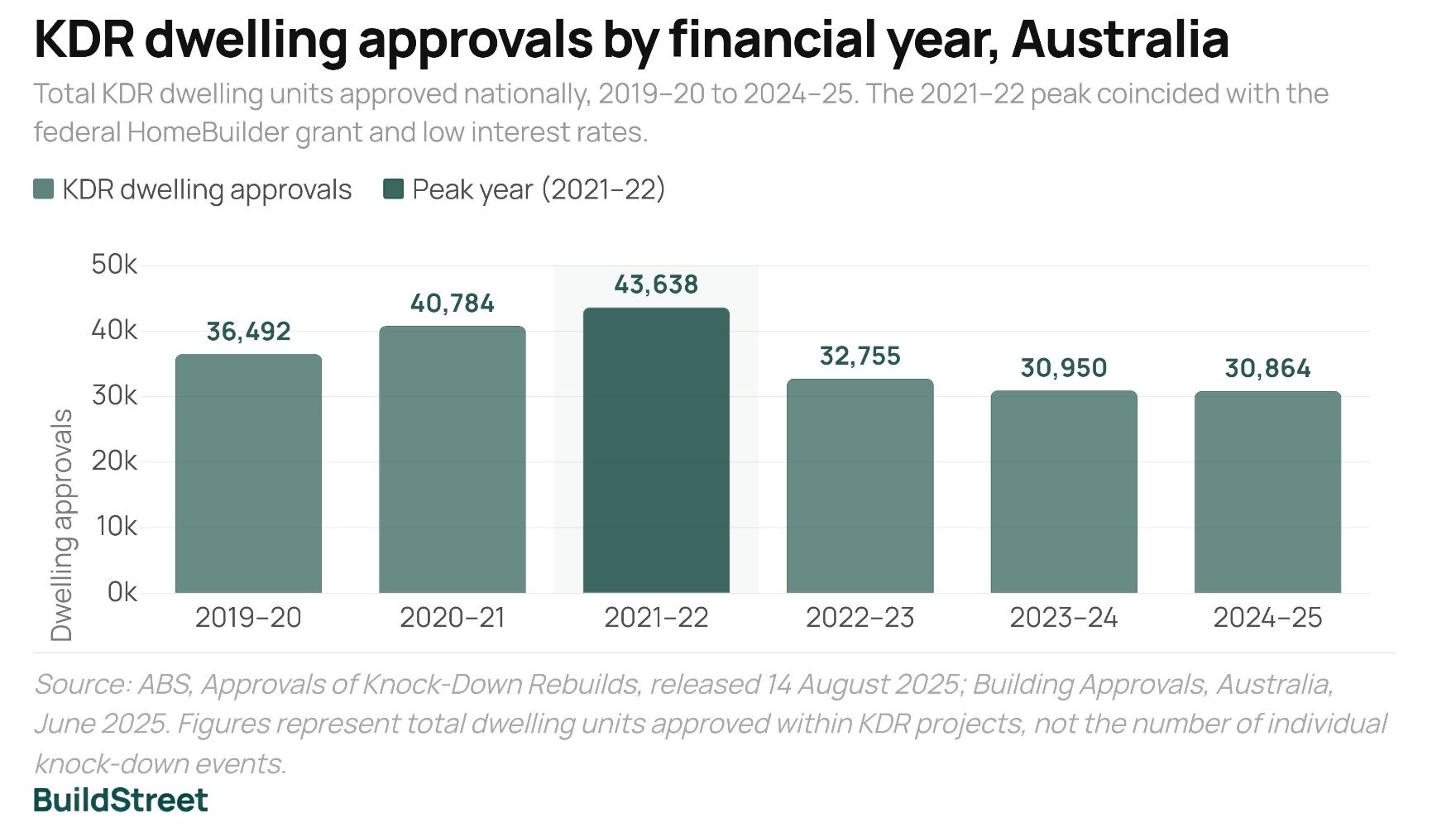
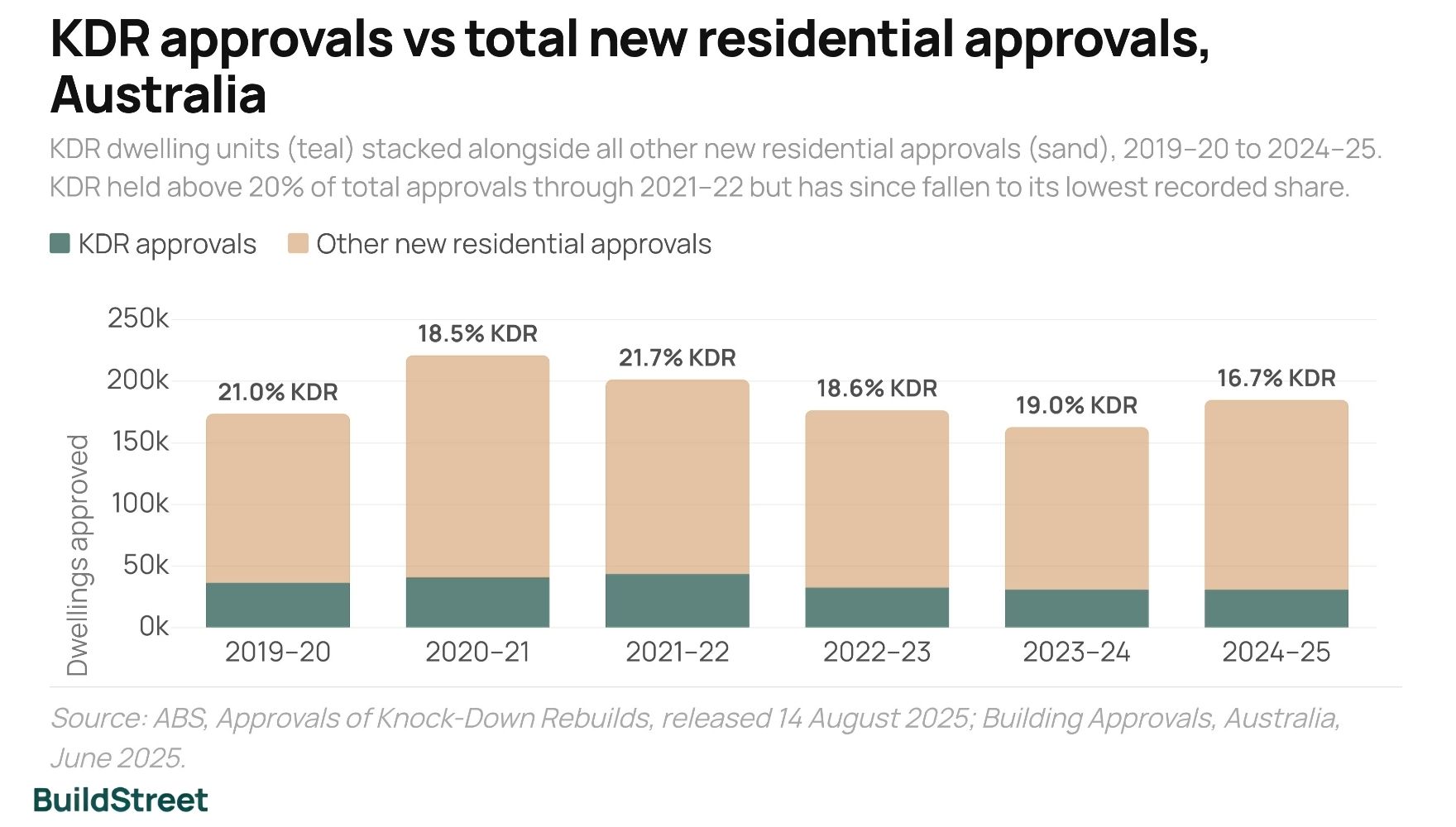
Australia approved 30,864 KDR dwelling units in 2024–25, down 29% from the 2021–22 peak of 43,638. That is roughly one in six of all new residential dwelling approvals nationally, with KDR projects recording their lowest share of total approvals at 16.7%.
KDR approvals moved through three clear phases between 2019–20 and 2024–25:
- 2019–20 to 2021–22: Approvals rose from 36,492 to 43,638, during a period that coincided with the federal HomeBuilder grant and low interest rates.
- 2022–23: Approvals fell 25% in a single year to 32,755, as interest rates rose and construction costs increased.
- 2023–24 to 2024–25: Activity levelled off, with the 2024–25 total of 30,864 sitting just 86 below the prior year.
Total residential approvals rose to 184,834 in 2024–25, with increases concentrated in apartments and greenfield housing. KDR approvals did not follow the same pattern, so KDR's share of all new residential approvals fell to its lowest level in the ABS data series.
These figures count approved dwelling units, not individual knock-down events. A single site that produces two new homes counts as two approved dwellings, but only one demolition.
KDR dwelling approvals by financial year, Australia
Total KDR dwelling units approved nationally, 2019–20 to 2024–25. The 2021–22 peak coincided with the federal HomeBuilder grant and low interest rates.
Source: ABS, Approvals of Knock-Down Rebuilds, released 14 August 2025; Building Approvals, Australia, June 2025. Figures represent total dwelling units approved within KDR projects, not the number of individual knock-down events.
KDR share at peak (2021–22)
21.7%
More than one in five new dwelling approvals were knockdown rebuilds in 2021–22
KDR share in 2024–25
16.7%
The lowest share in the data series. Apartment and greenfield approvals increased over the same period, while KDR approvals remained below their 2021–22 peak.
SECTION 02 · WHERE IT HAPPENS
Which states have the most knockdown rebuilds?
New South Wales (10,959 approvals) and Victoria (10,208) together accounted for 68.6% of all KDR approvals in 2024–25, a pattern that has held every year in the data series. Both states recorded fewer approvals than in 2023–24, with NSW down 9.3% and Victoria down 4.7%, though they remain the two largest KDR markets nationally.
Both states have large established suburbs, ageing housing stock, strong land values, and planning frameworks associated with infill development. These conditions are commonly linked with higher knockdown rebuild activity, although the ABS data does not isolate which factors explain approvals in each state.
Queensland and Western Australia were the only states to grow in 2024–25. Queensland rose 13.9% to 5,844 approvals, while Western Australia rose 19% to 2,090. Both states recorded growth from smaller bases than NSW and Victoria, which remained the two largest markets.
South Australia's reported figure of 1,193 should be treated with caution. The state recorded 151 approvals in December 2024 alone, compared with a typical monthly range of 20 to 70, which lifted the annual total. The ACT (398) and Tasmania (134) remained low-volume markets.
KDR dwelling approvals by state, 2019–20 to 2024–25
Annual KDR approvals by state. NSW and Victoria recorded the highest KDR approval volumes across every year in the series, though both declined from their 2021–22 peaks. Queensland and WA were the only states to record growth in 2024–25.
2019–20
Source: ABS, Approvals of Knock-Down Rebuilds, released 14 August 2025; Building Approvals, Australia, June 2025. KDR figures represent dwelling units, not individual knock-down events. NT omitted due to low volumes (under 100 per year).
| State/territory | 2023–24 | 2024–25 | Change | Share (2024–25) |
|---|---|---|---|---|
| New South Wales | 12,080 | 10,959 | -9.3% | 35.5% |
| Victoria | 10,710 | 10,208 | -4.7% | 33.1% |
| Queensland | 5,132 | 5,844 | +13.9% | 18.9% |
| Western Australia | 1,757 | 2,090 | +19% | 6.8% |
| South Australia | 581 | 1,193 | +105% | 3.9% |
| Australian Capital Territory | 451 | 398 | -11.8% | 1.3% |
| Tasmania | 213 | 134 | -37.1% | 0.4% |
| Northern Territory | 26 | 38 | +46.2% | 0.1% |
| Australia | 30,950 | 30,864 | -0.3% | 100% |
Source: ABS, Approvals of Knock-Down Rebuilds, released 14 August 2025; Building Approvals, Australia, June 2025. SA's 2024–25 figure includes an unusually high December 2024 reading.
SECTION 03 · WHAT GETS BUILT
Do knockdown rebuilds add new housing?
Nationally, 58.4% of KDR projects are one-for-one replacements, meaning one home is knocked down and one new home takes its place. These projects can improve housing quality and energy efficiency, but they do not add to the overall housing supply.
The remaining 41.6% of projects produce two or more dwellings per site and are the only KDR activity that contributes net new homes. Two-for-one rebuilds account for 26.7% of all projects; three-for-one for a further 6.2%.
Apartment-type projects make up a small share of all KDR work by number, but they average 9.5 new dwellings per knock-down, compared with 1.3 for a house-for-house replacement. Across all project types, the overall average is 2.1 dwellings per knock-down event, which indicates an approximate 14,700 individual knock-down events behind the 30,864 dwelling units approved in 2024–25.
Average dwellings approved per knock-down, by rebuild type
1.3
Average when rebuilt as a house, the most common KDR outcome by number of projects
3.0
Average when rebuilt as semi-detached dwellings or townhouses
9.5
Average when rebuilt as apartments, the highest average among the listed rebuild types
KDR project types by share of total projects
Cumulative breakdown of 95,443 KDR projects by rebuild configuration. More than half result in a one-for-one replacement and add no new dwellings to the housing stock. The remaining projects produced two or more homes per site and were the only KDR projects that added to net supply.
National breakdown
Source: ABS, Approvals of Knock-Down Rebuilds, released 14 August 2025; Building Approvals, Australia, June 2025. Project type counts are cumulative across the full data period.
One-for-one knockdown rebuild rates by state
The share of KDR projects that result in a one-for-one replacement varies considerably by state, ranging from 49.9% in South Australia to 74.9% in the ACT:
- ACT (74.9%) and Queensland (74.4%): most KDR activity in both territories results in a like-for-like replacement, adding no net homes to the local stock.
- NSW (54.8%) and Victoria (57.0%) both sit close to the 58.4% national average.
- South Australia (49.9%) has the lowest one-for-one rate on the mainland, meaning most projects there produce more than one dwelling per site.
The variation may reflect differences in local planning rules, housing stock and the types of sites where KDR activity is concentrated. The ABS data shows the pattern, but does not isolate the cause of the state-level differences.
| State/territory | Total KDR projects | One-for-one projects | One-for-one share |
|---|---|---|---|
| New South Wales | 33,343 | 18,286 | 54.8% |
| Victoria | 33,880 | 19,311 | 57% |
| Queensland | 11,367 | 8,457 | 74.4% |
| Western Australia | 7,723 | 4,583 | 59.3% |
| South Australia | 6,995 | 3,492 | 49.9% |
| Australian Capital Territory | 1,647 | 1,233 | 74.9% |
| Tasmania | 389 | 277 | 71.2% |
| Northern Territory | 99 | 53 | 53.5% |
| Australia | 95,443 | 55,692 | 58.4% |
Source: ABS, Approvals of Knock-Down Rebuilds, released 14 August 2025. Figures are cumulative across the full ABS data period.
58.4%
Share of KDR projects nationally that are one-for-one replacements, adding no net new dwellings to the housing stock
14,700
Estimated individual knock-down events behind the 30,864 KDR dwelling approvals in 2024–25, based on the 2.1 dwellings-per-event average
9.5×
Average dwellings per knock-down when replaced with apartments, the highest average among the listed rebuild types
SECTION 04 · WHAT IT COSTS
How much are KDR approvals worth compared with standard new builds?
The average approved value of a KDR detached house reached $1,037,336 in June 2025, compared with $434,960 for a standard new detached home. That is a premium of 138%, up from around 65% in July 2019. KDR approved values have risen 110% since 2019, more than twice the 45% increase recorded for standard new detached houses over the same period.
This comparison is based on approved building values, not final construction costs. KDR projects tend to be in established suburbs where land values are higher, and the homes are typically larger and better specified than volume-built homes on greenfield sites. The data does not adjust for location, size, or quality, so the gap reflects both where KDR happens and what gets built, not construction costs alone.
Average approved value of a KDR detached house, June 2025
$1.04m
Three-month rolling average approval value, 138% above the $434,960 average for a standard new detached home.
Jul-2019: $494,019 · Growth since 2019: +110% · Non-KDR growth: +45%
Average approval value: KDR detached houses vs other new detached houses
Three-month rolling average approval value in dollars, July 2019 to June 2025. Both series have risen since 2019, but KDR values have grown more than twice as fast. The gap widened from 2021 onward as KDR activity shifted toward larger, higher-specification homes in established suburbs.
Source: ABS, Approvals of Knock-Down Rebuilds, released 14 August 2025; Building Approvals, Australia, June 2025. Values are 3-month rolling averages for detached houses only. Not inflation-adjusted. The comparison does not control for location, dwelling size, or build quality.
SECTION 05 · DEMOLITION DATA
How many homes are approved for demolition in Australia each year?
Nationally, 19,082 house demolitions were approved in 2024–25. NSW (7,125) and Victoria (7,032) together accounted for 74.2% of that total, which was similar to their combined share of KDR approvals. Queensland accounted for a further 2,966 approved house demolitions, or 15.5% of the national total, while South Australia (67) and Tasmania (89) recorded small volumes.
Demolition approvals cover houses approved for demolition, whether or not a rebuild follows. Some sites may stay vacant, change ownership, or proceed under a separate approval pathway. These figures are drawn from a different dataset to the KDR approval data and use a different reporting frequency, so they cannot be directly compared.
| State/territory | House demolitions approved (2024–25) | Share of national total |
|---|---|---|
| New South Wales | 7,125 | 37.3% |
| Victoria | 7,032 | 36.8% |
| Queensland | 2,966 | 15.5% |
| Western Australia | 1,495 | 7.8% |
| Australian Capital Territory | 270 | 1.4% |
| Tasmania | 89 | 0.5% |
| South Australia | 67 | 0.4% |
| Northern Territory | 38 | 0.2% |
| Australia | 19,082 | 100% |
Source: ABS, Building Approvals, Australia, Table 87, demolition approvals for houses, original series, quarters ending September 2024 to June 2025. Figures cover house demolitions only and exclude units, townhouses and other non-house dwellings. Not all demolitions result in a KDR application..
SECTION 06 · DATA EXPLORER
Monthly knockdown rebuild approvals in Australia
Monthly KDR approvals nationally ranged from a low of 1,656 in January 2024 to a high of 4,448 in March 2021. The interactive below shows month-by-month approvals from July 2019 to June 2025, with the selected financial year highlighted.
Monthly KDR approvals in Australia
Select a financial year to see total approvals, the NSW + VIC contribution, and a one-line snapshot.
Total KDR (FY)
30,864
▼ -0.3% vs prior year
NSW
10,959
36% of national
Victoria
10,208
33% of national
Share of national
69%
NSW + VIC combined
2024–25: 30,864 approvals — essentially flat on 2023–24 (−0.3%). QLD and WA grow; NSW and VIC ease.
Source: ABS, Approvals of Knock-Down Rebuilds, released 14 August 2025; Building Approvals, Australia, June 2025. Drag the slider or click a bar to change financial year.
General information only
All figures are drawn from ABS, Approvals of Knock-Down Rebuilds, released 14 August 2025, and its associated data tables from Building Approvals, Australia, June 2025. KDR dwelling approval figures count the number of dwelling units approved, not the number of individual knock-down events. The event count is lower because some sites produce multiple dwellings. Financial year totals are calculated from monthly approval data covering July 2019 to June 2025. Approval value figures are three-month rolling averages for detached houses only and are not inflation-adjusted. Project type breakdowns are cumulative totals across the full ABS KDR data series. Demolition approval data is from ABS Table 87, reported quarterly, and cannot be directly reconciled with KDR approval figures.
ABS, Approvals of knock-down rebuilds, released 14 August 2025
ABS, Building Approvals, Australia, June 2025
Chart Snapshots