What does it cost to build a house in Australia? (2026)
Building a new house in Australia costs $474,939 on average for the structure alone, based on the latest ABS completion data. Add land, and the national total sits around $865,000 at the median, climbing past $1.2 million in Sydney. Costs are still rising: the ABS recorded a 3.7% annual increase to February 2026, the fastest pace in 16 months.
The number advertised is rarely the number you spend. Understanding what's included in a quoted price, and what isn't, is where most project budgets come undone.
Avg construction cost (2024–25)
$474,939
Excl. land · ABS Building Activity
Building cost inflation (Feb 2026)
+3.7%
Annual rate · 16-month high · ABS
Total new house spend (2025)
$53.9B
Up 54% in nominal terms since 2020
Brisbane: the fastest-escalating market in 2026
Queensland's construction industry is forecast to see costs rise at 7.0–7.5% in 2026, nearly double Sydney's pace. Olympic Games preparation, a statewide energy infrastructure rollout and relentless interstate migration have pushed Brisbane to the top of every quantity surveyor's escalation index. Residential projects are increasingly being squeezed out as large infrastructure programmes drain the available trades pool.
The government's share: up to 50 cents in every Sydney dollar
In Sydney, approximately $576,000 (around 50% of a typical house and land package) goes entirely to government taxes, charges and regulatory costs, according to a 2025 independent review of housing taxation. That figure has risen $160,000 (38%) since 2019 and is ultimately embedded in your mortgage.
Section 01 · State Snapshot
What a new house costs right now, by state
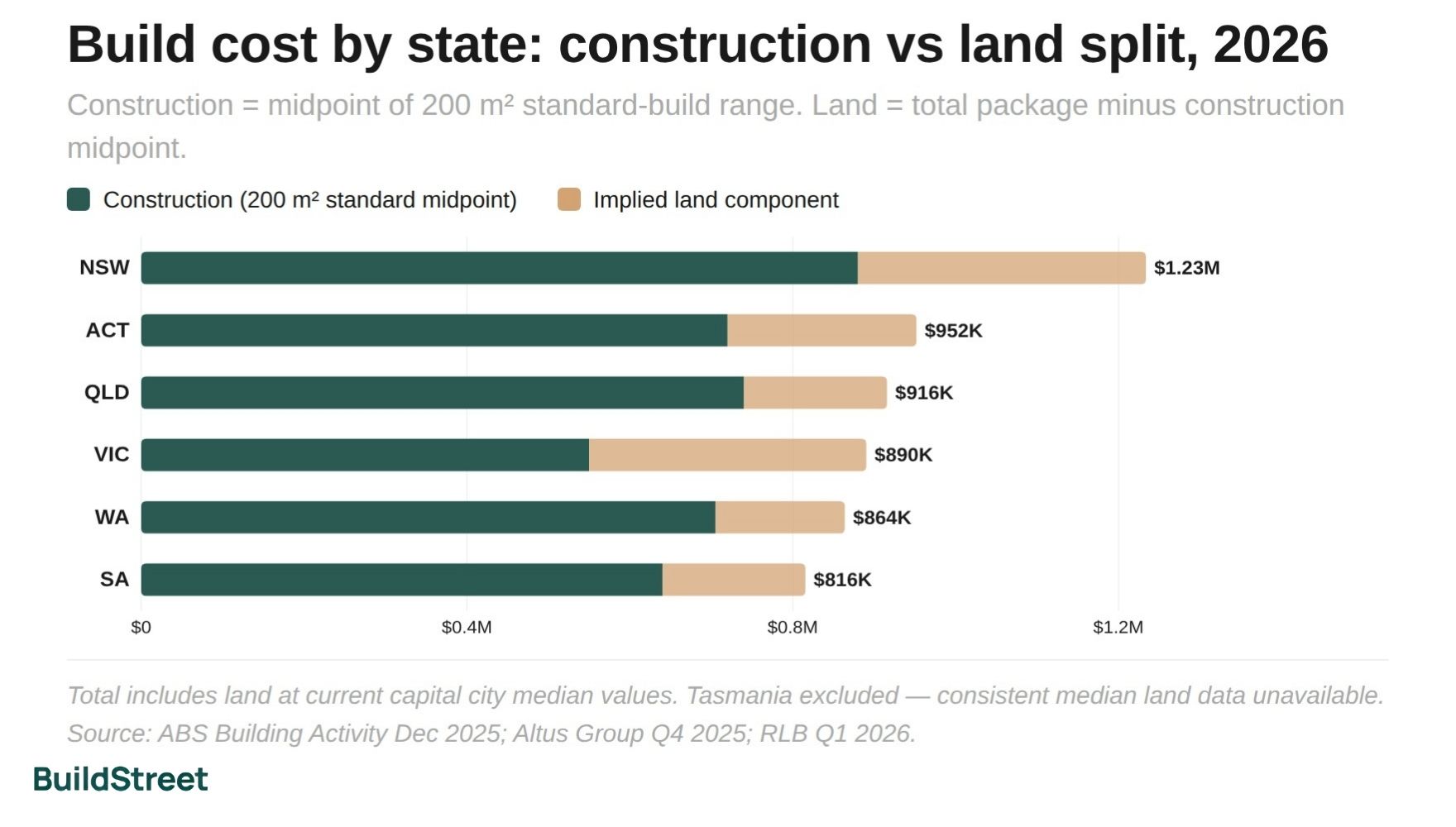
Sydney's total land-and-build package sits at $1.23 million, while Adelaide comes in at $815,500. That $418,000 gap between the two is driven almost entirely by land, not construction. The per-metre build rate across standard homes overlaps considerably across states; it's the land beneath that separates affordable markets from expensive ones. Queensland's forecast escalation rate of 7.0–7.5% means Brisbane is closing the gap on Sydney faster than any other city.
Estimated build cost by state: construction vs land split (2026)
Construction = midpoint of 200 m² standard-build range. Land = total package minus construction midpoint.
- Construction (200 m² standard midpoint)
- Implied land component
Methodology: Construction midpoint based on Altus Group / RLB 2026 standard-build ranges across a 200 m² footprint. Land component derived as total package minus construction midpoint, using current capital city median land values. AUD.
| State | Total (incl. land) | Construction /m² | 200 m² standard build | 2026 forecast |
|---|---|---|---|---|
| NSW (Sydney) | $1,233,600 | $3,300–$5,500+ | $660,000–$1,100,000 | 4.0–4.5% |
| ACT (Canberra) | $951,800 | $2,500–$4,700+ | $500,000–$940,000 | 4.5% |
| QLD (Brisbane) | $915,700 | $2,900–$4,500+ | $580,000–$900,000 | 7.0–7.5% |
| VIC (Melbourne) | $890,300 | $1,800–$3,700+ | $360,000–$740,000 | 4.0% |
| WA (Perth) | $863,900 | $2,300–$4,750+ | $460,000–$950,000 | 5.3–5.5% |
| SA (Adelaide) | $815,500 | $2,600–$3,800+ | $520,000–$760,000 | 5.1% |
| TAS | n/a | $1,700–$3,200+ | $340,000–$640,000 | n/a |
Total includes land at current capital city median values. Tasmania excluded from total as consistent median land data is not available. Construction ranges cover a 200 m² footprint at standard to premium specification. Source: ABS Building Activity, Australia, Dec 2025; Altus Group Q4 2025; RLB Market Intelligence Q1 2026.
Section 02 · 15-Year History
Average costs and home sizes, 2010 to 2025
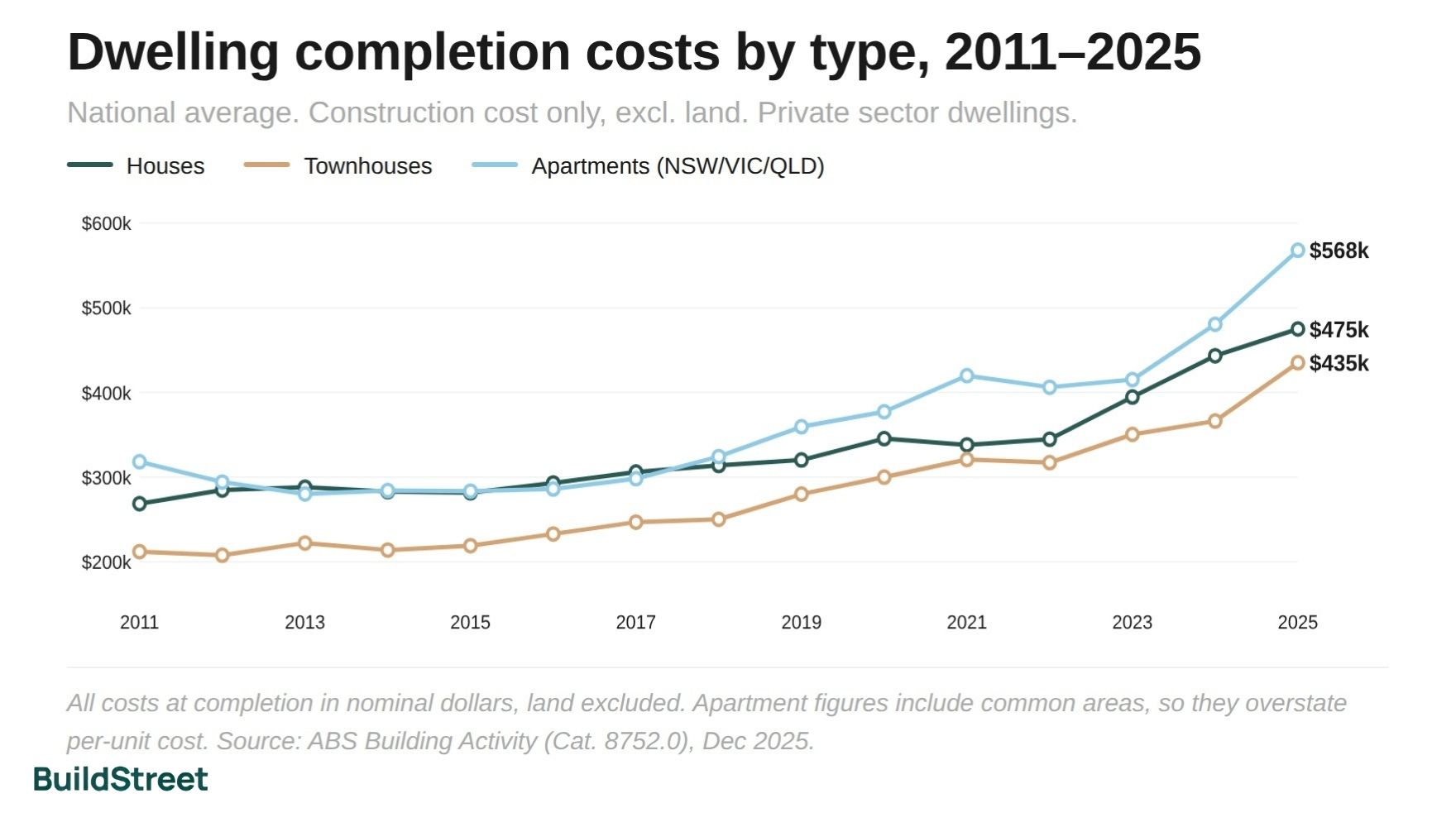
Construction costs held relatively steady through most of the 2010s, then the pandemic compressed nearly a decade of inflation into three years. House costs rose 77% nationally from 2010–11 to 2024–25, townhouses more than doubled at +105%, and the steepest single-year jump hit 14.5% between 2022–23 and 2023–24. Apartment data covers NSW, VIC and QLD only; the ABS does not publish apartment figures for other states due to insufficient completions. Apartment costs also carry a measurement bias because the ABS divides total building cost across all dwellings in a block, including shared lobbies and common areas.
House cost increase since 2010–11
+77%
$268,613 to $474,939 national avg
Townhouse cost increase since 2010–11
+105%
$211,903 to $435,089 · fastest of all types
Biggest single-year jump (houses)
+14.5%
2022–23 to 2023–24 nationally
Average completion cost per dwelling by type, 2010–11 to 2024–25
National average. Construction cost only, excl. land. Private sector dwellings.
Methodology: All costs at completion in nominal dollars, land excluded. Apartment figures include a share of building common areas, so they overstate the cost of any single unit. Source: ABS Building Activity, Australia (Cat. 8752.0), Dec 2025; ABS Characteristics of New Residential Dwellings, 15-Year Summary.
Average floor area per dwelling by type, 2010–11 to 2024–25 (m²)
National average. Apartment area = total building floor area ÷ number of dwellings, incl. common areas.
Methodology: Apartment floor area includes common spaces divided across dwellings, so it overstates actual unit size. House and townhouse areas are measured within external walls only. Source: ABS Characteristics of New Residential Dwellings, 15-Year Summary.
Australian houses are virtually the same size today as they were in 2010: 241.5 m² in 2024–25 against 240.0 m² in 2010–11. Costs nearly doubled while floor area barely moved. That divergence is pure price escalation per square metre, not bigger homes. Townhouses grew modestly from 148 m² to 174.5 m², partly reflecting a shift toward larger terrace-style builds in inner-city markets.
NSW and ACT consistently record the highest average build costs nationally. ACT's $645,052 average in 2024–25 partly reflects a project mix skewed toward larger, higher-spec builds. At the other end, SA's average of $389,949 makes it the most affordable state to build in. Select a dwelling type and toggle between average build cost and average floor area to see how each state compares.
| Financial year | NSW | VIC | QLD | SA | WA | TAS | NT | ACT | National |
|---|---|---|---|---|---|---|---|---|---|
| 2010–11 | $307,262 | $254,236 | $277,475 | $219,904 | $273,108 | $224,366 | $363,074 | $285,092 | $268,613 |
| 2011–12 | $314,320 | $274,796 | $287,295 | $228,912 | $299,387 | $248,132 | $364,020 | $317,314 | $284,739 |
| 2012–13 | $321,148 | $284,756 | $279,295 | $241,079 | $283,711 | $259,282 | $375,768 | $310,628 | $288,097 |
| 2013–14 | $302,125 | $278,664 | $278,471 | $236,618 | $282,923 | $257,675 | $359,826 | $344,831 | $282,801 |
| 2014–15 | $308,854 | $277,560 | $266,427 | $233,820 | $286,921 | $249,971 | $382,020 | $325,598 | $281,508 |
| 2015–16 | $322,446 | $287,773 | $293,191 | $247,811 | $281,321 | $255,154 | $379,050 | $372,205 | $293,042 |
| 2016–17 | $325,620 | $315,075 | $283,264 | $263,826 | $301,406 | $274,367 | $365,311 | $401,409 | $305,959 |
| 2017–18 | $348,264 | $316,537 | $289,319 | $270,979 | $297,428 | $291,538 | $356,110 | $431,504 | $313,715 |
| 2018–19 | $349,960 | $327,687 | $289,621 | $275,364 | $298,272 | $285,220 | $365,364 | $440,772 | $320,170 |
| 2019–20 | $399,478 | $345,201 | $312,857 | $279,083 | $316,846 | $302,974 | $354,256 | $450,478 | $345,410 |
| 2020–21 | $371,755 | $338,677 | $322,628 | $293,329 | $311,484 | $319,770 | $360,208 | $463,090 | $338,051 |
| 2021–22 | $400,728 | $343,478 | $324,125 | $295,292 | $293,958 | $340,891 | $376,957 | $455,259 | $344,656 |
| 2022–23 | $432,039 | $412,090 | $389,911 | $310,737 | $335,550 | $374,822 | $434,325 | $452,472 | $394,579 |
| 2023–24 | $520,907 | $433,431 | $450,807 | $371,627 | $380,874 | $411,797 | $471,006 | $563,824 | $443,333 |
| 2024–25 | $565,749 | $485,292 | $458,868 | $389,949 | $407,114 | $420,756 | $475,310 | $645,052 | $474,939 |
Completion costs and floor areas for new private-sector dwellings by state, nominal dollars, land excluded. Apartment data covers NSW, VIC and QLD only. Source: ABS Building Activity, Australia (Cat. 8752.0), Dec 2025.
Section 03 · Cost per square metre
What the ABS data implies about cost per square metre, by state
Western Australia is the most cost-efficient state to build in based on ABS 2024–25 completions, at $1,585/m² implied, despite Perth's rapidly rising land prices. NSW is the most expensive at $2,395/m². Tasmania's implied rate of $2,538/m² tops even NSW, driven by small sample size and the elevated cost of remote materials delivery. Worth noting across all states: ABS implied rates reflect contracts signed 12–24 months earlier, so they consistently sit below current QS quotes for new work.
| State | Avg house cost (2024–25) | Avg floor area (2024–25) | Implied cost/m² (ABS) | Current QS range (2026) |
|---|---|---|---|---|
| NSW | $565,749 | 236.1 m² | $2,395/m² | $3,300–$5,500+ |
| ACT | $645,052 | 298.2 m² | $2,162/m² | $2,500–$4,700+ |
| QLD | $458,868 | 230.9 m² | $1,988/m² | $2,900–$4,500+ |
| VIC | $485,292 | 253.5 m² | $1,914/m² | $1,800–$3,700+ |
| WA | $407,114 | 256.8 m² | $1,585/m² | $2,300–$4,750+ |
| SA | $389,949 | 218.1 m² | $1,788/m² | $2,600–$3,800+ |
| TAS | $420,756 | 165.8 m² | $2,538/m² | $1,700–$3,200+ |
| NT | $475,310 | 206.5 m² | $2,302/m² | $2,600–$3,500+ |
Implied cost/m² = ABS 2024–25 state average completion cost divided by state average floor area. Current QS ranges are 2026 industry estimates for new contracts, which will exceed the ABS-implied rate. Source: ABS Building Activity, Australia, Dec 2025; Altus Group Q4 2025; RLB Q1 2026.
Section 04 · Budget tiers
From basic brick-and-tile to fully bespoke: what each budget tier costs per square metre
Volume builders keep the floor low. Standard project homes with production-line designs and minimal selections sit at the bottom of these ranges. Moving to a semi-custom or architect-designed build can more than double the rate in NSW or the ACT. Three things consistently push a project out of its intended tier, regardless of state:
- Slope and site access. Sloping blocks need engineered retaining walls and split-level slabs. Narrow inner-city sites may require crane hire for material delivery. Either can add $30,000–$80,000+ before a single room is framed.
- Soil conditions. Reactive clay or uncompacted fill requires deep bored piers or heavily reinforced slabs instead of a standard footing. Geotechnical risk is rarely priced into a builder's base quote.
- Soft costs. Design fees, structural engineering, energy compliance reports, planning permits and surveying typically consume 10–15% of the total project budget before construction begins and rarely appear in a builder's base price.
| State | Standard / Volume | Mid-range / Semi-custom | Premium / Fully custom |
|---|---|---|---|
| NSW (Sydney) | $2,400–$3,200 | $3,200–$4,500 | $4,500–$8,000+ |
| VIC (Melbourne) | $1,800–$2,500 | $2,500–$3,700 | $3,700–$8,000+ |
| QLD (Brisbane / SEQ) | $2,200–$2,900 | $2,900–$3,800 | $3,800–$6,500+ |
| WA (Perth) | $2,300–$3,100 | $2,800–$3,500 | $4,000–$6,000+ |
| SA (Adelaide) | $2,100–$2,700 | $2,700–$3,400 | $3,400–$5,500+ |
| Tasmania | $2,400–$3,200 | $3,200–$4,200 | $4,200–$6,500+ |
| ACT (Canberra) | $2,500–$3,300 | $3,300–$4,500 | $4,500–$7,000+ |
| NT (Darwin) | $2,600–$3,500 | $3,500–$4,800 | $4,800–$7,500+ |
Rates are per m² and assume a flat, accessible site with M-class soil. Sloping blocks, reactive soils or remote locations will push costs beyond these ranges. Source: Altus Group Q4 2025; RLB Q1 2026; BMT Cost Data, 2026.
Section 05 · Land vs construction
Land has risen 500% in 25 years. Construction has risen 150%. That gap is the affordability crisis.
Building costs are not what made homeownership unaffordable in Australia. Construction and skilled labour costs rose by approximately 150% over the past 25 years. Residential land prices surged by more than 500% over the same period, more than double the Consumer Price Index and five times the rate of building material inflation.
National median lot price (2025)
$421,525
National average · HIA–CoreLogic
Total land + build (national avg, 2025)
$864,947
Median land $421,525 + avg build $443,422
Sydney median lot price
$666,670
Before a slab is poured
The old 40/60 rule (where land accounts for 40% of total project value and the dwelling 60%) is now impossible in Sydney and increasingly unworkable in Brisbane and Melbourne. A mid-range 200 m² build in Sydney costs $660,000–$900,000 to construct; the median Sydney lot takes that project well above $1.3 million before landscaping, driveways or fencing.
The shortage is not land itself. It is shovel-ready land. State and local government zoning timelines, infrastructure servicing delays and developer contribution levies are all embedded in the retail lot price. Capital city lot sales fell 35.4% year-on-year in late 2025 as buyers hit their borrowing limits, yet median prices kept rising.
Section 06 · Government share
Before you pour a slab, you're already paying the government: how much each city extracts
A 2025 independent review of housing taxation identified how much of a new home's total cost flows to government through taxes, levies, infrastructure charges and regulatory compliance. Housing now carries one of the heaviest tax burdens of any consumer item in the Australian economy. GST applies only to new construction, stamp duty is levied on land and councils pass infrastructure contribution charges directly to the buyer. Those costs are typically borrowed against, meaning 30 years of compounding interest on top of the original tax bill.
| Capital city | Taxes on house & land package | Share of total | Change since 2019 | Taxes on new apartment | Apt. share |
|---|---|---|---|---|---|
| Sydney | $576,000 | approx. 50% | +$160k (+38%) | $346,000 | 38% |
| Brisbane | $257,000 | 34% | +$179k (+106%) | $256,000 | 34% |
| Melbourne | $237,000 | 32% | +$47k since 2019 | $236,000 | 32% |
| Perth | n/a | approx. 30% | n/a | $149,000 | 30% |
| Adelaide | n/a | approx. 31% | n/a | $183,000 | 31% |
Government costs include GST, stamp duty on land, infrastructure charges and developer contribution levies. These are typically financed over a mortgage, compounding the total amount paid. Perth and Adelaide house-and-land package totals were not published in this review. Source: Centre for International Economics / HIA, Taxation's Major Impact on Housing, 2025.
The same review identified a significant "time tax." Development approvals for a subdivision now take over a year on average, with at least seven months attributed to avoidable delays. In a high-rate environment, holding costs on development land during that wait compound directly into the final price.
Section 07 · Build vs Buy
Is building cheaper than buying? What the data actually shows
The dollar gap between buying established and building has grown from $123,700 in 2015 to $306,347 in 2025. That widening is mostly the story of established home prices accelerating, not building becoming cheaper. In real terms, building a new home now costs significantly more than it did a decade ago. But the price advantage of the land-and-build pathway has held consistently, every year across the full period.
Build cheaper by (2025)
$306,347
26.1% below the established median
Narrowest gap (2019)
$140,000
18.6% · post-boom correction year
Widest gap (2021)
$270,100
29.3% · established prices spiked first
National cost comparison: land-and-build vs established home (2015–2025)
Modelled national averages. Established prices via CoreLogic/ABS composites. Build totals via HIA–CoreLogic median land + ABS construction averages.
Methodology: Land-and-build total = national median lot price + ABS national average house completion cost. Established median = national median dwelling price. Figures are nominal; transaction costs such as stamp duty and conveyancing are excluded from both pathways. Source: ABS Building Activity, Australia, Dec 2025; HIA–CoreLogic Residential Land Report; CoreLogic national median dwelling price.
Section 08 · First home buyers
What first home buyers can still claim: grants and concessions by state
Queensland and Tasmania currently offer the most generous grants nationally at $30,000 each. The federal 5% Deposit Scheme lets eligible buyers build or purchase with as little as a 5% deposit (2% for single parents), bypassing Lenders Mortgage Insurance entirely. The First Home Super Saver Scheme allows voluntary super contributions to be withdrawn at concessional tax rates to fund a deposit.
Demand-side grants in a supply-constrained market tend to get absorbed into higher land and property prices rather than improving net affordability. The grants help individual buyers cross the deposit threshold, but the broader market benefit is typically captured by land developers and volume builders. The structural fix is land supply reform, not cash grants.
| State / Territory | FHOG (2026) | Key conditions and stamp duty concessions |
|---|---|---|
| Queensland | $30,000 | Most generous nationally. Contracts signed before 30 June 2026. Property capped at $750,000. Full stamp duty concessions available separately. |
| Tasmania | $30,000 | Available 1 July 2025–30 June 2026. No property price cap on the grant. Full stamp duty exemption on properties under $750,000. |
| South Australia | $15,000 | No property value cap for contracts signed post-June 2024. Zero stamp duty for eligible first-home buyers on new builds. |
| New South Wales | $10,000 | New builds up to $600,000 (or building contracts to $750,000). Supplemented by the First Home Buyer Assistance Scheme for stamp duty concessions. |
| Victoria | $10,000 | New homes up to $750,000. Full stamp duty exemption under $600,000; sliding-scale concession to $750,000. |
| Western Australia | $10,000 | New builds only. Modest relief against Perth's rapidly rising construction and land costs. |
| Northern Territory | $10,000 | New builds. Supplemented by specific home renovation grants for targeted demographic categories. |
| ACT | Nil (replaced) | FHOG abolished. Replaced by the Home Buyer Concession Scheme (HBCS), offering means-tested stamp duty concessions up to $35,238. |
General information only
This article is based on publicly available ABS data and third-party forecasts. It is general information only and does not constitute financial or investment advice. If you are making decisions about saving for a property purchase, consider speaking with a licensed financial adviser.
- ABS Building Activity, Australia, Dec 2025 (Cat. 8752.0)
- ABS Characteristics of New Residential Dwellings, 15-Year Summary
- ABS Consumer Price Index, Australia, February 2026
- Altus Group, Australian Construction Price Outlook Q4 2025
- RLB Australia Market Intelligence Update, Q1 2026
- CIE / HIA, Taxation's Major Impact on Housing (2025 Report)
- HIA–CoreLogic Residential Land Report, Q3 2025
- Master Builders Australia, New home building inflation hits 16-month high
Chart Snapshots