The States with the Fastest and Slowest Home Build Times in Australia
Building a new home in Australia involves two key waiting periods: approval to commencement (the time from receiving planning approval to breaking ground), and commencement to completion (the time from first sod to handover). Both phases vary by state, and both have been affected by the post-COVID construction slowdown.
Fastest (Houses, FY2025)
ACT
0.57 qtrs · 1.7 months
National average (Houses)
0.76
0.76 qtrs · 2.3 months
Slowest (Houses, FY2025)
SA
1.19 qtrs · 3.6 months
The 1.2 million homes target by June 2029
Australia needs 240,000 new homes a year to reach the National Housing Accord's target of 1.2 million by June 2029. That's roughly 43% more than the 168,797 built in 2025 and a rate the country has never sustained. The NHSAC's March 2026 quarterly report confirmed that completions since the Accord began are running well below the required pace.
Is the 1.2 million target achievable? →Are build times finally improving?
Post-pandemic construction delays pushed build times to record highs, but the wait from approval to handover is getting shorter. By early 2026, detached houses were averaging around 12 to 13 months from approval to completion, down from 17 months in 2022. If that trend holds, completions should start rising through 2026 and 2027.
How long does it take to build a house in Australia? →Section 01
How Long Does It Take to Build a Home in Australia?
Building a new home involves two main stages: the wait from approval to commencement, and the build itself from commencement to completion. Both stages matter, but the real blowout has been in construction, not in getting projects started.
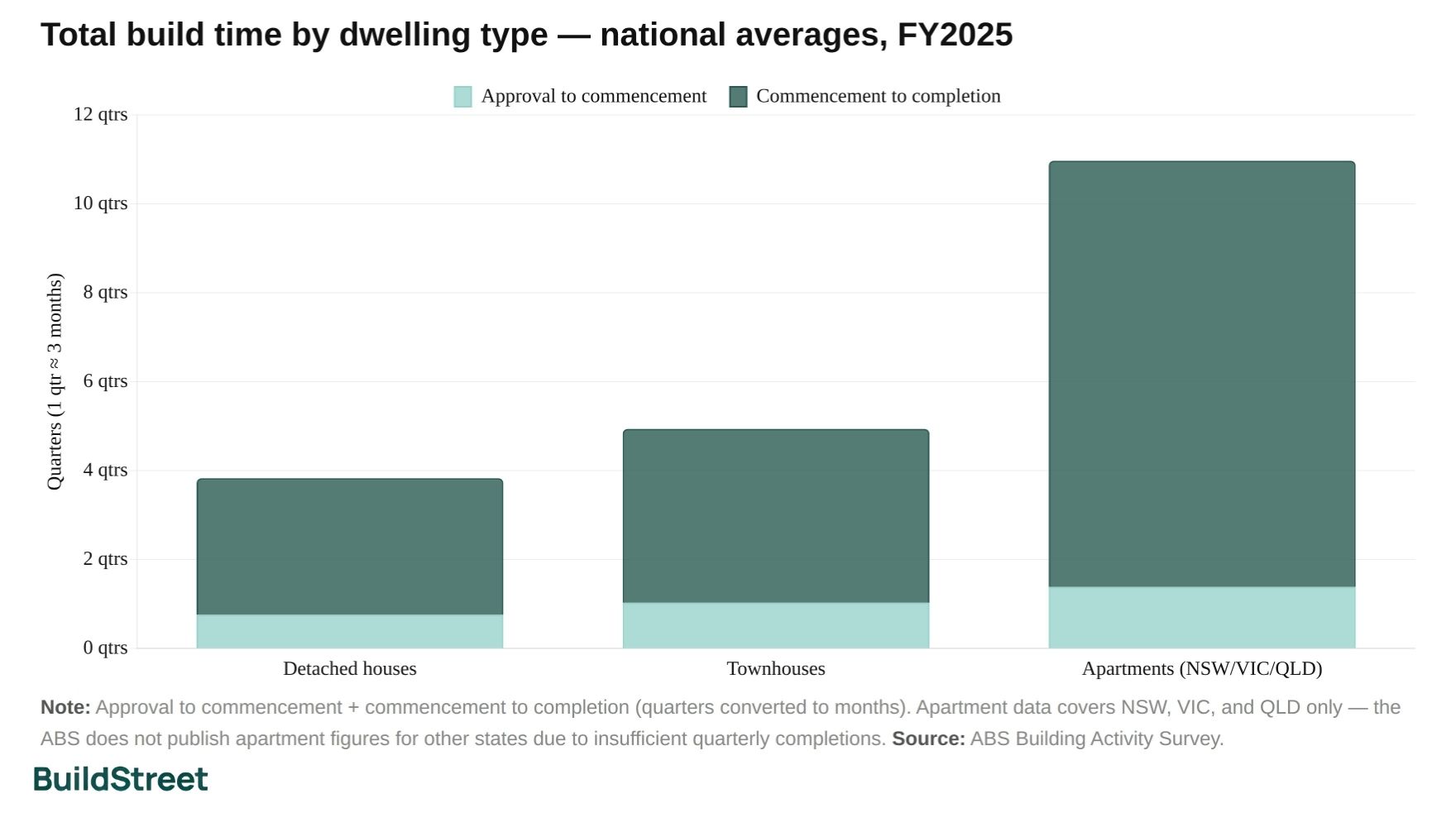
What you build matters almost as much as where you build it. Detached houses remain the quickest to complete, taking an average of 9.2 months nationally in FY2025. Townhouses are slower at 11.7 months. Apartments take the longest at 28.7 months, pushing the average build time close to two and a half years from commencement to handover. In NSW, apartment completion times reached 31.8 months in FY2025, the longest recorded in this dataset.
Once the approval phase is added in, the gap becomes even clearer. The total time from planning approval to completion is 11.5 months for houses and 14.8 months for townhouses. Apartments are in a different category altogether, taking almost 33 months from approval to completion, or close to three years.
Total build time by dwelling type — national averages, FY2025
Approval to commencement + commencement to completion (quarters). Source: ABS Building Activity Survey. Apartment data: NSW, VIC, QLD only.
Why apartments show 3 states only: The ABS only publishes apartment data for NSW, VIC, and QLD. Other states do not have enough completions each quarter to produce a reliable figure.
| Dwelling type | Approval → commencement qtrs / months |
Commencement → completion qtrs / months |
Total qtrs / months |
|---|---|---|---|
| Detached houses | 0.762.3 mo | 3.079.2 mo | 3.8311.5 mo |
| Townhouses | 1.033.1 mo | 3.9111.7 mo | 4.9414.8 mo |
| Apartments (NSW/VIC/QLD) | 1.394.2 mo | 9.5828.7 mo | 10.9732.9 mo |
Section 02
Approval-to-Commencement Times by State
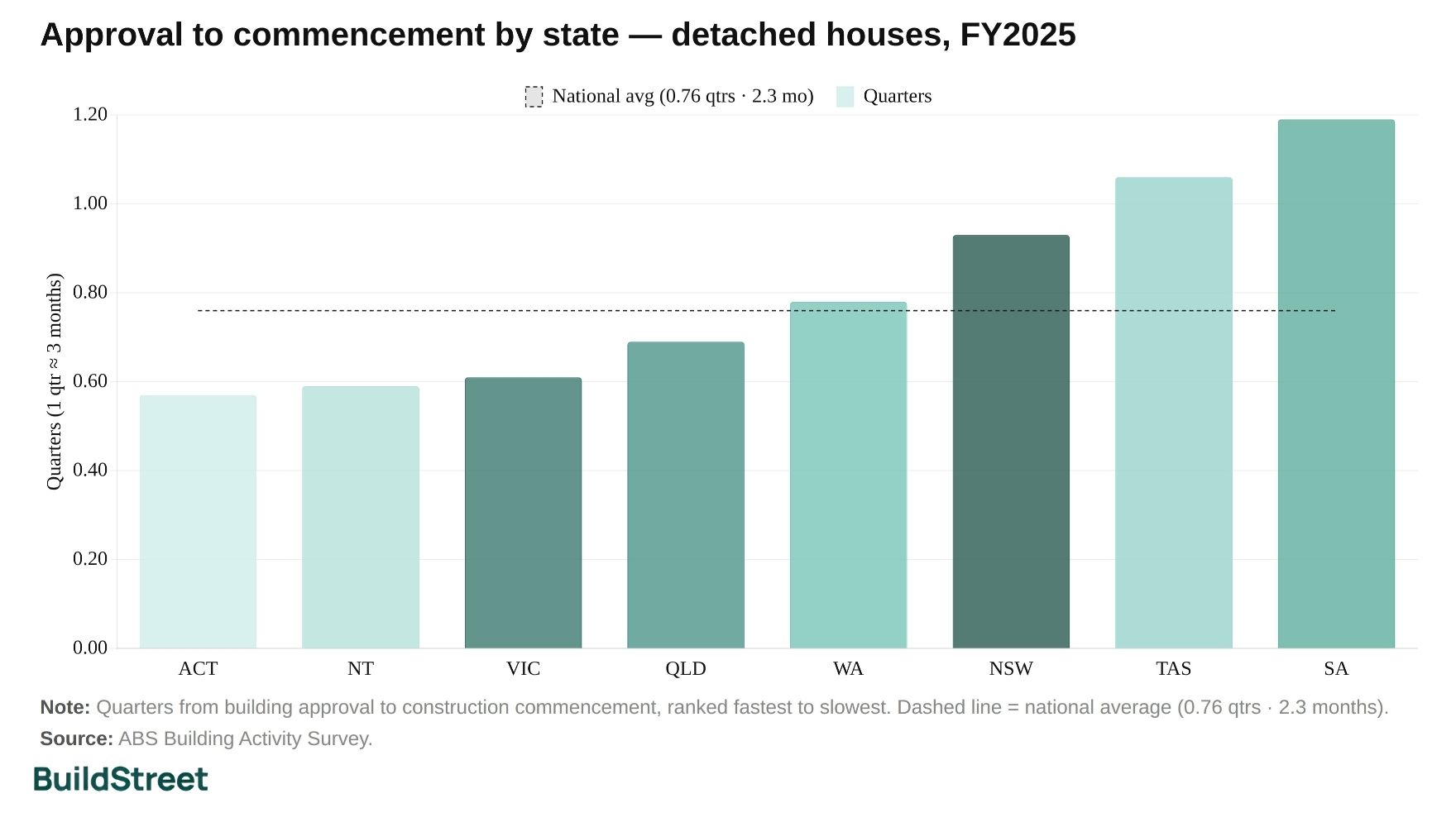
Once a building approval is granted, the next question is how quickly construction actually begins. Nationally, new houses in Australia took an average of 2.3 months to move from approval to commencement in FY2025, or roughly seven to eight weeks. But that average masks a wide gap between states.
The ACT was the fastest at 1.7 months, followed closely by the Northern Territory and Victoria at 1.8 months. South Australia was the slowest at 3.6 months, more than double the ACT's pace. It has held that position for most of the past decade, suggesting a structural issue rather than a short-term delay.
For townhouses, New South Wales recorded the slowest start times in the country in FY2025, at 4.6 months. That is almost double its FY2021 low of 2.3 months. Even so, approval-to-commencement times have remained far more stable than construction times. The biggest post-COVID blowout in build times has happened after projects get underway, not before.
ACT
0.57 qtrs
1.7 months · ~7 weeks
NT
0.59 qtrs
1.8 months · ~8 weeks
VIC
0.61 qtrs
1.8 months · ~8 weeks
QLD
0.69 qtrs
2.1 months · ~9 weeks
WA
0.78 qtrs
2.3 months · ~10 weeks
NSW
0.93 qtrs
2.8 months · ~12 weeks
TAS
1.06 qtrs
3.2 months · ~14 weeks
SA
1.19 qtrs
3.6 months · ~16 weeks
Fastest to break ground
ACT
0.57 qtrs · 1.7 months
The ACT consistently breaks ground the fastest after approval. At just 1.7 months, it is less than half the time it takes in South Australia. The ACT's smaller approval pipeline and concentrated building activity in Canberra help keep pre-construction delays short.
Slowest to break ground
SA
1.19 qtrs · 3.6 months
South Australia has held the slowest approval-to-commencement position for most of the past decade. At 3.6 months, SA takes more than double the ACT. This points to structural causes — including slower council processes and a smaller builder base — rather than short-term pressure.
Townhouse watch — NSW
NSW
1.53 qtrs · 4.6 months (townhouses)
For townhouses specifically, NSW now has the slowest build start time in the country. That is nearly double its FY2021 low of 0.78 quarters. Pre-construction delays in NSW for medium-density builds have grown significantly, likely reflecting planning complexity and site preparation pressures in Sydney.
Key insight
Phase 1 is stable
COVID impact was mostly in Phase 2
Across all states, approval-to-commencement times have remained relatively stable over the past decade. The big blowout in home build times since 2021 happened almost entirely in the commencement-to-completion phase — the actual construction period — not in the pre-construction pipeline.
Approval to commencement by state — detached houses, FY2025
Quarters from building approval to construction commencement, ranked fastest to slowest. Source: ABS Building Activity Survey
ACT
Note: Quarters from building approval to construction commencement, ranked fastest to slowest. Dashed line = national average (0.76 qtrs · 2.3 months).
Source: ABS Building Activity Survey.
Full data: approval-to-commencement times by year
| State | FY2015 | FY2016 | FY2017 | FY2018 | FY2019 | FY2020 | FY2021 | FY2022 | FY2023 | FY2024 | FY2025 |
|---|---|---|---|---|---|---|---|---|---|---|---|
| NSW | 0.742.2 mo | 0.822.5 mo | 0.882.6 mo | 0.832.5 mo | 0.812.4 mo | 0.762.3 mo | 0.812.4 mo | 0.912.7 mo | 0.902.7 mo | 0.872.6 mo | 0.932.8 mo |
| VIC | 0.561.7 mo | 0.631.9 mo | 0.581.7 mo | 0.581.7 mo | 0.611.8 mo | 0.611.8 mo | 0.561.7 mo | 0.641.9 mo | 0.621.9 mo | 0.652.0 mo | 0.611.8 mo |
| QLD | 0.561.7 mo | 0.571.7 mo | 0.561.7 mo | 0.581.7 mo | 0.662.0 mo | 0.561.7 mo | 0.641.9 mo | 0.752.3 mo | 0.752.3 mo | 0.702.1 mo | 0.692.1 mo |
| SA | 0.982.9 mo | 0.993.0 mo | 1.073.2 mo | 1.043.1 mo | 1.113.3 mo | 1.153.4 mo | 0.982.9 mo | 1.444.3 mo | 1.103.3 mo | 1.283.8 mo | 1.193.6 mo |
| WA | 0.722.2 mo | 0.702.1 mo | 0.702.1 mo | 0.672.0 mo | 0.631.9 mo | 0.652.0 mo | 0.672.0 mo | 1.033.1 mo | 0.812.4 mo | 0.762.3 mo | 0.782.3 mo |
| TAS | 0.742.2 mo | 0.802.4 mo | 0.993.0 mo | 0.872.6 mo | 0.882.6 mo | 0.852.5 mo | 0.962.9 mo | 1.123.4 mo | 0.952.8 mo | 1.053.2 mo | 1.063.2 mo |
| NT | 0.561.7 mo | 0.571.7 mo | 0.581.7 mo | 0.541.6 mo | 0.471.4 mo | 0.591.8 mo | 0.521.6 mo | 0.571.7 mo | 0.511.5 mo | 0.591.8 mo | 0.591.8 mo |
| ACT | 0.692.1 mo | 0.601.8 mo | 0.621.9 mo | 0.601.8 mo | 0.571.7 mo | 0.531.6 mo | 0.591.8 mo | 0.762.3 mo | 0.631.9 mo | 0.682.0 mo | 0.571.7 mo |
| Australia | 0.662.0 mo | 0.692.1 mo | 0.702.1 mo | 0.682.0 mo | 0.712.1 mo | 0.682.0 mo | 0.682.0 mo | 0.852.5 mo | 0.772.3 mo | 0.772.3 mo | 0.762.3 mo |
Section 03
Commencement-to-Completion Times by State
This is where the numbers are most striking. House build times blew out after FY2021 as supply chain delays, labour shortages, and the HomeBuilder-driven surge in demand pushed construction capacity to its limit.
Queensland and the NT have the fastest house completion times, both at 7.1 months in FY2025. The Sunshine State has held this position for most of the past decade, helped by less complex houses and a labour market that has generally been less strained than the southern states.
At the other end is Western Australia. WA has the longest home build times of any state, with commencement-to-completion times peaking at 15.6 months in FY2024, more than double the national average. Extended border closures worsened labour shortages just as demand was rising. That eased to 13.1 months in FY2025, but WA remains well above the national average and its pre-COVID level. The ACT, at 11.3 months, and South Australia, at 10.1 months, are also slower than average.
The national average for houses fell from a peak of 10.4 months in FY2024 to 9.2 months in FY2025. Conditions are easing, but build times across Australia are still about 40% longer than they were before COVID.
QLD
2.36 qtrs
7.1 months
FY2024 → FY2025: 12.9% faster
NT
2.36 qtrs
7.1 months
FY2024 → FY2025: 2.9% faster
VIC
2.65 qtrs
7.9 months
FY2024 → FY2025: 15.1% faster
TAS
2.89 qtrs
8.7 months
FY2024 → FY2025: 10.8% faster
NSW
3.17 qtrs
9.5 months
FY2024 → FY2025: 6.5% faster
SA
3.38 qtrs
10.1 months
FY2024 → FY2025: 16.3% faster
ACT
3.76 qtrs
11.3 months
FY2024 → FY2025: 5.3% faster
WA
4.37 qtrs
13.1 months
FY2024 → FY2025: 15.8% faster
Slowest in Australia
WA
4.37 qtrs · 13.1 months — 42% above national average
Western Australia has the longest house build times of any state. Its peak was 5.19 quarters (15.6 months) in FY2024, more than double the national average at the time. Extended border closures compounded an already severe labour shortage. FY2025 shows a 15.8% improvement, but WA is still 85% above its pre-COVID average of 2.37 quarters.
Fastest in Australia
QLD & NT
2.36 qtrs · 7.1 months — 23% below national average
Queensland has held the fastest house completion position for most of the past decade. Simpler home types, a less strained labour market, and strong regional building capacity all help. Queensland also improved by 12.9% in FY2025, showing that being already fast does not prevent further gains.
Biggest improver
SA
16.3% faster year-on-year
South Australia recorded the biggest percentage improvement of any state in FY2025, dropping from 4.04 quarters (12.1 months) in FY2024 to 3.38 quarters (10.1 months). The state had accumulated one of the worst backlogs during the boom years, and its pipeline is now clearing faster than most.
The good news
Every state improved
FY2025 is the first year all 8 states got faster
For the first time since the COVID boom, every state and territory recorded a shorter commencement-to-completion time for houses in FY2025 compared to FY2024. The improvements range from 2.9% in the NT to 16.3% in SA. The national average is still 40% above pre-COVID, but the direction has clearly turned.
Commencement to completion by state — detached houses, FY2025
Quarters from construction start to project completion, ranked fastest to slowest. Source: ABS Building Activity Survey
QLD
Full data: commencement-to-completion times by year
| State | FY2015 | FY2016 | FY2017 | FY2018 | FY2019 | FY2020 | FY2021 | FY2022 | FY2023 | FY2024 | FY2025 |
|---|---|---|---|---|---|---|---|---|---|---|---|
| NSW | 2.226.7 mo | 2.196.6 mo | 2.306.9 mo | 2.357.1 mo | 2.377.1 mo | 2.377.1 mo | 2.367.1 mo | 2.828.5 mo | 3.149.4 mo | 3.3910.2 mo | 3.179.5 mo |
| VIC | 2.246.7 mo | 2.156.4 mo | 2.246.7 mo | 2.367.1 mo | 2.357.1 mo | 2.206.6 mo | 2.176.5 mo | 2.517.5 mo | 3.079.2 mo | 3.129.4 mo | 2.657.9 mo |
| QLD | 1.654.9 mo | 1.695.1 mo | 1.705.1 mo | 1.705.1 mo | 1.735.2 mo | 1.725.2 mo | 1.865.6 mo | 2.316.9 mo | 2.818.4 mo | 2.718.1 mo | 2.367.1 mo |
| SA | 2.176.5 mo | 2.176.5 mo | 2.126.4 mo | 2.286.8 mo | 2.276.8 mo | 2.256.8 mo | 2.377.1 mo | 2.918.7 mo | 3.7311.2 mo | 4.0412.1 mo | 3.3810.1 mo |
| WA | 2.678.0 mo | 2.738.2 mo | 2.347.0 mo | 2.236.7 mo | 2.337.0 mo | 2.377.1 mo | 2.437.3 mo | 3.219.6 mo | 4.8814.6 mo | 5.1915.6 mo | 4.3713.1 mo |
| TAS | 2.286.8 mo | 2.236.7 mo | 2.437.3 mo | 2.276.8 mo | 2.256.8 mo | 2.577.7 mo | 2.557.6 mo | 2.908.7 mo | 3.289.8 mo | 3.249.7 mo | 2.898.7 mo |
| NT | 1.805.4 mo | 1.675.0 mo | 1.644.9 mo | 1.795.4 mo | 1.895.7 mo | 1.835.5 mo | 1.835.5 mo | 2.286.8 mo | 2.276.8 mo | 2.437.3 mo | 2.367.1 mo |
| ACT | 2.186.5 mo | 2.357.1 mo | 2.447.3 mo | 2.597.8 mo | 2.497.5 mo | 2.647.9 mo | 2.688.0 mo | 2.978.9 mo | 3.4710.4 mo | 3.9711.9 mo | 3.7611.3 mo |
| Australia | 2.206.6 mo | 2.206.6 mo | 2.146.4 mo | 2.196.6 mo | 2.226.7 mo | 2.186.5 mo | 2.206.6 mo | 2.647.9 mo | 3.3410.0 mo | 3.4710.4 mo | 3.079.2 mo |
Section 04
Build Time Trends in Australia Since 2015
The past decade falls into two distinct phases. From FY2015 to FY2021, build times were relatively stable across all major dwelling types. Houses typically took between 6.4 and 6.7 months to complete, townhouses between 8.8 and 10.6 months, and apartments between 18 and 26.1 months. Apartments were always slower, but the overall pattern was steady.
That changed from FY2022. Build times lengthened as the HomeBuilder stimulus drove demand higher, supply chains for materials came under pressure, and builders struggled to keep up as projects stacked up across multiple states.
The latest FY2025 data suggests the worst of that blowout may be easing, at least for lower-density housing. National house build times have fallen from a peak of 10.4 months in FY2024 to 9.2 months in FY2025. Townhouse build times have also improved, dropping from 12.9 months to 11.7 months over the same period. But the recovery is uneven. Western Australia remains the clearest pressure point. Even after improving from its FY2024 peak of 15.6 months, detached house build times in WA were still 13.1 months in FY2025, nearly double their pre-COVID level.
Total build time trend — approval to completion, national averages
Approval to commencement + commencement to completion, FY2015 to FY2025. Source: ABS Building Activity Survey. Apartments: NSW, VIC, QLD only.
| Financial Year | Houses qtrs / months |
Townhouses qtrs / months |
Apartments qtrs / months |
|---|---|---|---|
| FY2015 | 2.868.6 mo | 3.6611.0 mo | 6.9820.9 mo |
| FY2016 | 2.898.7 mo | 3.7711.3 mo | 7.1121.3 mo |
| FY2017 | 2.848.5 mo | 3.7911.4 mo | 7.7123.1 mo |
| FY2018 | 2.878.6 mo | 3.9011.7 mo | 8.0924.3 mo |
| FY2019 | 2.938.8 mo | 4.3513.1 mo | 8.2324.7 mo |
| FY2020 | 2.868.6 mo | 4.4113.2 mo | 9.3828.1 mo |
| FY2021 | 2.888.6 mo | 4.2312.7 mo | 10.5231.6 mo |
| FY2022 | 3.4910.5 mo | 4.5413.6 mo | 10.2330.7 mo |
| FY2023 | 4.1112.3 mo | 4.9714.9 mo | 10.0930.3 mo |
| FY2024 | 4.2412.7 mo | 5.3216.0 mo | 11.0433.1 mo |
| FY2025 (latest) | 3.8311.5 mo | 4.9414.8 mo | 10.9732.9 mo |
General information only
This article is based on publicly available ABS data. It is general information only and does not constitute financial advice. If you are making decisions about saving for a property purchase, consider speaking with a licensed financial adviser.
Chart Snapshots