

Published 15 Sept 2026 · Updated 18 Sept 2026
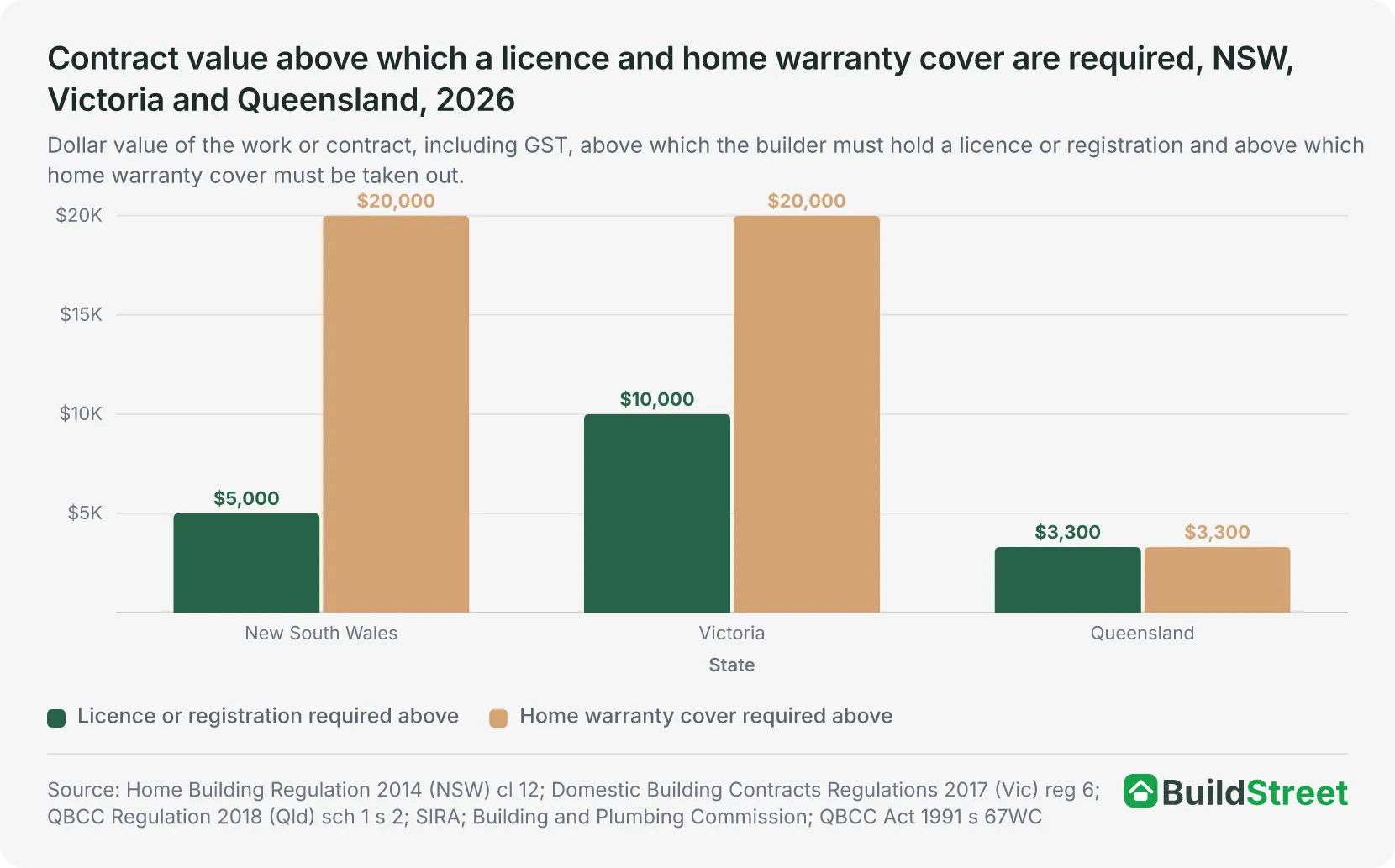
A builder's licence is checked on a free public register in each state: NSW Fair Trading's Verify licence register, the Building and Plumbing Commission's practitioner search in Victoria, and the Queensland Building and Construction Commission (QBCC) licensee register in Queensland. Each register shows the licence holder's name, licence number, class of work and current status. Disciplinary history is also published in each state, although not always shown on the same register. A licence is required for residential work worth more than $5,000 in New South Wales, for contracts of more than $10,000 in Victoria and for work worth more than $3,300 in Queensland. Home warranty cover is checked separately in every state. Company records, insolvency statistics, complaints registers and tribunal decisions provide additional information about a builder's history.
 What does home warranty insurance cover?The statutory cover that sits behind a building contract in each state: when it is required, who provides it and what a claim can pay for.
 What is a fixed-price building contract?How a fixed-price contract allocates risk between the builder and the owner, what can still change the price, and what to read before signing.
 How much does it cost to build a house?Building costs across the states, what drives them, and how a builder's advertised base price relates to the finished cost.
Section 01 · The three registers
Where is a builder's licence checked in NSW, Victoria and Queensland?
A builder's licence can be checked for free, without a login, on the state regulator's public register in each of the three states. In New South Wales the register is Verify licence, which provides "licence records from current and historical databases about builder and tradespersons licences" and is run by NSW Fair Trading1. In Victoria the Building and Plumbing Commission (BPC) publishes a practitioner search for building and plumbing practitioners, and in Queensland the Queensland Building and Construction Commission (QBCC) keeps the licensee register that section 99 of its Act requires2.
Each register can be searched using common identifying details. The New South Wales search starts from the licensee name, licence number, licence type, Australian Business Number (ABN), Australian Company Number (ACN) or location3. The Victorian search takes a practitioner name, business name, registration or licence number, location or type of work2. The Queensland register is searched by licence number or name, and the QBCC describes it as more detailed than its find-a-local-contractor directory because it "provides a complete licence history"4.
Where the contracting party is a company, regulator guidance separates the company licence search from searches for the people behind it. The New South Wales register's search tips call for separate searches of the licences held by company directors, partners and nominated supervisors, and the Queensland register warns that a search of a licensed company should be followed by searches of the directors' and nominee supervisor's own licences5.
| Where a builder's licence and disciplinary history are checked, NSW, Victoria and Queensland, 2026 | ||||
|---|---|---|---|---|
| State | Regulator | Licence register | Searched by | Disciplinary record |
| New South Wales | Building Commission NSW and NSW Fair Trading | Verify licence, trades register | Licensee name, licence number, licence type, ABN, ACN or location | On the same record: public warnings, finalised disciplinary action, insurance claims paid, suspensions and cancellations. Complaints on the separate Complaints Register |
| Victoria | Building and Plumbing Commission | Practitioner search (Find a builder, Find a plumber) | Practitioner name, business name, registration or licence number, location or type of work | Separate Compliance and Enforcement Register: disciplinary action, prosecutions and court outcomes, suspensions, cancellations and conditions |
| Queensland | Queensland Building and Construction Commission | QBCC licensee register | Licence number or name | On the same record: disciplinary action, directions to rectify, convictions, paid infringement notices, demerit points, suspensions and cancellations, exclusions, insurance claims approved |
Source · NSW Fair Trading, Verify licence and Complaints Register; Building and Plumbing Commission, Find and check a practitioner and Compliance and Enforcement Register; QBCC, Find a licensed contractor and Queensland Building and Construction Commission Act 1991 s 99.
Section 02 · Five checks
What builder records can be checked before signing a building contract?
Regulator guidance in New South Wales, Victoria and Queensland covers five main areas: licence details, the people behind a company, disciplinary records, insurance, and company, complaint and tribunal records.
Licence register
The register shows the licence holder's name, class of work, current status and any conditions.
The people behind the company
Regulator guidance covers separate searches for directors, partners and the nominee or nominated supervisor under their own names.
Disciplinary record
Disciplinary information appears in the compliance section of the record in New South Wales and Queensland, and in the Compliance and Enforcement Register in Victoria.
Insurance
Home warranty cover is recorded through the certificate of insurance or notice of cover for the job, with a separate state cover check where available.
Company, complaint and tribunal records
Company records are available through ASIC and ABN Lookup, while complaints and published tribunal decisions are recorded separately from the licence registers.
These five areas reflect the checks described by NSW Fair Trading, the Building and Plumbing Commission and the QBCC; no single register covers all five.
Source: NSW Fair Trading, Verify licence, Search tips; Building and Plumbing Commission, Find and check a practitioner; QBCC, Combating fraud and checking if a licence is legit.
Section 03 · When a licence is required
When does a builder need a licence for residential building work?
A licence is required in New South Wales for residential building work when the reasonable market cost of labour and materials exceeds $5,000, and for specialist work at any value. Under the Home Building Act 1989, residential building work must be carried out by, or on behalf of, a contractor licence holder authorised for that type of work7. Non-specialist residential work valued at $5,000 or less generally falls outside the licensing requirement8. Specialist work includes electrical wiring, plumbing, drainage, gasfitting, air conditioning and refrigeration9.
In Victoria, a builder generally needs to be registered when entering into a major domestic building contract worth more than $10,000. Some types of work, including demolition, electrical and structural work, require a registered practitioner regardless of cost.
The practitioner's registration must authorise the type of work covered by the contract. A breach can attract a penalty of 500 penalty units for an individual and 2,500 penalty units for a body corporate10. The $10,000 threshold is set under the Domestic Building Contracts Regulations 201711. The BPC adds that a practitioner carrying out only one task, such as painting, plastering or tiling, does not need to be registered. Domestic builders are registered in 30 classes, either as Domestic Builder (Unlimited) or in a limited class such as carpentry1213.
Queensland sets the lowest threshold of the three states, at $3,300. Under the QBCC Act 1991 a person generally cannot carry out or agree to carry out building work above this value without a contractor's licence for the appropriate class of work. A person who carries out work without the required licence is generally not entitled to payment or other consideration for that work14. Work valued at $3,300 or less generally falls outside the licensing requirement, although some licence classes are exceptions and require a licence regardless of value15. Unlicensed contracting was the alleged offence the QBCC opened most often for investigation in 2024-25, accounting for 46 per cent of the cases under the five most common offence types16.
| Licence, contract, deposit and insurance thresholds for home building work, NSW, Victoria and Queensland, 2026 | |||
|---|---|---|---|
| Rule | New South Wales | Victoria | Queensland |
| Licence or registration required | Residential building work worth more than $5,000 in labour and materials; specialist work at any value | A major domestic building contract, more than $10,000; some work at any value | Building work worth more than $3,300; some licence classes at any value |
| Written contract required | More than $5,000 (small jobs); the full contract form above $20,000 | More than $10,000 (major domestic building contract) | More than $3,300 (level 1); $20,000 or more (level 2) |
| Maximum deposit | 10% of the contract price | 10% below $20,000; 5% at $20,000 or more | 10% (level 1); 5% (level 2); 20% where off-site work exceeds 50% of the price |
| Home warranty cover required | Work costing more than $20,000 (home building compensation) | More than $16,000 under domestic building insurance (contracts before 1 July 2026); more than $20,000 under Home Warranty (contracts from 1 July 2026) | Most residential building work worth more than $3,300 (Queensland Home Warranty Scheme) |
| Cooling-off period | 5 clear business days, contracts above $20,000 | 5 clear business days, major domestic building contracts | 5 business days from receiving the signed contract |
Source · Home Building Act 1989 (NSW) ss 4, 7, 7AAA, 7BA, 8 and 92 and Home Building Regulation 2014 cll 5, 7 and 12; SIRA, Home building compensation; Domestic Building Contracts Act 1995 (Vic) ss 3, 11, 29 and 31 and Domestic Building Contracts Regulations 2017 reg 6; Building and Plumbing Commission, Domestic Building Insurance and Home Warranty; Queensland Building and Construction Commission Act 1991 s 42, s 67WC and sch 1B ss 6, 7, 13, 33 and 35 and QBCC Regulation 2018 sch 1 s 2.
Written-contract and deposit rules also depend on the value of the work or contract. In New South Wales a contract for more than $5,000 must be in writing, dated and signed, the full contract requirements apply above $20,000, and the deposit is capped at 10 per cent of the contract price8.
In Victoria a builder must not demand or receive a deposit of more than 5 per cent of a contract price of $20,000 or more, or 10 per cent of a price below $20,000, before starting work10.
In Queensland a level 1 regulated contract, covering work priced above $3,300 and below $20,000, must be in writing and carry the contractor's licence number as it appears on the licence. A level 2 regulated contract applies to work priced at $20,000 or more14. The Queensland deposit caps are 10 per cent for a level 1 contract, 5 per cent for a level 2 contract, and 20 per cent where off-site work such as made-to-measure cabinetry or windows exceeds half the contract price17.
BuildStreet's guide to fixed-price building contracts covers what those contracts must contain in each state.
Section 04 · What the register shows
What does a builder licence search show about licence history?
Builder licence registers show the current licence status and work categories, but the amount of disciplinary and historical information available differs between New South Wales, Victoria and Queensland.
What does the NSW builder licence register show?
A New South Wales licence search shows the holder's name, the names of partnership members or company directors, the licence number and status, the commencement date and renewals, the category of work, the expiry date and any suspension or cancellation dates1.
The compliance section can also show public warnings about the licensee, finalised disciplinary action, statutory insurance claims, licence suspensions or cancellations1. Fair Trading's guidance adds licence conditions, formal cautions, penalty infringement notices and prosecution results to that list9.
Consumer complaints and current investigations are not shown on the licence record. Complaints are published separately through the NSW Complaints Register where the publication threshold is met1. The published extract of the register, dated 4 December 2023, listed 178,901 current contractor licences, of which 41,580 carried the Builder class18.
What does the Victorian builder register show?
Victoria uses two registers for licence and disciplinary information. The Register of Building Practitioners includes the names, categories and classes of registered practitioners and can include criminal or disciplinary sanctions19.
The BPC's Compliance and Enforcement Register lists disciplinary action, prosecutions and court outcomes, and suspensions, cancellations or conditions20. Individual building records are available from April 2019, company records from July 2018 and plumbing records from June 2019.
Not every complaint, enquiry, inspection or compliance activity appears on the Compliance and Enforcement Register.
What does the Queensland builder licence register show?
Queensland's register includes licence details as well as a broad range of disciplinary and compliance history. It records the licensee's name, business address, licence number and class, current and past conditions, and the nominee and directors of a licensed company.
It can also show disciplinary action, directions to rectify, convictions, paid infringement notices, demerit points, suspensions and cancellations, exclusions and bans, and the number and cost of home warranty claims approved for the licensee's work14.
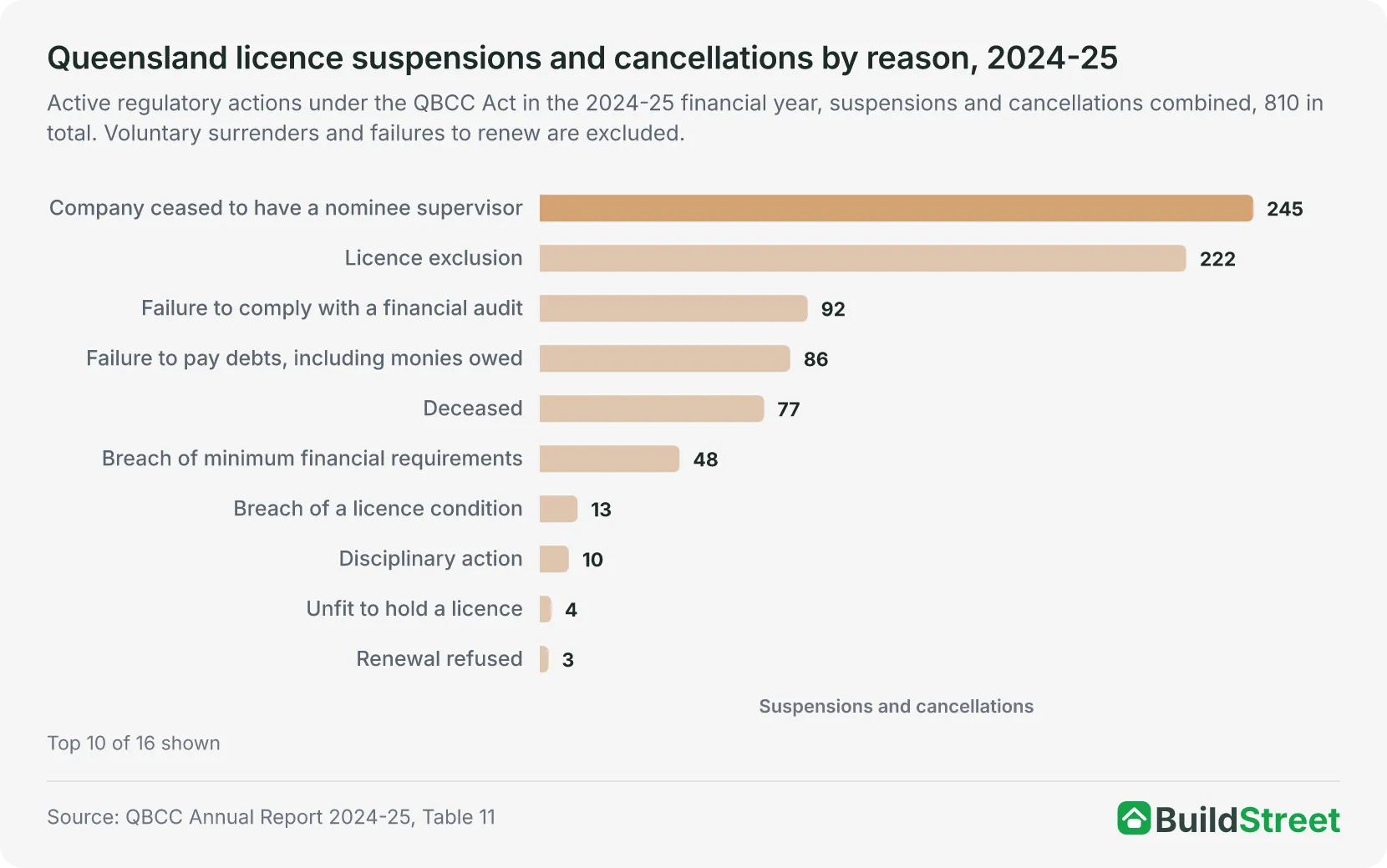
Insolvencies, bankruptcies and civil proceedings are not shown on the register. The QBCC instead directs these searches to ASIC, the Australian Financial Security Authority, QCAT and the courts. Regulatory information is generally published after an investigation is complete and any action has been finalised5.
Offences attract two to 10 demerit points each. A licensee who accumulates 30 points in a three-year period cannot hold a licence for three years. An unpaid judgment debt attracts 10 points. The QBCC removes offence details after five years and demerit points after three years or when they stop having effect21.
| What each state's builder licence register shows and does not show, 2026 | |||
|---|---|---|---|
| Item | New South Wales | Victoria | Queensland |
| Name, licence number, status and expiry | Shown | Shown | Shown |
| Class or category of work | Shown | Shown, with any conditions or limits | Shown, with current and past conditions |
| People behind a company or partnership | Directors and partnership members | Not among the items the search page lists | Nominee and each director |
| Suspensions and cancellations | Dates shown | Compliance and Enforcement Register | Shown, with the circumstances |
| Disciplinary action and prosecutions | Finalised disciplinary action, public warnings, formal cautions, penalty notices and prosecution results | Compliance and Enforcement Register, records from 2018 and 2019, kept for five years | Disciplinary action that has taken effect, convictions and paid infringement notices |
| Directions to rectify | Non-compliance with a tribunal order | Not among the items the register page lists | Each direction noted |
| Demerit points | No demerit system on the register page | No demerit system on the register page | Shown; removed after three years or when they stop having effect |
| Home warranty claims | Claims paid | Not among the items the register page lists | Number and cost of claims approved |
| Consumer complaints and current investigations | Not shown; separate Complaints Register | Not every complaint appears | Not shown until an investigation is complete |
| Insolvency, bankruptcy and court proceedings | Not among the items the register page lists | Not among the items the register page lists | Not shown; ASIC, AFSA, QCAT and the courts |
Source · NSW Fair Trading, Verify licence, Trades register and Home building licence check; Building Act 1993 (Vic) ss 175 and 175A; Building and Plumbing Commission, Find and check a practitioner and The Compliance and Enforcement Register; Queensland Building and Construction Commission Act 1991 s 99; QBCC Licensee Register warning; QBCC, Fines.
Section 05 · Insurance
How is a builder's home warranty insurance checked in each state?
Home warranty cover is checked differently in New South Wales, Victoria and Queensland, with each state using its own scheme and project records.
Home building compensation cover is required in New South Wales for residential construction or renovation work costing more than $20,000 including GST, unless exempt. A builder must not do the work or take any payment under the contract, including the deposit, until required insurance is in place and a certificate of insurance has been given to the owner22. Insurance and Care NSW (icare) issues a certificate of insurance for each project, and cover on a property can be checked through the HBC Check on the Verify licence site23. The cover runs for six years for major construction defects and two years for other losses from the project's completion22.
Victoria changed schemes on 1 July 2026. Domestic building insurance applies to eligible contracts signed before that date and is required for work valued over $16,000. For homes up to three storeys, it generally covered up to $300,000 for loss where the builder died, disappeared or became insolvent24. For eligible contracts signed on or after 1 July 2026, Home Warranty applies to domestic building work valued at more than $20,000. It may provide up to $400,000 in total assistance per home where work is incomplete, defective or non-compliant and the builder fails or refuses to fix it25. Home Warranty does not protect an owner who uses an unregistered builder for work that must be done by a registered builder.
In Queensland most residential building work valued at more than $3,300 including materials, labour and GST must have cover under the Queensland Home Warranty Scheme, which is administered by the QBCC27. The contractor collects the premium as part of the contract price and must pay it to the QBCC before work starts or within 10 business days of signing the contract, whichever is earlier28. The QBCC then issues a notice of cover. A registered owner or a prospective purchaser can request an insurance search on the property, which shows whether cover is in place and, if so, whether a claim has been made and any amount paid29.
BuildStreet's guide to home warranty insurance covers what a claim under each state's scheme can pay for.
| Home warranty cover for residential building work, NSW, Victoria and Queensland, 2026 | ||||
|---|---|---|---|---|
| Scheme | Work covered | Administered by | Before a deposit is paid | Cover |
| Home building compensation, New South Wales | Work costing more than $20,000 including GST, unless exempt | icare HBCF, regulated by SIRA | A certificate of insurance for the job, before any work or payment | 6 years for major construction defects and 2 years for other losses from completion; property cover checked through the HBC Check |
| Domestic building insurance, Victoria (contracts before 1 July 2026) | Work valued over $16,000 | Building and Plumbing Commission | A copy of the policy and a certificate of currency for the property | Generally up to $300,000 for homes up to three storeys where the builder died, disappeared or became insolvent |
| Home Warranty, Victoria (contracts from 1 July 2026) | Eligible work valued at more than $20,000 | Building and Plumbing Commission | Cover is provided by the BPC for eligible work; the builder must be registered for the work | Up to $400,000 in total per home where eligible work is incomplete, defective or non-compliant and the builder fails or refuses to fix it |
| Queensland Home Warranty Scheme | Most residential building work valued at more than $3,300 including GST | Queensland Building and Construction Commission | The premium is part of the contract price, paid by the contractor before work starts or within 10 business days of signing; the QBCC issues a notice of cover | 6 years 6 months from the earliest of premium, contract or start of work; $200,000 for each category of loss, $300,000 with optional additional cover |
Source · SIRA, Home building compensation; icare, Apply for a Certificate of Insurance; Building and Plumbing Commission, Domestic Building Insurance and Home Warranty and Home Warranty; Consumer Affairs Victoria, Deposits and payments; QBCC, Queensland Home Warranty Scheme, Who pays the premium, Time limits for cover and claims and Maximum amounts covered.
Section 06 · Company records
How is a building company's history checked beyond the licence register?
A building company's history can also be checked through the Australian Securities and Investments Commission (ASIC) and ABN Lookup, because licence registers do not contain all company information.
ASIC's company and organisation register is searched through ASIC Connect, and ASIC also publishes a register of people disqualified or banned from roles in corporations30. ABN Lookup shows without a login whether an ABN is active or cancelled, the business type and GST status, and historical trading names where available31.
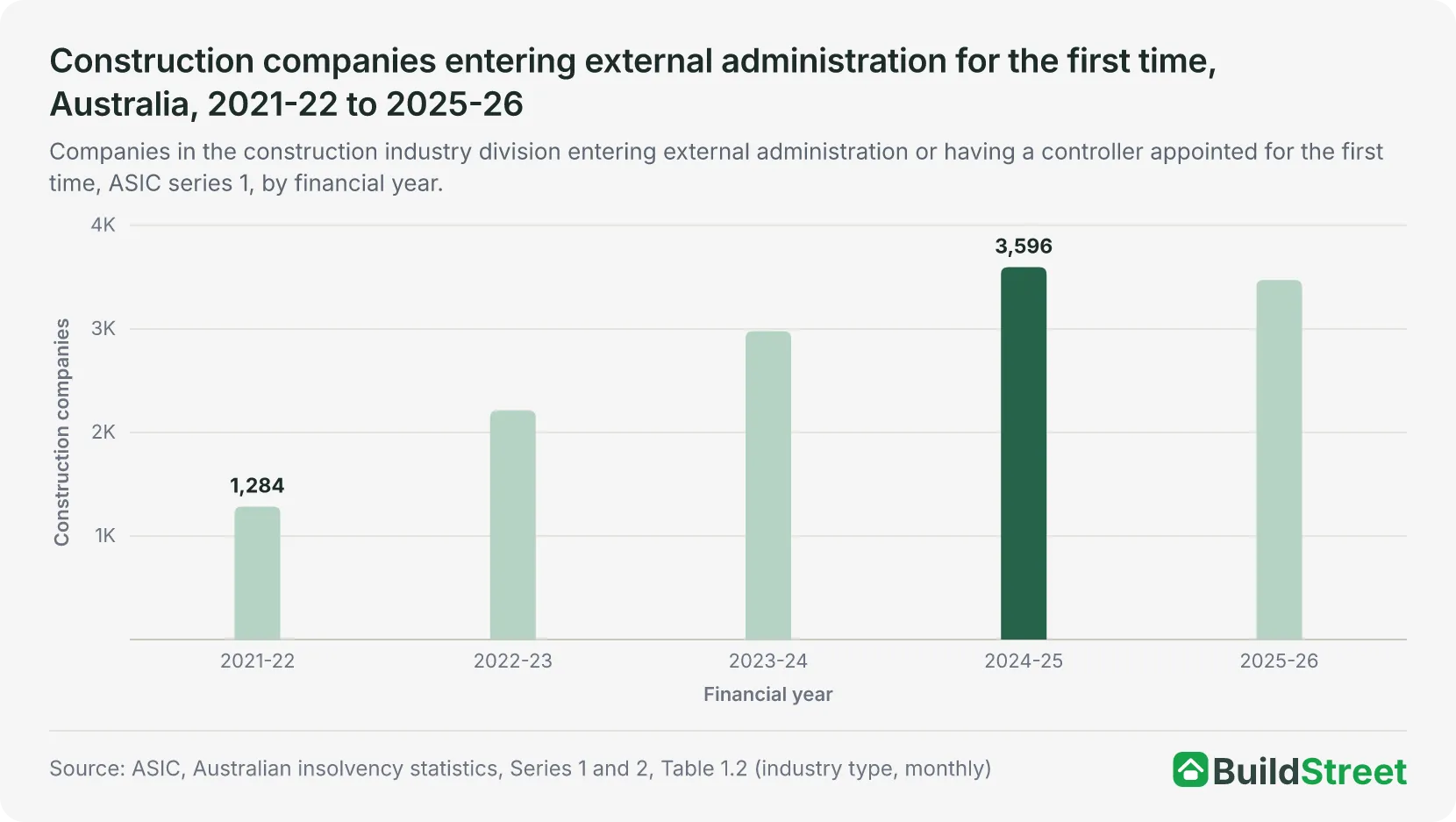
Construction recorded the largest number of companies entering external administration or having a controller appointed for the first time of any industry division in 2025-26. There were 3,472 construction companies, representing 24.5 per cent of the 14,153 companies recorded nationally32.
The count rose from 1,284 in 2021-22 to 2,213 in 2022-23, 2,977 in 2023-24 and 3,596 in 2024-25, before falling to 3,472 in 2025-26. This was the first annual decline over the period32. ASIC counts individual companies rather than corporate groups, and its August 2026 figures include 542 related companies of one property development and construction group, which affects the 2026-27 months rather than the years charted33.
Section 07 · Complaints and tribunals
Where are builder complaints and tribunal decisions published?
Complaints and tribunal decisions are published differently across New South Wales, Victoria and Queensland. NSW Fair Trading publishes a Complaints Register covering businesses that received 10 or more complaints in a month. It includes two years of data that can be filtered by business name, location, industry and issue34. A complaint counts even when the customer withdraws it.
Home building disputes in New South Wales must be referred to Fair Trading before the NSW Civil and Administrative Tribunal (NCAT) accepts an application. Some matters are exempt, including appeals against an insurer's decision. NCAT can make orders for payment, completion of incomplete or defective work, and insurance claim appeals35. Published NCAT decisions are on NSW Caselaw, alongside the courts' decisions.
In Victoria, the Compliance and Enforcement Register publishes disciplinary outcomes, and the Victorian Civil and Administrative Tribunal (VCAT) hears domestic and commercial building disputes between owners, builders, subcontractors, architects, engineers and other practitioners, as well as disputes between an owner and a warranty insurer36.
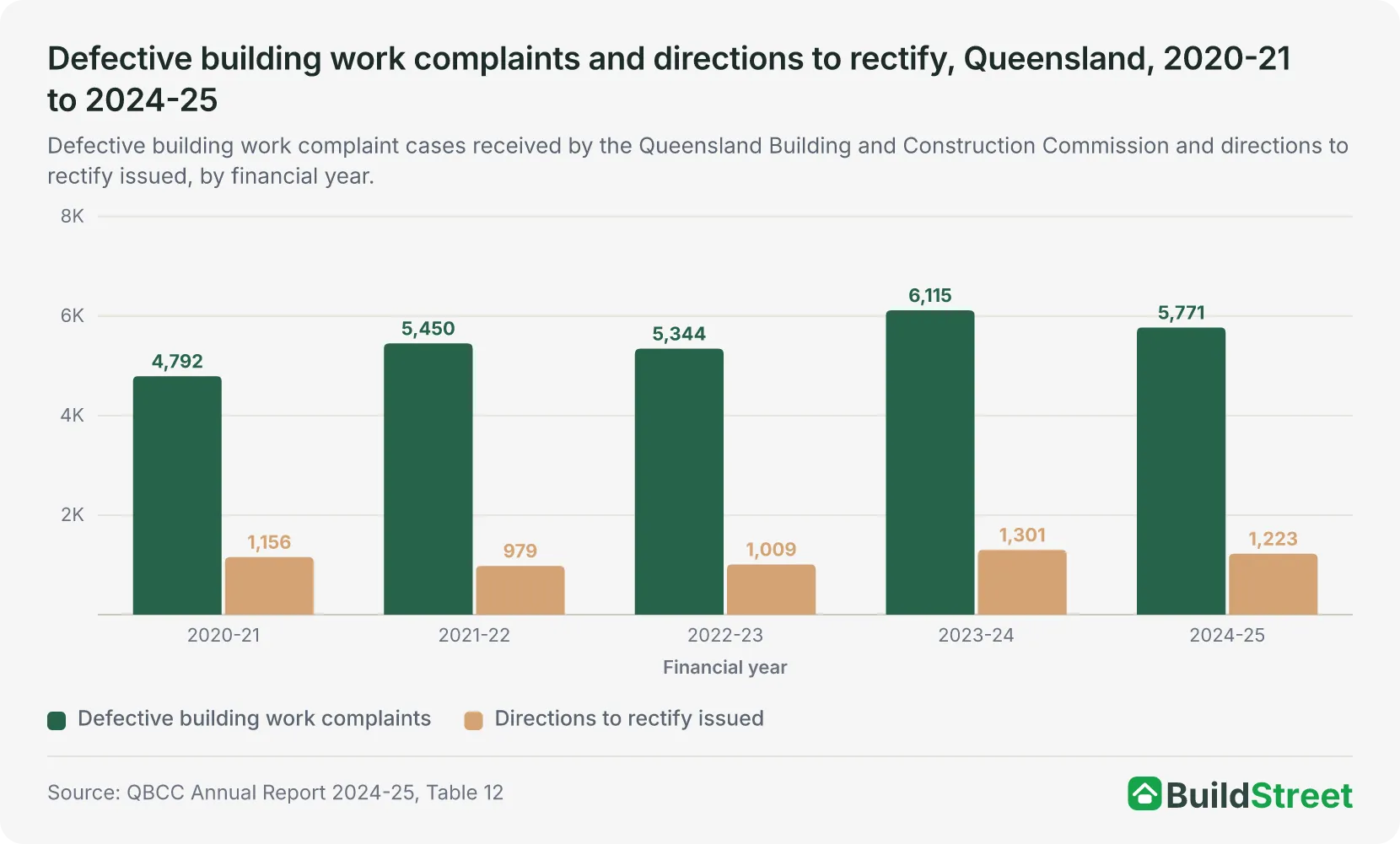
The QBCC received 5,771 defective building work complaint cases in 2024-25, compared with 4,792 in 2020-21, 5,450 in 2021-22, 5,344 in 2022-23 and 6,115 in 2023-24. It also issued 1,223 directions to rectify in 2024-2516. Each direction to rectify is noted against the licensee on the register, so the outcome can appear even though the underlying complaint is not published.
The Queensland Civil and Administrative Tribunal (QCAT) hears domestic and commercial building disputes and reviews of QBCC decisions. Written reasons are published through the Supreme Court Library Queensland, generally after they have been provided to the parties37.
Section 08
Builder's licence: quick answers
How is a builder's licence checked in NSW?
A builder's licence in New South Wales is checked on the Verify licence register run by NSW Fair Trading. It can be searched by licensee name, licence number, licence type, ABN, ACN or location. The record shows the licence number, class of work, status, commencement and expiry dates, and compliance information such as public warnings, finalised disciplinary action and insurance claims paid.
Does a builder need a licence for a small job in Queensland?
Building work with a value of $3,300 or less is generally not building work for licensing purposes under the Queensland Building and Construction Commission Regulation 2018, subject to exceptions for particular trade classes. Above $3,300 the contractor must hold a licence of the appropriate class of work. The Queensland Home Warranty Scheme also generally applies to residential building work valued at more than $3,300.
What is the difference between Domestic Builder Unlimited and Domestic Builder Limited registration in Victoria?
A Domestic Builder (Unlimited) is registered to carry out, manage and arrange all components of domestic building work, although the Building and Plumbing Commission can grant the class with conditions that restrict it to particular building classes. A Domestic Builder (Limited) can do only certain types of domestic building work, such as carpentry or glazing.
Does a licence search show complaints made against a builder?
The New South Wales register shows compliance outcomes such as public warnings, finalised disciplinary action and paid insurance claims, but not consumer complaints or current investigations, which is why NSW Fair Trading publishes a separate Complaints Register of businesses with 10 or more complaints in a month. The Victorian Compliance and Enforcement Register and the Queensland licensee register show finalised disciplinary action, and Queensland's also notes each direction to rectify, but neither shows every complaint.
How long does disciplinary action stay on a builder's licence record?
In Victoria, information about a disciplinary sanction stays on the Register of Building Practitioners until five years after the sanction is imposed or ceases to have effect, whichever is later. In Queensland, the QBCC removes fines and offence details from the public record after five years and demerit points after three years or when they stop having effect.
Is home warranty insurance required for every building contract?
No. Home building compensation cover applies to New South Wales work costing more than $20,000. Victoria's Home Warranty applies to eligible work valued at more than $20,000 under contracts signed from 1 July 2026, while domestic building insurance applies to eligible contracts signed before that date for work valued at more than $16,000. The Queensland Home Warranty Scheme applies to most residential building work valued at more than $3,300.
References
- NSW Fair Trading, Verify licence: trades register · verify.licence.nsw.gov.au ↑ b c d
- Building and Plumbing Commission, Find and check a practitioner · bpc.vic.gov.au ↑ b
- Service NSW, Check a builder or tradesperson licence · service.nsw.gov.au ↑
- QBCC, Find a licensed contractor · qbcc.qld.gov.au ↑
- QBCC Licensee Register (myQBCC) · my.qbcc.qld.gov.au ↑ b
- QBCC, Combating fraud and checking if a licence is legit · qbcc.qld.gov.au ↑
- Home Building Act 1989 (NSW), current version for 10 June 2026 · legislation.nsw.gov.au ↑
- Home Building Regulation 2014 (NSW), current version for 16 May 2025 · legislation.nsw.gov.au ↑ b
- NSW Fair Trading, Home building licence check · fairtrading.nsw.gov.au ↑ b
- Domestic Building Contracts Act 1995 (Vic) · legislation.vic.gov.au ↑ b
- Domestic Building Contracts Regulations 2017 (Vic), authorised version 004 · content.legislation.vic.gov.au ↑
- Building and Plumbing Commission, Domestic Builder · bpc.vic.gov.au ↑
- Building and Plumbing Commission, Finding a practitioner and getting quotes · bpc.vic.gov.au ↑
- Queensland Building and Construction Commission Act 1991 (Qld), current as at 1 February 2026 · legislation.qld.gov.au ↑ b c
- Queensland Building and Construction Commission Regulation 2018 (Qld), current as at 1 September 2026 · legislation.qld.gov.au ↑
- Queensland Building and Construction Commission: Annual Report 2024-25 · qbcc.qld.gov.au ↑ b c
- Deposits and progress payments, Queensland Building and Construction Commission · qbcc.qld.gov.au ↑
- NSW Fair Trading, Home Building Licensing dataset: Current Licence Extract, Contractor Licence (4 December 2023) · data.gov.au ↑
- Building Act 1993 (Vic), authorised version 151 · content.legislation.vic.gov.au ↑
- Building and Plumbing Commission, The Compliance and Enforcement Register · bpc.vic.gov.au ↑
- QBCC, Demerit points · qbcc.qld.gov.au ↑ b
- SIRA – Home building compensation · sira.nsw.gov.au ↑ b
- icare, Apply for a Certificate of Insurance · icare.nsw.gov.au ↑
- Building and Plumbing Commission Victoria – Domestic Building Insurance and Home Warranty · bpc.vic.gov.au ↑ b
- Building and Plumbing Commission (Victoria): Home Warranty · bpc.vic.gov.au ↑
- NSW Government, Building and trade licences and registrations · nsw.gov.au ↑
- Queensland Building and Construction Commission – Queensland Home Warranty Scheme · qbcc.qld.gov.au ↑
- Queensland Building and Construction Commission – Who pays the premium · qbcc.qld.gov.au ↑
- QBCC — Insurance search for a property · qbcc.qld.gov.au ↑
- ASIC, Search ASIC's registers · asic.gov.au ↑
- ABN Lookup (Australian Business Register) · abr.business.gov.au ↑
- ASIC, Australian insolvency statistics, Series 1 and 2, published 14 September 2026 · download.asic.gov.au ↑ b c
- ASIC Insolvency Statistics, FY2024-25 and FY2023-24 · asic.gov.au ↑
- NSW Fair Trading, Complaints Register · nsw.gov.au ↑
- NSW Civil and Administrative Tribunal, Home building · ncat.nsw.gov.au ↑
- Victorian Civil and Administrative Tribunal, Building and construction · vcat.vic.gov.au ↑
- Queensland Civil and Administrative Tribunal, Published reasons for decisions · qcat.qld.gov.au ↑
