Canberra housing trends: approvals are rising, but starts remain the risk
The ACT is projected to reach its National Housing Accord target in September 2029, one quarter after the official June 2029 deadline. That makes it one of Australia's better-performing jurisdictions, alongside Victoria and Western Australia.
The territory needs to deliver 21,057 homes between July 2024 and June 2029, or about 4,211 homes a year. Approvals have improved sharply, rising 117% in the 12 months to January 2026, the strongest growth rate of any state or territory on NHSAC's March 2026 scorecard.
The main risk is not approvals. It is whether approved homes move into construction quickly enough. The ACT had 1,203 approved dwellings still waiting to start at June 2025, build times are longer than before the pandemic, and quarterly completions remain uneven.
Accord target (Jul 2024 to Jun 2029)
21,057
To be delivered July 2024 to June 2029; about 4,211 per year
Rolling 12-month approval growth
+117%
To January 2026; highest on NHSAC's March 2026 scorecard
Projected completion
Sep 2029
One quarter after the Accord deadline; tied with Victoria and WA
SECTION 01 · THE HOUSING TARGET
The ACT is projected to reach its housing target in September 2029
The ACT needs to deliver 21,057 homes between July 2024 and June 2029 under the National Housing Accord. That is the smallest target of any state or territory, reflecting the ACT's relatively small share of Australia's population when the Accord was agreed.
On NHSAC's March 2026 projections, the ACT is expected to reach that target in September 2029. That is one quarter after the official deadline and puts the territory among the strongest performers nationally.
Only Victoria and Western Australia share the same projected completion date. Other jurisdictions are forecast to take longer:
- New South Wales is projected to reach its target in June 2031, almost two years after the deadline.
- Tasmania is projected to reach its target in September 2033, more than four years after the deadline.
- The Northern Territory is not expected to reach its target until after 2034.
- Nationally, the 1.2 million-home target is not expected to be reached until June 2030.
The ACT has two structural advantages. The territory government has direct control over land supply through its land release program, and planning policy directs most new housing into existing urban areas. That makes apartments and townhouses a larger part of the supply pipeline than detached greenfield housing.
ACT Housing Accord progress
Cumulative progress against the target of 21,057 homes by June 2029, as at March 2026.
Accord startJun 2029
Accord deadline
% of 21,057
% of 21,057
Live risk: a widening gap between approvals and completions
Of the 1,928 dwellings approved in the ACT in the six months to June 2025, only 993 began construction in the same period. The approved-but-not-commenced backlog grew 40.4% to 1,203 homes, and house build times have stretched 36% since 2020.
How the ACT compares to other states and territories
The ACT has built 23% of its Accord target, tied with Victoria for the highest share among the larger states and territories. It is also one of only three jurisdictions projected to reach its target within one quarter of the June 2029 deadline.
| State / territory | 5-yr target | Built | Approved | Expected delivery | 12mo growth | Annual pace |
|---|---|---|---|---|---|---|
| Australian Capital Territory | 21,057 | 23% | 25% | Sep 2029 | +117% | 4,211 |
| Victoria | 306,000 | 23% | 28% | Sep 2029 | −1% | 61,200 |
| Western Australia | 129,000 | 22% | 29% | Sep 2029 | +13% | 25,800 |
| Queensland | 246,000 | 17% | 26% | Sep 2030 | +16% | 49,200 |
| South Australia | 84,000 | 19% | 27% | Sep 2030 | +15% | 16,800 |
| New South Wales | 376,000 | 15% | 21% | Jun 2031 | +8% | 75,200 |
| Tasmania | 26,000 | 12% | 15% | Sep 2033 | +4% | 5,200 |
| Northern Territory | 11,000 | 5% | 9% | After 2034 | +38% | 2,200 |
| Australia (total) | 1,200,000 | 18% | 25% | Jun 2030 | +9% | 240,000 |
Source: NHSAC Quarterly Report, March 2026; ABS National, State and Territory Population (December 2022). Accord targets apportioned by population share, rounded to the nearest thousand except for the ACT.
The ACT's land release pipeline is larger than its Accord target
The ACT's five-year land release program targets 25,948 dwellings between 2025-26 and 2029-30. That is about 23% higher than the territory's 21,057-home Accord target. The extra capacity gives the ACT some room for delays and supports the territory government's separate goal of enabling 30,000 new homes by 2030.
In 2025-26, 3,184 dwellings are scheduled for release. Most of that supply is higher-density housing, with multi-unit dwellings accounting for 89% of scheduled releases.
SECTION 02 · APPROVALS
ACT building approvals are at multi-year highs
ACT building approvals rose 117% in the 12 months to January 2026, the fastest growth rate of any state or territory on NHSAC's March 2026 scorecard. The Northern Territory was next at 38%, while approvals nationally rose 9%.
The ACT and Northern Territory are reported in original rather than seasonally adjusted terms, so the comparison with the states should be read as directional rather than exact.
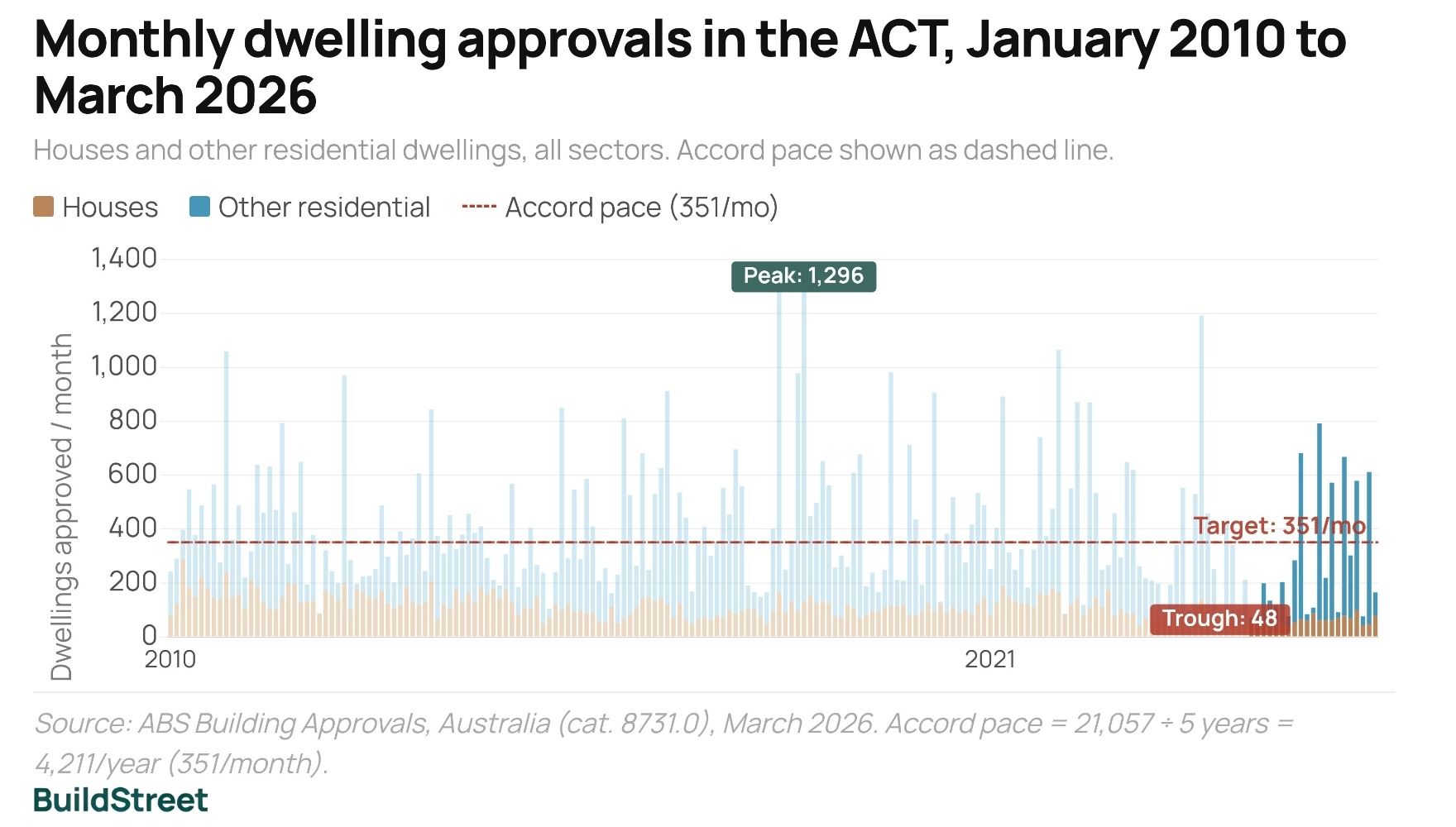
Monthly ACT approvals can move sharply because large apartment projects are approved in batches. A single multi-unit project can add hundreds of dwellings to one month's total:
- June 2025 recorded 792 approvals, one of the strongest months in the series.
- October 2025 recorded 668 approvals.
- Several months between those peaks recorded fewer than 100 approvals.
The annual view gives a clearer picture of the underlying trend. FY2021-22 remains the high point, with 6,193 approvals. FY2022-23 was the low point, with 3,703 approvals, before activity began to recover. FY2024-25 recorded 2,829 approvals for the full financial year — a figure that understates the recent recovery because most approvals in that year were recorded between March and June 2025.
Dwelling approvals in the ACT, January 2010 to March 2026
Houses and other residential, all sectors. Monthly approvals swing sharply when large apartment projects are batched; the annual view is a better guide to the underlying trend.
Source: ABS Building Approvals, Australia (cat. 8731.0), March 2026. Original series, total sector. Accord-period bars (from July 2024) shown in stronger colour. Rolling 12-month total to January 2026 was 4,457 dwellings (+122%); NHSAC's published +117% uses a slightly broader series.
Most ACT approvals are now apartments and townhouses
Detached houses made up 45% of ACT residential approvals in FY2012-13. By FY2024-25, that share had fallen to 25%. The shift reflects the ACT's planning direction: with most new housing expected to be built within the existing urban footprint, infill sites are more likely to support apartments and townhouses than detached greenfield housing.
Why monthly ACT approval data is volatile
Monthly ACT building approval figures can be misleading when read in isolation. In December 2025, the ACT recorded 579 approvals. In January 2026, it recorded just 76. That does not necessarily mean demand or construction conditions changed dramatically in one month. It more likely reflects the timing of large multi-unit approvals. For the ACT, the rolling 12-month total is usually a better measure of the housing supply pipeline than any single month.
SECTION 03 · COMMENCEMENTS & BUILD TIMES
Approved homes are taking longer to move into construction
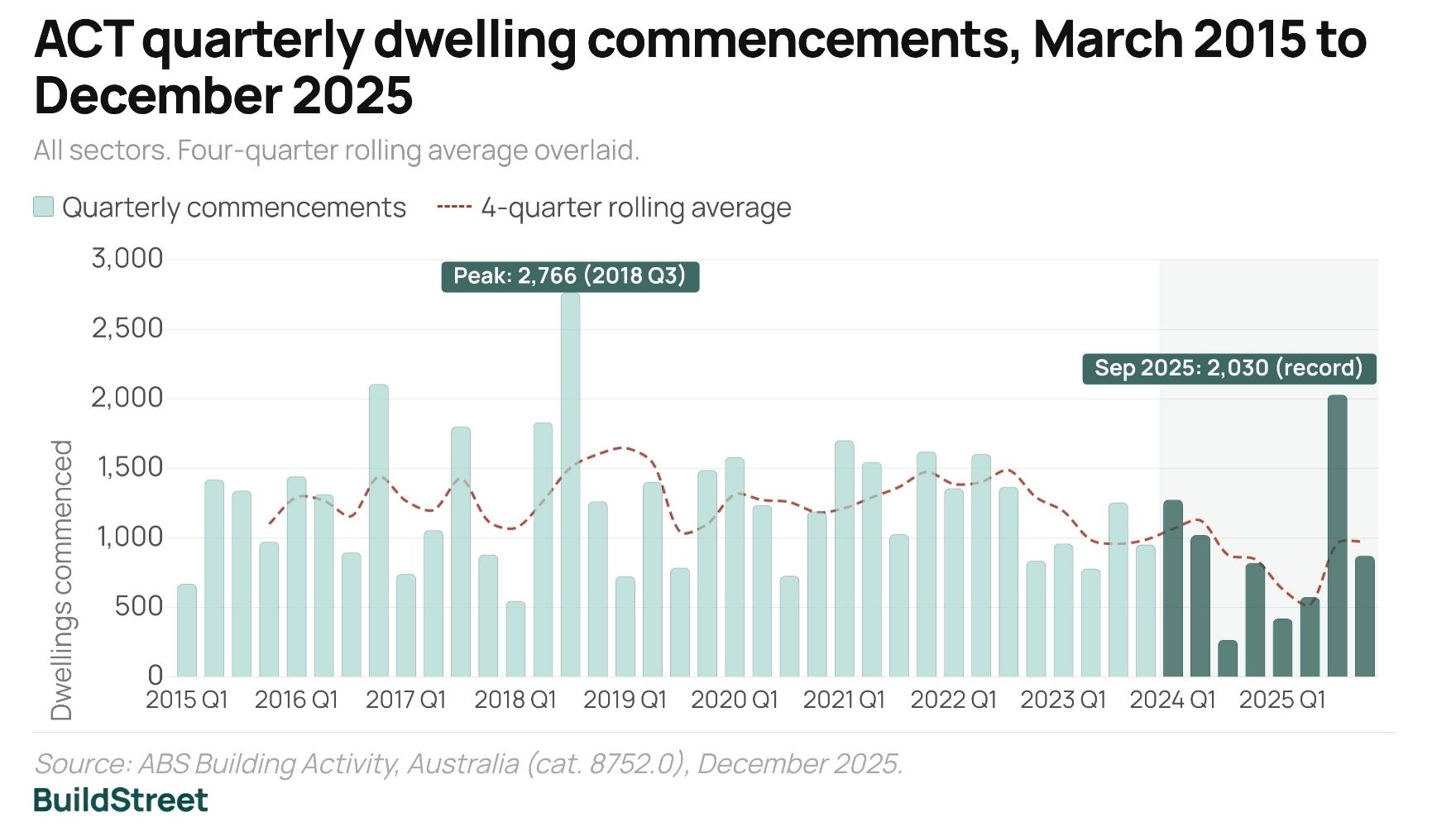
ACT dwelling commencements fell 8.5% in the six months to June 2025, dropping to 995 starts. Over the same period, approvals rose 140.7%. That gap shows the pressure lower down the pipeline. By June 2025, the number of approved dwellings that had not yet started construction had grown 40.4% to 1,203 homes.
The September 2025 quarter showed a sharp rebound, with commencements reaching 2,030 dwellings. That was the highest quarterly figure in more than a decade. However, the increase was likely driven by one or more large multi-unit projects starting construction, rather than a broad-based improvement across the market.
Approved but not commenced
1,203
↑ 40.4% in 6 monthsAt June 2025; backlog is growing
House build time (2024-25)
4.33 qtrs
↑ 36% since 2020Commencement to completion is the bottleneck
Sep 2025 quarter commencements
2,030
Strongest in 10+ yearsLikely driven by large multi-unit starts
ACT quarterly dwelling commencements, March 2015 to December 2025
All sectors, with four-quarter rolling average overlaid. The September 2025 quarter rebounded to 2,030, the highest in more than a decade, likely driven by large multi-unit starts.
Source: ABS Building Activity, Australia (cat. 8752.0), December quarter 2025.
House build times have increased since 2019-20
Total build time for a detached house in the ACT rose from 3.17 quarters in 2019-20 to 4.33 quarters in 2024-25, an increase of about 3.5 months. Most of the increase has come from the construction phase. The time from commencement to completion rose 42% to 3.76 quarters.
The ACT sits in the slower half of the country. Build times across states for 2024-25:
- Western Australia: 5.15 quarters (slowest nationally)
- South Australia: 4.57 quarters
- ACT: 4.33 quarters
- New South Wales: 4.10 quarters
- Victoria: 3.26 quarters
- Queensland: 3.05 quarters
- Northern Territory: 2.95 quarters (fastest nationally)
Detached house build times by phase, ACT, 2019-20 vs 2024-25
Total build time rose from 3.17 to 4.33 quarters. The construction phase grew 42%, while the approval-to-start phase barely moved.
Source: ABS Building Activity (cat. 8752.0). Median time for new private-sector detached houses.
Detached house build times by state, 2024-25
Total quarters from approval to completion. The ACT sits in the slower half of the country at 4.33 quarters.
Source: ABS Building Activity (cat. 8752.0), 2024-25.
SECTION 04 · COMPLETIONS
Are ACT housing completions recovering?
ACT dwelling completions fell 43% in the six months to June 2025, dropping from 2,619 homes in the previous six months to 1,497 homes.
The decline was sharper for attached dwellings, which is expected in a market where large apartment projects make up a major share of new supply. These projects take longer to complete and are often handed over in batches, making quarterly completion figures uneven.
The September and December quarters of 2025 brought a partial recovery, with 1,015 and 1,151 homes completed respectively.
Over the first six quarters of the Accord period, from July 2024 to December 2025, ABS completions data shows roughly 6,300 completed homes. NHSAC's March 2026 scorecard shows the ACT had built 23% of its Accord target, equal to about 4,843 homes. The gap reflects different counting methods. Both measures suggest the ACT is tracking comparatively well, but the ABS series shows more homes completed over the same broad period.
SECTION 05 · WHERE NEW HOMES ARE BEING BUILT
Most new ACT housing is planned for Molonglo Valley
The ACT's five-year land release program allocates 25,948 dwellings across nine districts between 2025-26 and 2029-30.
Molonglo Valley has the largest allocation, with 7,612 planned dwelling releases. That is 29% of the five-year program and more than double the allocation for any other district.
- Gungahlin: 3,788
- Woden Valley: 3,420
- Belconnen: 3,298
- Inner South: 3,130
- Tuggeranong: 993 and Weston Creek: 800 (smallest allocations)
Five-year residential land releases
25,948
2025-26 to 2029-30; 23% above the 21,057 Accord target
Molonglo Valley allocation
7,612
29% of all five-year releases; the largest district allocation
Molonglo population growth (2024-25)
+11.6%
1,884 new residents; Whitlam suburb grew 83%
ACT residential land release allocations by district, 2025-26 to 2029-30
Molonglo Valley has 29% of the five-year program, more than double any other district.
Source: ACT Housing Supply and Land Release Program 2025-26 to 2029-30; ABS Regional Population 2024-25 (cat. 3218.0).
Population growth is also concentrated in Molonglo Valley
Molonglo Valley's population grew by 11.6% in 2024-25, adding 1,884 residents. That was more than eight times the ACT's overall growth rate of 1.3%.
Within Molonglo Valley, Whitlam recorded the fastest growth, increasing 83% from 891 to 1,632 residents. Denman Prospect grew 11%, from 4,939 to 5,503 residents.
Growth was much slower in some established areas. Tuggeranong added 92 residents, while Canberra East recorded a population decline.
Most new ACT housing is being directed into existing suburbs
Around 68% of new ACT housing capacity is being directed into existing suburbs, close to the planning strategy's 70% target. Government infill releases account for 42% of total residential capacity. Greenfield releases, mainly in Molonglo Valley and outer Gungahlin, account for 32%. Private-sector infill makes up the remaining 26%.
Composition of ACT residential land release, 2025-26 to 2029-30
Share of total five-year dwelling yield by location type.
ACT Government infill releases
ACT Government greenfield releases
Private sector infill development
Source: ACT Housing Supply and Land Release Program 2025-26 to 2029-30.
SECTION 06 · WHAT IS BEING BUILT
Most new ACT dwellings are apartments and townhouses
Of the 3,184 dwellings scheduled for release in 2025-26, only 336 are detached houses. The remaining 2,848 dwellings, or 89% of the total, are multi-unit homes such as apartments and townhouses.
The five-year land release program has a similar mix. Between 2025-26 and 2029-30, the ACT plans to release capacity for 23,569 multi-unit dwellings, compared with 2,379 single-dwelling homes. This higher-density mix helps the ACT plan for more homes in a small jurisdiction, but it also creates delivery risks:
- Multi-unit projects often need presales, fixed-price contracts and financing before construction can start.
- Apartments and townhouses usually take longer to build than detached houses.
- Completions often arrive in batches, which can make quarterly supply figures uneven.
ACT residential land releases by dwelling type
Single dwellings vs multi-unit, for 2025-26 alone and the full five-year program. Multi-unit accounts for 89% of one-year and 91% of five-year releases.
- 2025-26 (one-year)
- 2025-26 to 2029-30 (five-year)
Source: ACT Housing Supply and Land Release Program 2025-26 to 2029-30. Government releases only.
Recent planning reforms are likely to reinforce the shift toward apartments, townhouses and dual occupancies. The ACT's Missing Middle Housing Reforms cover much of the urban area and are designed to make it easier to build more homes on existing residential land. The reforms allow more flexible subdivision and multi-unit development in suburban zones, including two homes on some larger residential blocks. Stamp duty exemptions and Lease Variation Charge changes are also being used to encourage take-up.
SECTION 07 · POPULATION VS SUPPLY
Housing stock is growing faster than the ACT population
The ACT's dwelling stock grew 2.1% in the year to September 2025, faster than population growth of 1.3% over the same period. The territory's population reached 484,630 at 30 June 2025, an increase of 6,200 people over 12 months.
More dwellings than residents does not automatically mean affordability will improve. The type, price point and location of new homes matter as much as the total number built. Average household sizes are also falling as the population ages and more people live alone. That means the ACT needs more dwellings to house the same number of residents, which is one reason affordability pressure can persist even when overall supply looks strong.
Components of ACT population growth, 2024-25
Natural increase, net overseas migration and net interstate migration.
Source: ABS National, state and territory population, 2024-25.
The ACT's population has grown almost continuously since the early 2000s, with only a brief pause during the pandemic years, when international arrivals slowed. The territory is projected to pass 500,000 residents in the late 2020s, reach nearly 700,000 around 2050, and surpass 800,000 by 2065. Most long-term growth is expected in Molonglo Valley and Belconnen.
ACT estimated resident population, 2001 to 2025
The territory's population has grown almost continuously since 2001, reaching 484,630 at 30 June 2025 and projected to pass 500,000 in the late 2020s.
Source: ABS Regional Population, 2024-25 (cat. 3218.0).
SECTION 08 · HISTORICAL PIPELINE
ACT housing approvals and completions since 2009-10
Annual completions peaked at 5,334 in FY2022-23, the highest result in the dataset. That peak followed the record approvals year in FY2021-22, when 6,193 dwellings were approved.
FY2022-23 was also the low point for approvals, with 3,703 dwellings approved before activity began to recover. Approvals in FY2024-25 totalled 2,829 for the full financial year, although that likely understates the recent pace because most of the year's approvals were recorded between March and June 2025.
The Accord benchmark is 4,211 completions a year. The ACT met or exceeded that benchmark in 10 of the 16 financial years shown, including every year from 2016-17 to 2022-23. In FY2024-25, the ACT completed 4,116 dwellings. That was 97.7% of the annual Accord pace, or 95 homes below the benchmark.
6,193
Peak approvals (since 2009-10)
FY2021-22; driven by Inner North and Molonglo apartment activity
5,334
Peak completions (since 2009-10)
FY2022-23; following the record FY2021-22 approvals year
4,116
FY2024-25 completions
97.7% of pace; 95 homes below the 4,211-home benchmark
4,211
Accord pace benchmark
Completions needed each year to meet the 21,057-home target
Full historical data: ACT pipeline summary (2009-10 to 2024-25)
General information only
This article draws on publicly available data from the Australian Bureau of Statistics, the National Housing Supply and Affordability Council and the ACT Government. It is general information only and does not constitute financial, investment or legal advice. Figures are sourced from official Australian government data releases. Forward-looking estimates are based on NHSAC modelling and may change as new data becomes available.
ABS Building Approvals, Australia, March 2026 (cat. 8731.0)
ABS Building Activity, Australia, December quarter 2025 (cat. 8752.0)
ABS Regional Population, Australia, 2024-25 (cat. 3218.0)
NHSAC Quarterly Report, March 2026
NHSAC State of the Housing System, 2025
ACT Housing Supply and Land Release Programme 2025-26 to 2029-30
ACT Population Projections 2025 to 2065
Chart Snapshots