Prefab home statistics in Australia in 2026: market size, costs and adoption
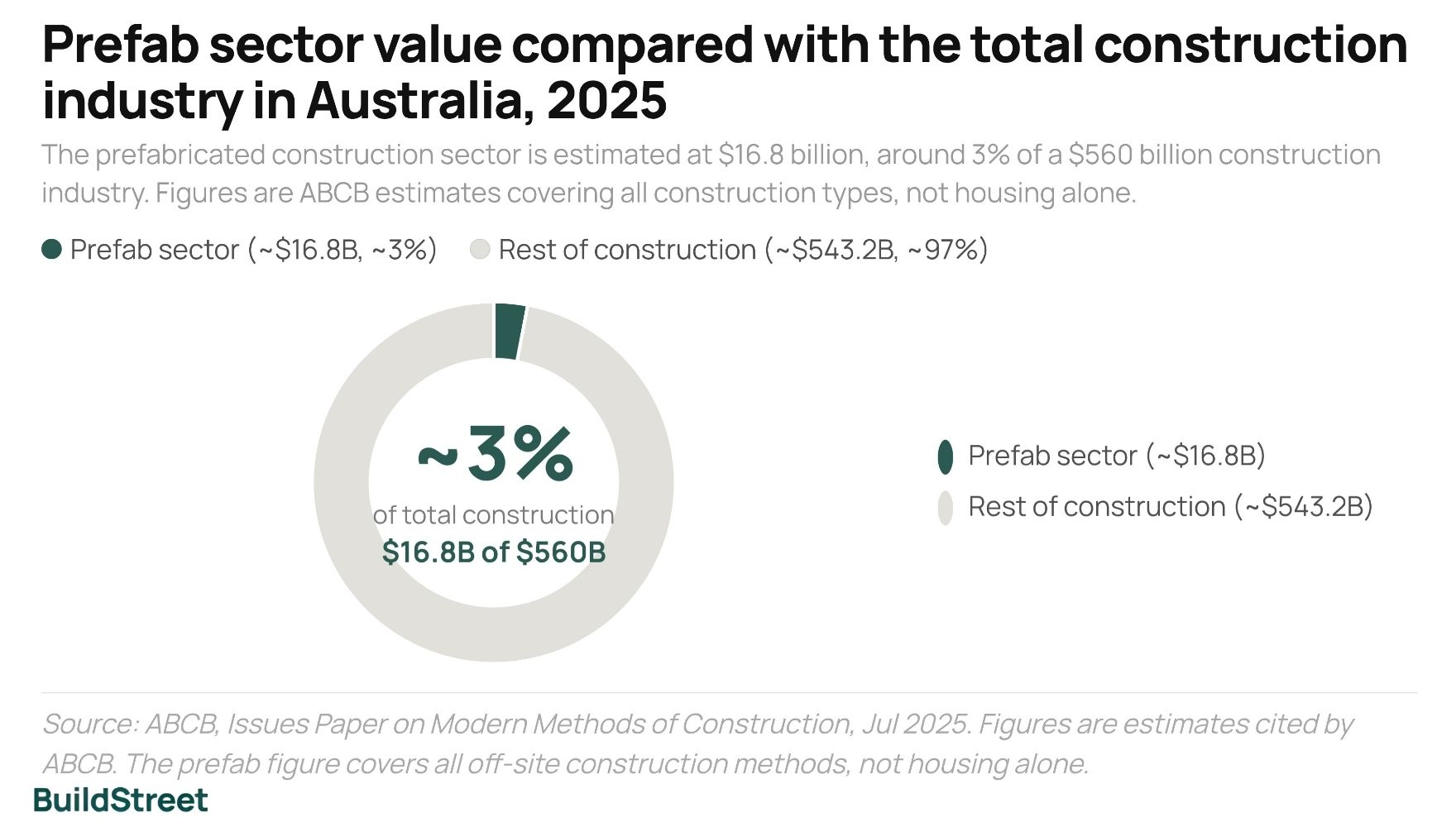
Prefab and modular construction has received increased policy attention in Australia, with governments funding programmes intended to support faster housing delivery. The prefabricated construction sector is estimated at approximately $16.8 billion, equivalent to about 3% of a $560 billion construction industry. The figure covers all prefabricated construction, not prefab housing alone.
For comparison, Japan's prefab sector made up 11.75% of new dwellings built in 2024. Federal and state governments across Queensland, NSW, Victoria, WA, South Australia and Tasmania have active prefab, modular or off-site construction programmes, supported by a $54 million federal commitment in the 2025–26 Budget.
Prefab sector value
$16.8B
Of a $560B national construction industry. Estimate cited by ABCB · Jul 2025
Official estimate · ABCB, Jul 2025Share of total construction
~3%
$16.8B of $560B; covers all construction types, not housing alone
Derived from ABCB-cited figures · Jul 2025Federal budget commitment
$54M
2025–26 Budget; $49.3M to states, with the remainder allocated to regulatory and certification work
Official · ABCB, Jul 2025Active government programmes
6
Qld, NSW, Vic, WA, SA, Tas — jurisdictions with confirmed programmes
Official · as at Jun 2026SECTION 01 · DEFINITIONS
What is prefab construction in Australia?
Prefab construction accounts for less than 5% of total construction in Australia, according to an industry estimate. The term covers a broad range of building methods, from wall panels to fully assembled modular homes.
Prefab, or prefabricated construction, refers to building components made off-site and assembled at their final location. Modular construction is a subset of prefab construction. It refers to fully volumetric rooms or dwellings built in a factory and transported to site for installation. All modular homes are prefabricated, but not all prefabricated homes are modular.
Prefabricated construction is an umbrella term covering modular, panelised and other off-site manufacturing methods. The ABS classifies a "kit house" (category 112) as a house made predominantly from prefabricated components, with modular homes listed as an example. Government documents often use modern methods of construction (MMC) as a broader term.
The distinction matters because each method has different transport, factory, site-work and installation requirements. These differences can affect programme design, delivery timelines and reported costs.
Prefab, panelised, modular and kit-home definitions used in Australian sources
Source: ABCB, Issues Paper on Modern Methods of Construction, Jul 2025; ABS Building Approvals (Cat. 8731.0), dwelling type definitions; prefabAUS, "What is Prefab?" (industry body definitions).
SECTION 02 · SECTOR SIZE
How big is Australia's prefab and off-site construction sector?
Share of $560B construction industry
~3%
Estimated prefab sector share; covers all construction types, not housing alone. Source: ABCB, Jul 2025
Named government commitments
~$191M
Selected named public commitments only: Commonwealth $54M, WA $97M, Victoria $30.38M and NSW $10M. Different programme types; not a like-for-like total. Qld, SA, Tas not separately quantified.
Data scope & caveat
The ~3% sector share is derived from the ABCB Issues Paper on Modern Methods of Construction, Jul 2025, using the estimated $16.8B prefab sector value against a $560B national construction industry. The ABCB does not publish the percentage itself.\n\nThe figure covers all construction types, including residential, commercial, industrial and infrastructure, not housing alone. The named government commitments, including Commonwealth $54M, WA $97M, Victoria $30.38M and NSW $10M, cover different programme types and should not be treated as a like-for-like funding total. Queensland, South Australia and Tasmania amounts are not publicly quantified. No Australian agency publishes a residential-specific prefab adoption rate, a prefab share of housing starts or completions, or a year-on-year sector value series.
Prefab sector value compared with the total construction industry in Australia, 2025
Estimated values only. The prefab figure covers all off-site construction methods, not housing alone.
Source: ABCB, Issues Paper on Modern Methods of Construction, Jul 2025. Figures are estimates cited by ABCB.
Government prefab and modular housing commitments in Australia
Published named commitments include the Commonwealth's $54 million prefab and modular allocation, WA's $97 million (Housing Innovation Fund grants and a separate advanced manufacturing facilities investment), Victoria's $30.38 million and NSW's $10 million. Queensland, South Australia and Tasmania amounts are not publicly quantified.
These commitments cover different programme types and should not be treated as a like-for-like funding total. The table below lists confirmed government programmes and named commitments. Some cost figures remain commercial-in-confidence or unquantified.
SECTION 03 · COSTS
How much does a prefab home cost in Australia?
Only official cost data available
Queensland's QBuild MMC programme is the only official prefab home cost source identified in the sources reviewed
That range is a government procurement estimate for social housing, not a retail price. No national average sale price for prefab homes has been published in Australia.
Official · Qld Parliament, QON 756, 2024Every official cost figure identified in the sources reviewed relates to a government social housing programme, not the private market. Costs reflect social housing specifications, government procurement arrangements, transport to regional or remote sites, site works and the scale of individual contracts.
QBuild MMC · Queensland · 2024
$209,000–$442,000 per home
Estimated cost range per home under the QBuild Modern Methods of Construction programme. Costs vary by supplier, transport distance, site location and site works. Specific project costings are commercial-in-confidence. The Queensland Government noted that "an average cost for all modular homes built across regional Queensland cannot be provided."
Source: Qld Parliament, Question on Notice No. 756, 2024. · Official estimate · social housing procurement
Walkervale modular homes · Queensland · 2024
$663,154 per home
Two homes at Walkervale had a total disclosed cost of $1,326,308, which equals $663,154 per home. This is above the QBuild programme range of $209,000 to $442,000 and reflects site-specific conditions for this project only. It is not representative of typical prefab home costs.
Source: Qld Parliament, Question on Notice No. 756, 2024. · Official figure · single project, 2 homes
National retail average
No official data published
No Australian government agency has published a prefab-specific price series or national average. For context, ABS figures for 2024–25 put the average construction cost at $474,939 for a new house, $435,089 for a townhouse and $567,947 for an apartment. These cover all construction methods and are not prefab-specific.
Source: ABS Building Activity, 2024–25; ABCB 2025. · Data gap · to be updated when published
Victoria's programme ($30.38 million for 114 homes) works out to roughly $266,500 per home by dividing the total budget. That is derived arithmetic, not a stated per-home cost, so it is not used as a headline figure.
What affects prefab home costs in Australia?
The official programme disclosures point to several factors that drive cost variation:
- Transport distance: moving large modules to regional or remote sites adds logistics cost
- Site works: preparation, foundations and service connections are costs separate from the factory build
- Specifications: government social housing programmes use standard specifications that differ from a privately commissioned home
- Certification: inspection requirements vary by jurisdiction and can affect both timeline and cost
Scale is a separate factor. Early-stage government factory programmes can face higher per-unit costs when production volumes are low. Several federal and state measures relate to manufacturing capacity, regulation or programme delivery rather than direct retail price support for individual prefab homes.
Data gap: national retail price series
No Australian government agency was identified in the sources reviewed as publishing a prefab-specific residential price series. Figures shown are the best available official data and are labelled accordingly.
SECTION 04 · ADOPTION
How does prefab adoption in Australia compare internationally?
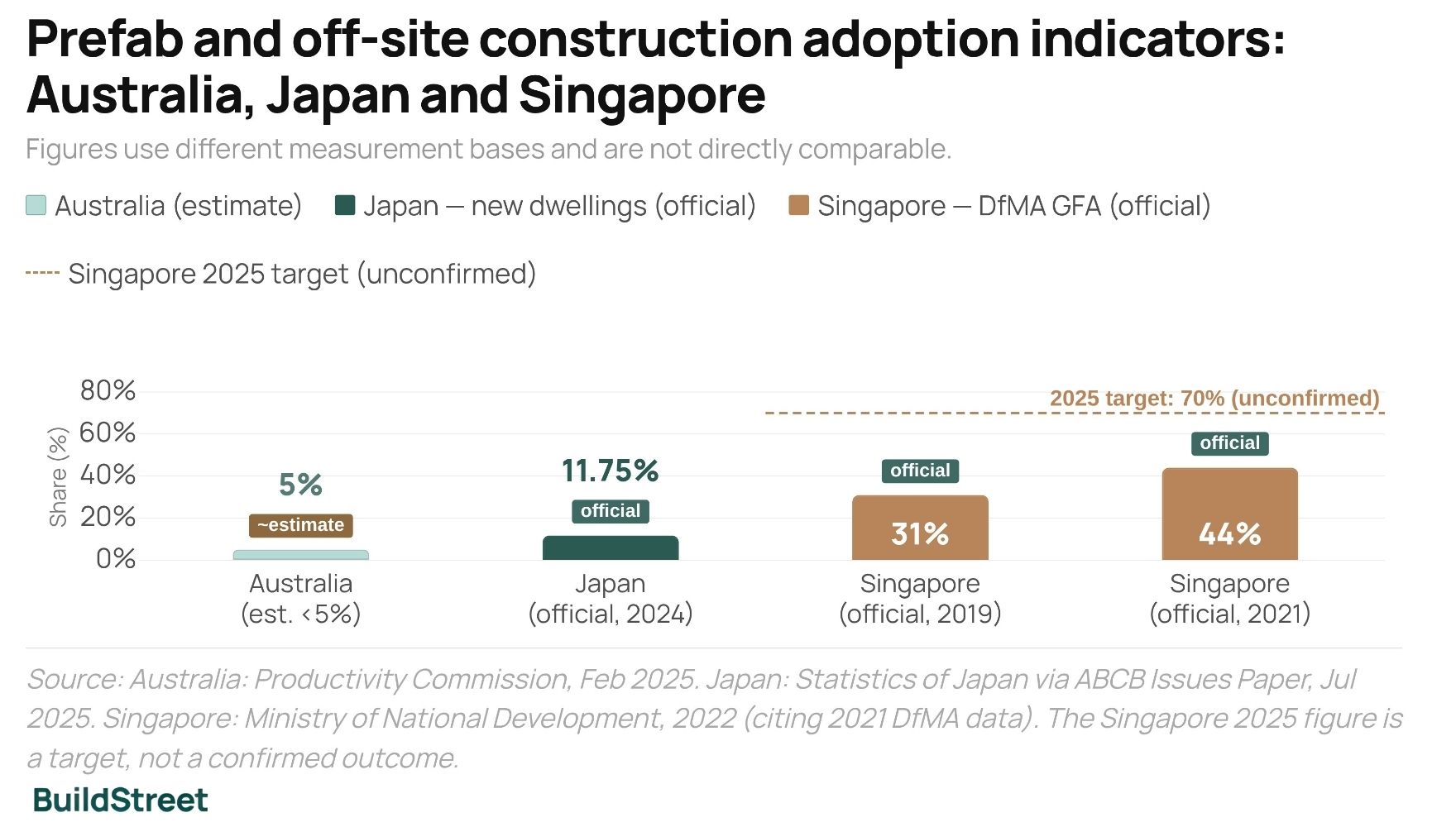
Australia · share of total construction
<5%
Industry estimate; covers all construction types, not housing alone
Japan · share of new dwellings (2024)
11.75%
Official; measures prefab share of new dwelling completions
Singapore · DfMA by gross floor area
44%
2021 indicator; not housing-specific and not directly comparable with Australia or Japan.
Prefab and offsite construction adoption indicators in Australia, Japan and Singapore
Figures use different measurement bases. Australia covers all construction types, based on an industry estimate. Japan covers new dwellings only. Singapore covers gross floor area across all building sectors. The figures should not be compared directly.
Covers all Australian construction, not housing specifically. No official residential prefab adoption rate exists.
Measures prefab as a share of new dwelling completions, which is the metric Australia does not yet publish. Some other Australian official sources cite 12–16% and 28% benchmarks; the 11.75% figure is the one used in the ABCB issues paper.
Measures Design for Manufacture and Assembly (DfMA) adoption by gross floor area across the whole building sector. Singapore increased from 31% in 2019 to 44% in 2021. The 2025 target of 70% has not been confirmed as achieved in the sources reviewed.
Source: Australia — Productivity Commission, Feb 2025. Japan — Statistics of Japan, via ABCB Issues Paper, Jul 2025. Singapore — Ministry of National Development, Singapore, 2022 statement citing 2021 DfMA adoption by gross floor area.
Japan's figure is the closest comparator for Australia because it uses the same metric Australia does not yet publish: prefab's share of new dwelling completions. Singapore's DfMA rate is not directly comparable, because it measures gross floor area across all building types, not housing specifically, and reflects a broader industry mandate that goes beyond residential construction.
Japan and Singapore use different policy and reporting frameworks from Australia, so their figures should be treated as context rather than direct benchmarks. Australia does not publish an equivalent residential prefab adoption series, which limits direct comparison with Japan's dwelling-completion data and Singapore's DfMA gross-floor-area measure.
SECTION 05 · BARRIERS
What is slowing prefab adoption in Australia?
Official reports identify four barriers to greater prefab uptake in Australia: regulatory frameworks designed for on-site construction, financing models that do not suit factory workflows, demand and industry factors including consumer preferences and skills gaps, and scale constraints that keep per-unit costs high at current production volumes. Lack of demand is identified as probably the largest barrier.
Two reports published in 2025 give the most detailed official picture of what is holding back prefab adoption. Both identify the same four barriers, listing regulatory and certification frameworks as a structural constraint for off-site construction methods.
BARRIER
Construction-phase lending is now being targeted
Tasmania's June 2026 Modular Housing Finance Guarantee is designed to support construction-phase lending for modular housing projects. The Premier stated: "the biggest obstacle to modular housing isn't the build, it's access to finance." Regulatory reform is also continuing through the ABCB certification work.
SECTION 06 · GOVERNMENT PROGRAMMES
How are governments using prefab and modular housing in Australia?
The six state programmes active as at mid-2026 are all government-funded. Most delivery programmes target social, affordable or public housing, while other measures support finance, regulation or manufacturing capacity rather than building homes directly. Some programmes refer to regional delivery, social housing supply, faster construction methods, finance, regulation or manufacturing capacity.\u00a0\n\nThere is no comparable official data on prefab uptake in the private residential market.
Prefab and modular housing policy timeline, 2022 to 2026
2022
Tasmania launches ModHomes
Target of around 200 modular social homes over four years.
June 2024
Queensland announces up to 600 modular homes
The MMC 600 programme targets modular homes delivered through industry suppliers.
July 2024 / July 2025
NSW launches modular housing trial and expansion
The initial $10M trial covered 8 homes, followed by a 2025 update announcing 90 modular homes.
February 2025
Productivity Commission identifies MMC barriers
The report identified regulatory, finance, demand and scale barriers to prefab adoption.
June 2025
SA Housing Trust issues tender for 120 off-site panelled homes
The tender covers off-site or modular homes to be built over approximately four years.
2025–26 Budget
Commonwealth allocates $54M for prefab and modular housing
Funding supports state and territory programmes, regulatory reform and certification work.
May 2026
WA awards $49M to 15 local housing manufacturers
The grants sit alongside a separate $48M advanced manufacturing facilities investment.
June 2026
Tasmania announces Modular Housing Finance Guarantee
The guarantee is designed to support construction-phase lending for modular housing projects.
Note on Queensland completion data
The MMC 600 programme target, up to 600 homes delivered through industry suppliers, was confirmed, but progress against that target was not quantified in the sources reviewed. Separately, QBuild's RAAC facilities had completed 44 modular homes since 2023, with 18 in Cairns and 26 at Eagle Farm in Brisbane. Where targets and confirmed completions differ, both are labelled accordingly throughout this article.
Data notes
What the prefab data does and does not show
Australia's prefab sector is estimated at $16.8 billion, equivalent to around 3% of total construction when calculated from ABCB-cited figures. Six state governments have active programmes covering social and affordable housing delivery, finance, regulation and manufacturing capacity. These are supported by a federal commitment of $54 million in the 2025–26 Budget.
Official data does not yet include:
- a national prefab home count
- a prefab share of housing starts or completions
- a retail price series for prefab homes
- a year-on-year trend in sector value
The $16.8 billion figure is a single point in time, not a trend. Sector share figures cover all construction, not just housing. Cost figures reflect government procurement for social housing and are not equivalent to private market prices.
General information only
This page draws on publicly available official sources, including ABS statistical releases, Commonwealth budget documents, ABCB publications, Productivity Commission reports and state and territory government announcements. It is general information only and does not constitute financial, building or legal advice. Data gaps are noted throughout rather than estimated or filled in. Cost figures relate to specific government programmes and are not indicative of retail prices for prefab homes.
Australian Building Codes Board, Issues Paper on Modern Methods of Construction (MMC Certification Scheme), July 2025
Productivity Commission, Housing construction productivity: Can we fix it?, February 2025
ABS, Building Approvals, Australia, April 2026
ABS, Building Activity, Australia
Queensland Parliament, Question on Notice No. 756, 2024
Queensland Parliament, Question on Notice No. 441, 2025
Queensland Government, Homes for Queenslanders: 600 modular homes, June 2024
QBuild, Modern Methods of Construction program overview
NSW Government, Modular homes to deliver more social housing, July 2024
NSW Government, First tenants call public modular housing home, July 2025
Premier of Victoria, Modular Homes Housing People Across Victoria
Premier of Victoria, Delivering More Homes For Regional Victorians, January 2024
WA Government, Advanced manufacturing facilities to boost housing supply, May 2026
WA Government, $49 million for local housing manufacturers, May 2026
SA Housing Trust, Trust homes built with pre-constructed wall panels, June 2025
Premier of Tasmania, Modular Finance Guarantee, June 2026
Chart Snapshots