Australian modular housing statistics 2026: build times, costs and government programmes
Six Australian state governments have announced, funded or delivered modular, prefabricated or other off-site construction housing programmes to deliver social, regional and key-worker housing faster. Selected official examples report build-time measures ranging from three to nine months, while one Queensland Government comparator cites about a year for many traditional on-site builds. These examples measure different stages of delivery, so they should not be compared as like-for-like build times.
No official national figure tracks how many modular homes are built each year, and cost data is limited to specific government programmes rather than the broader market.
Faster delivery (upper claim)
Up to 50%
Upper estimate for modular build time against traditional construction
Official claim · 2024–25Federal commitment
$54M
2025–26 Budget for prefab and modular housing, including $49.3M to states and territories
Official · 2025Jurisdictions with programmes
6
States with modular or off-site housing programmes: Qld, NSW, Vic, WA, SA, Tas
Compiled from official sources · 19 Jun 2026State programme pipeline
215+
Queensland modular social homes completed or under contract
Official programme figure · 2024–25SECTION 01 · SCOPE
What counts as modular housing in Australia?
A modular home is a dwelling built as complete sections or modules in a factory, then transported to site and installed on prepared foundations. Modular housing is one form of prefabricated or off-site construction, alongside panelised systems and other factory-made building components.
Modular and off-site housing programmes have been announced or delivered in six Australian states, but the way they are counted is not standardised. Public dwelling data records homes by type, sector and state, but does not separately identify whether a home was built using modular, panelised or other off-site construction methods.
Government sources often group modular, panelised and other factory-built systems under modern methods of construction, or MMC. The terms overlap, which is one reason a clear national modular housing figure is difficult to find.
Modular and off-site construction methods used in Australian government housing sources, 2024 to 2026
Source: Australian Government, YourHome, Construction systems; state government programme descriptions, 2024 to 2026.
Data gap: a national modular count
No official public dataset records how many modular homes are built in Australia each year, what share of housing starts are modular, or the average national price of a modular home. The figures in this article are programme counts, funding commitments, build-time examples and finance details, not a measure of the total modular housing market.
SECTION 02 · SPEED
How much faster is modular construction in Australia?
Modular construction is reported to be about 20% faster in one NSW social housing programme and up to 50% faster in upper-range official estimates. These figures should not be read as average build-time savings across the whole market, because each source measures a different stage of delivery.
The 20% figure comes from a specific NSW modular social housing programme. The up to 50% figure and the year-to-three-months example are upper estimates that depend on repeatable designs, available factory capacity and sites being ready for installation.
Programme estimate
About 20% faster
A programme-level estimate for modular social housing, with time savings expected to grow as the programme matures.
Upper claim
Up to 50% faster
An upper-range estimate for modular build timelines compared with traditional construction.
Best-case example
A year to 3 months
A best-case example for a high-quality home built with advanced manufacturing and automation.
Source: Homes NSW, 2025; Department of Industry, Science and Resources, 2024 and 2025; Housing Australia, NHIF Review, December 2024.
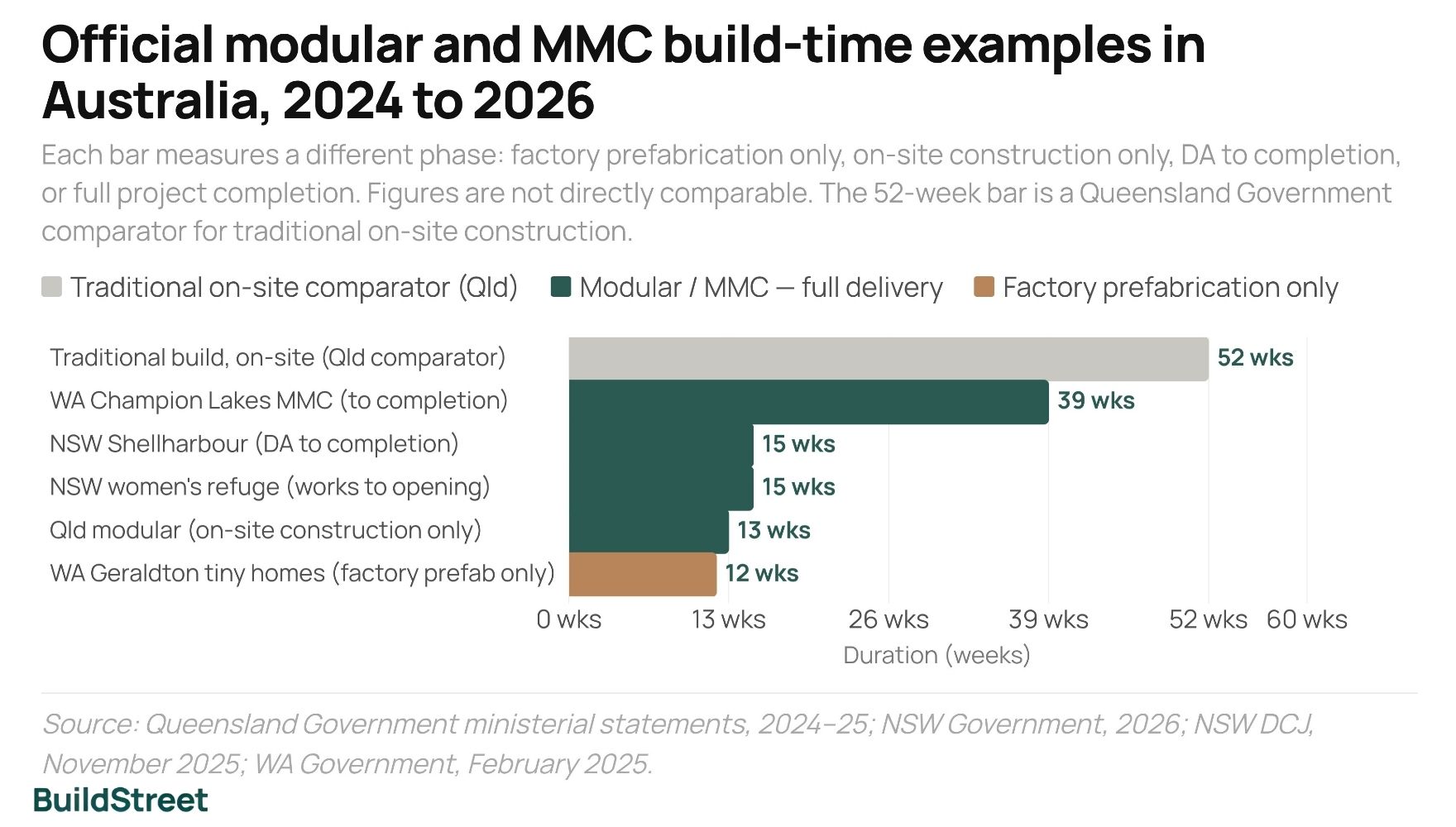
Official modular and MMC build-time examples in Australia, 2024 to 2026
Each bar measures a different phase: factory prefabrication only, on-site construction only, DA to completion, or full project completion. Figures are not directly comparable. The 52-week figure is a Queensland Government comparator for traditional on-site construction.
Source: Queensland Government ministerial statements, 2024 and 2025; NSW Government, 2026; NSW Department of Communities and Justice, November 2025; WA Government, February 2025.
The chart examples measure different stages of delivery:
- In Queensland, on-site modular construction was reported at about three months, compared with about a year for many traditional builds.
- WA's Champion Lakes social homes, built using modern construction methods including prefabricated timber walls and roofs, were completed in about nine months.
- A NSW women's refuge opened about three and a half months after works began, with studios assembled on site in a single day.
- WA's Geraldton tiny homes had a 12-week factory prefabrication window, covering the build only rather than full delivery.
Time savings depend on approvals, site readiness, factory capacity, transport logistics and how repeatable the design is.
SECTION 03 · GOVERNMENT PROGRAMMES
Which states have modular or off-site housing programmes?
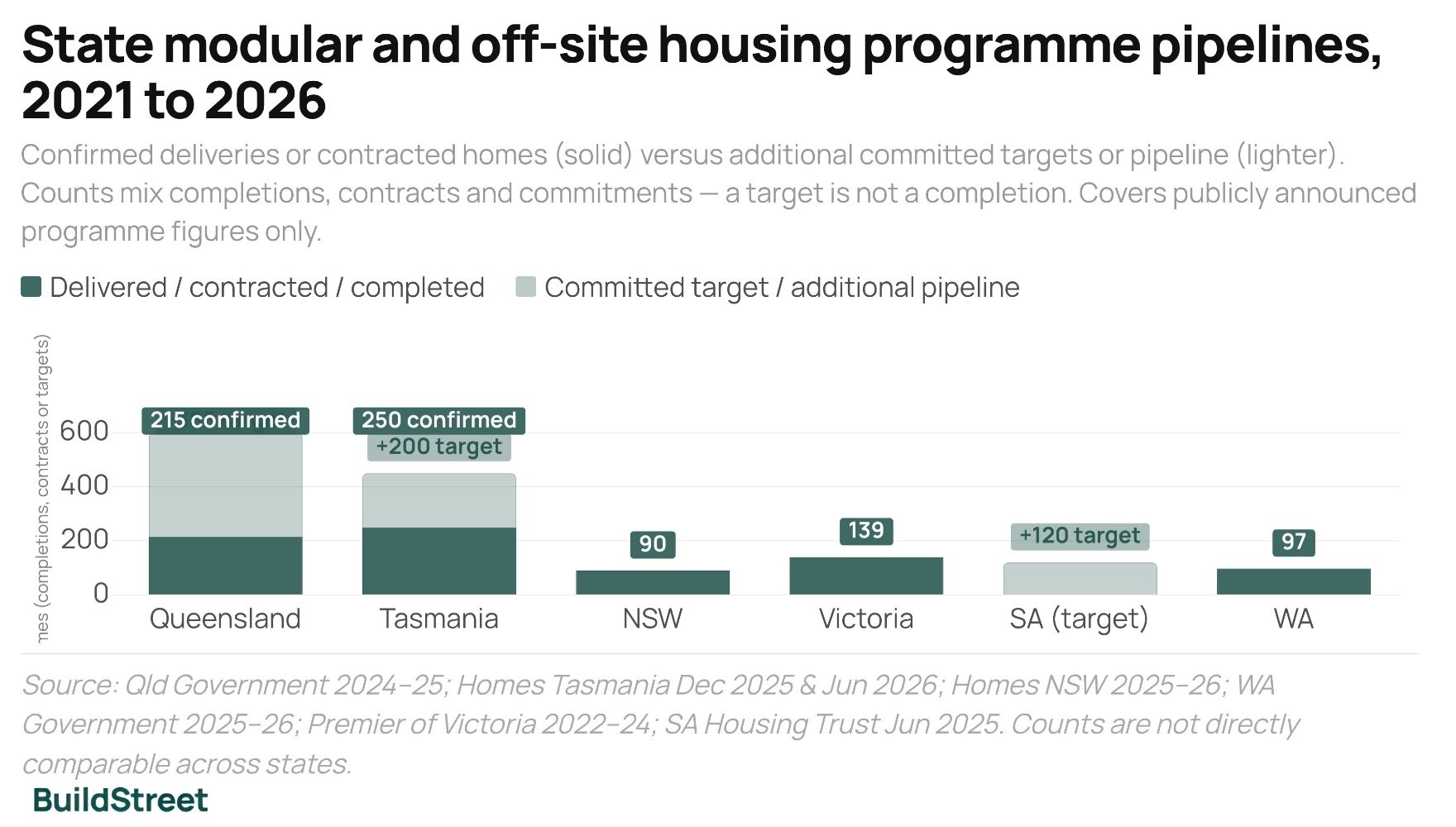
Queensland, Tasmania, New South Wales, Western Australia, Victoria and South Australia have announced, funded or delivered modular, prefabricated or off-site housing programmes in recent years. Most are focused on social, affordable, regional or key-worker housing. The counts mix completions, contracts, commitments and targets. A target is not a completion, and a home under construction is not yet built.
Queensland · Large state programme pipeline
QBuild Modern Methods of Construction
- Delivered or contracted: more than 215 modular social homes
- Committed: up to 600 homes through the State Budget as a target
- Methods: volumetric, flat-pack and kit-of-parts
- Purpose: social housing and frontline-worker accommodation, including regional Queensland
Source: Queensland Government, 2024 and 2025.
Tasmania
ModHomes and Modular Housing Finance Guarantee
- Delivered: more than 250 modular homes across Tasmania since 2021
- Committed: a further 200 homes
- Finance: Modular Housing Finance Guarantee, June 2026
Source: Homes Tasmania, December 2025; Premier of Tasmania, October 2025 and June 2026.
New South Wales
Modular housing trial and expansion
- Trial: $10M for demonstration homes; first tenants have moved in
- Expansion: 90 modular homes announced for the year ahead
- Speed: three Shellharbour homes completed 14 to 16 weeks from development approval
Source: Homes NSW, 2025 and 2026.
Western Australia
Social housing, tiny homes and manufacturing
- Capacity: $49M in grants to 15 local manufacturers
- Social housing: 81 homes across six developments using modern construction methods, including Champion Lakes in nine months
- Regional: 16 modular tiny homes for Geraldton
Source: WA Government, 2025 and 2026.
Victoria
Homes Victoria modular programme
- Funding: $30.38M for 114 modular homes
- Regional: a further 25 modular homes in a $10.1M Horsham project for up to 47 people
- Purpose: social and regional housing
Source: Premier of Victoria, 2022 and January 2024.
South Australia
SA Housing Trust off-site tender
- Target: 120 turn-key homes using off-site components over about four years
- Market share: modular has been about 5% of the SA market, occurring in health, education and commercial building
Source: SA Housing Trust, June 2025.
Notes on the programme counts
The programme counts are point-in-time figures and use different measures. Queensland's 600-home figure is a commitment or target, not a completion count. South Australia's 5% market-share figure should also be treated carefully because it refers to the broader South Australian market, not a national modular housing share.
Federal and state milestones, 2021 to 2026
Modular housing activity moved from early state delivery programmes to national policy support, manufacturing grants and new finance products between 2021 and 2026.
From 2021–22
Tasmania scales modular social housing
More than 250 modular homes delivered through Homes Tasmania since 2021, with modular used across the state toward a target of 10,000 social and affordable homes by 2032. Not all of that target is modular.
2024
Queensland and NSW commit to modular social housing
Queensland's Budget supported up to 600 modular homes, with on-site construction of about three months against about a year for many traditional builds. NSW began a modular housing trial within a wider essential-housing package.
February 2025
Productivity Commission examines housing construction
The Commission found housing construction productivity has declined over decades and identified slow approvals, low innovation, a fragmented industry and workforce gaps as barriers. Potential savings from modular are conditional on production volume, design repetition and site conditions.
June 2025
South Australia tenders for 120 off-site homes
SA Housing Trust announced a tender for 120 turn-key homes using off-site components over about four years.
2025–26 Budget
Commonwealth commits $54M for prefab and modular housing
The commitment totals $54M, including $49.3M for states and territories and $4.7M for voluntary certification. A separate $120M from the National Productivity Fund supports consistent regulation of modern construction methods.
May 2026
WA funds manufacturing capacity
In May 2026, WA announced $49M through the Housing Innovation Fund for 15 local housing-manufacturing projects using prefabrication, modular and other modern methods of construction.
June 2026
Tasmania announces a Modular Housing Finance Guarantee
Designed to back construction loans while homes are built off-site, then cease once homes are installed and become standard mortgage security.
SECTION 04 · FINANCE
Why standard construction loans do not suit modular home builds
Standard construction loans release money in stages tied to on-site progress. That model does not always fit a modular build, where most of the value is created in a factory before anything appears on the block. Without a structure on site, there is little for a lender to secure a loan against.
Two governments have introduced products to bridge that gap. Tasmania's Modular Housing Finance Guarantee, announced in June 2026, backs construction lending during the factory build phase and ceases once the home is installed and can serve as standard mortgage security.
COLLATERAL GAP
The core issue
Value is created before the home becomes mortgage security
During off-site construction, limited collateral can restrict lending before a home is installed and becomes standard mortgage security. Tasmania's June 2026 guarantee is designed to cover that phase, then cease once the home is in place. Finance access has been described as a major obstacle to modular housing.
Official · Tasmanian Government, Jun 2026Construction-loan stage payments vs the modular factory-build finance gap, 2025 to 2026
Standard construction loans in Australia draw down against five on-site progress stages. With modular homes, most of the building happens in a factory before any of those stages are reached.
Source: Keystart, construction payment stages and modular home loan guidance; Tasmanian Government, June 2026.
Both WA and Tasmania have responded with specific products:
- In Western Australia, a government-backed lender has introduced a low-deposit loan covering land, construction, transport and connection to foundations, recognising that modular builds require larger upfront payments.
- Tasmania's guarantee backs lending during the factory phase and ends once the home is installed on site.
In both cases, the finance issue is that much of the home's value exists off-site before installation.
SECTION 05 · COST
How much does modular housing cost in Australia?
Tasmania has claimed that modular homes take half the time to build and cost about 70% of a comparable traditionally built home. A separate official estimate says modern methods of construction, including modular and prefabricated homes, can reduce overall costs by up to 20%.
Neither figure is a national modular housing price benchmark. Available cost evidence comes from government claims, programme estimates and project budgets rather than a broad market survey.
Tasmania · Ministerial claim
About 70% of cost
ModHomes are claimed to take half the time of a traditional build and cost about 70% of a traditionally constructed home. This is a programme claim, not a measured national price benchmark.
Source: Premier of Tasmania, 10 October 2025. · Official · programme claim
NSW citing the Productivity Commission
Up to 20% lower
Modern methods of construction such as modular and prefabricated homes can reduce overall costs by up to 20% and be up to 50% faster than traditional building. This is an estimate of potential savings, not a realised national cost series.
Source: NSW Government, 2026, citing a Commonwealth Productivity Commission estimate. · Official · potential, not guaranteed
National retail price
No official data published
No Australian government agency publishes a modular-specific price series or national average. The official cost evidence available is a mix of government claims, state programme figures and project budgets; none is a national modular retail-price series.
Source: Review of ABS Building Activity methodology and official sources, as at 19 June 2026. · To be updated if published
Potential savings are not guaranteed. Modular housing costs can vary with production volume, design repetition, transport distance, site preparation, foundations, service connections and programme specifications.
Modular construction can cost as much as, or more than, a traditional on-site build in some cases. Recent public funding has focused on manufacturing capacity, certification, finance products and direct state procurement rather than producing a national modular housing price benchmark.
SECTION 06 · ADOPTION
Why isn't modular housing more widespread in Australia?
Modular housing adoption in Australia is limited by regulation, finance, industry capacity and scale. These barriers appear across government programmes and policy sources, especially where approval systems, construction loans and production models were designed around conventional on-site building.
The available market-share evidence is limited. The only market-share figure found is South Australia's estimate that modular construction accounts for about 5% of the state's market, with use concentrated in health, education and commercial building rather than residential housing.
Four barriers recur across the programmes and policies reviewed:
- regulation built for on-site construction
- finance models that do not suit factory workflows
- demand and industry factors, including low innovation, fragmented industry structure and skills gaps
- scale and logistics constraints that can keep per-home costs higher at low production volumes.
Regulation and certification
Approval and inspection processes were designed for on-site construction. A modular home may arrive near-complete from a factory, which does not map neatly onto stage inspections. Earlier laws treated prefabricated and manufactured homes differently, and slow or inconsistent approvals have been cited as potential barriers to finance and consumer confidence. Policy responses include NSW reforms to recognise prefabricated buildings in law, a voluntary national certification scheme and $120 million from the National Productivity Fund to support more consistent regulation.
Source: NSW Government, 2025 and 2026; Federal Building Ministers, 2025; Treasury, 2025.
Finance
Construction loans pay against on-site progress. A factory needs capital before anything appears on site, and the home's value is held off the buyer's land until installation. Limited collateral during off-site construction can restrict lending, and modular builds may require larger upfront payments. Policy responses include Tasmania’s Modular Housing Finance Guarantee, a WA low-deposit modular loan and federal work with lenders on modular finance.
Source: Tasmanian Government, June 2026; WA Government, 2025.
Demand and industry
Several constraints on uptake are cited in the sources reviewed, including demand for modular and off-site construction, workforce settings, low innovation and a fragmented industry structure. Factory-based construction can require different skills and production settings from conventional on-site building. No official demand-side survey of consumer attitudes to modular housing was found.
Source: Productivity Commission, February 2025.
Scale and logistics
Potential savings depend on production volume and design repetition. Early, low-throughput programmes can cost more per home, while large modules can add transport and access costs. Site access, module width, crane access and overhead wires are practical constraints. YourHome also notes that no single construction system suits every site or climate. Policy responses include WA’s $49 million in grants to 15 local manufacturers and federal support for manufacturing capacity.
Source: Australian Government, YourHome; Productivity Commission, February 2025; WA Government, 2026.
Data notes
What the data does and does not show
Modular build-time claims in Australia include about 20% faster, up to 50% faster and as few as three months in selected examples. These figures measure different stages of delivery and are not directly comparable. Six states have announced, funded or delivered modular or off-site housing programmes, and the Commonwealth has committed $54 million for prefab and modular housing.
Official data does not include:
- a national count of modular homes built each year
- a modular share of housing starts or completions
- a national modular retail price series
- a harmonised dataset separating volumetric modular, panelised and other off-site methods across all states
Programme counts are point-in-time figures and can mix completions, contracts, commitments and targets. Cost figures are government claims, estimates or project/programme figures; they are not retail prices or national averages.
General information only
This page is based on publicly available official sources, including Australian Government guidance, Treasury and Productivity Commission material, Housing Australia, and state and territory government announcements. It is general information only and is not financial, building or legal advice. Where national modular housing data is unavailable, the article notes the gap rather than estimating a figure. Cost figures are government claims, estimates or programme figures, not retail prices or national averages.
Chart Snapshots