Dual occupancy in Australia 2026: rules, approvals and how it differs from duplexes
Dual occupancy generally means two dwellings on one lot, although the exact rules differ by state and territory. Australia does not publish a national dual occupancy approvals dataset, so this article uses ABS semi-detached, row, terrace and townhouse approvals as the closest official proxy for attached low-rise activity.
Australia approved 34,488 semi-detached, row and terrace houses and townhouses in 2025, up 20.5% from the 2023 low. The 2025 figure was still around 8% below the 2017 peak, while recent planning reforms in NSW, Victoria and WA have coincided with stronger activity in some attached low-rise housing categories. South Australia also recorded a sharp increase in 2025.
Semi-detached approvals, 2025
34,488
The closest official proxy for dual occupancy-style activity nationally, not a direct count of dual occupancies.
Change from 2023 low
+20.5%
From 28,619 in 2023 to 34,488 in 2025, the strongest two-year gain in this category since 2021.
Share of all new dwellings, 2025
17.6%
Up from 16.5% in 2024. The share has remained between 15% and 18% since 2016.
WA growth, 2022–2025
+269%
From 605 in 2022 to 2,232 in 2025. The strongest proportional gain of any mainland state.
Source: ABS Building Approvals, Australia, Tables 20–29, April 2026. Figures are approval counts, not completions.
About the data
Australia does not publish a national dual occupancy approval series. The ABS groups dwellings by building type, not by planning category. The "semi-detached, row or terrace houses, townhouses" series is the closest available national measure.
It covers attached low-rise forms broadly and includes some row terraces and townhouse developments that would not qualify as dual occupancies under state planning law. For that reason, this article uses "dual occupancy" when explaining planning rules and "semi-detached, row, terrace and townhouse approvals" when discussing ABS approval data.
SECTION 01 · DEFINITIONS
What is dual occupancy in Australia?
Dual occupancy generally refers to two dwellings on one lot. The dwellings may be attached side by side or built as separate structures, depending on the state or territory rules.
Australia has eight state and territory planning systems, and at least five different official terms are used for what many people call a dual occupancy. NSW and Queensland both use "dual occupancy" in planning rules, although permissibility and assessment pathways vary by zone and local scheme.
What is the difference between a dual occupancy and a duplex?
The word "duplex" is common in real estate, but it does not have one consistent planning meaning across Australia. In NSW, it usually refers to an attached dual occupancy: two dwellings built side by side on one lot, which may be subdivided so each dwelling sits on its own title.
A dual occupancy can be attached or detached, depending on the jurisdiction. A duplex is usually used to describe an attached pair of dwellings.
WA does not use "dual occupancy" as a planning category. The R-Codes regulate development through categories such as grouped dwellings, single houses and multiple dwellings, with rules set by the site's density code.
Three dwelling types are sometimes confused with dual occupancies but are not the same under current state planning definitions:
- a granny flat or secondary dwelling, which is usually a smaller, subordinate dwelling on the same lot
- a townhouse development of three or more dwellings on one lot
- a strata-titled apartment block
Because each state uses different planning categories and terminology, no single official series tracks dual occupancy approvals nationally.
NSW definition
2 dwellings
On one lot, attached or detached. Excludes secondary dwellings. Since 1 July 2024, permitted in R2 low-density residential zones statewide, subject to planning standards, consent pathways and site exclusions.
Queensland definition
2 dwellings
On one lot, or on separate lots sharing common property. Permissibility depends on the local planning scheme and assessment category.
WA equivalent
Grouped dwelling
WA uses the R-Codes category "grouped dwelling" instead of dual occupancy. Permissibility depends on density code and minimum site area.
Source: NSW Planning, Applicant Guide to Dual Occupancies, December 2025; Queensland Planning Regulation 2017 Schedule 24; WA Residential Design Codes Volume 1, 2026.
SECTION 02 · NATIONAL APPROVALS
How many dual occupancy-style dwellings are approved each year in Australia?
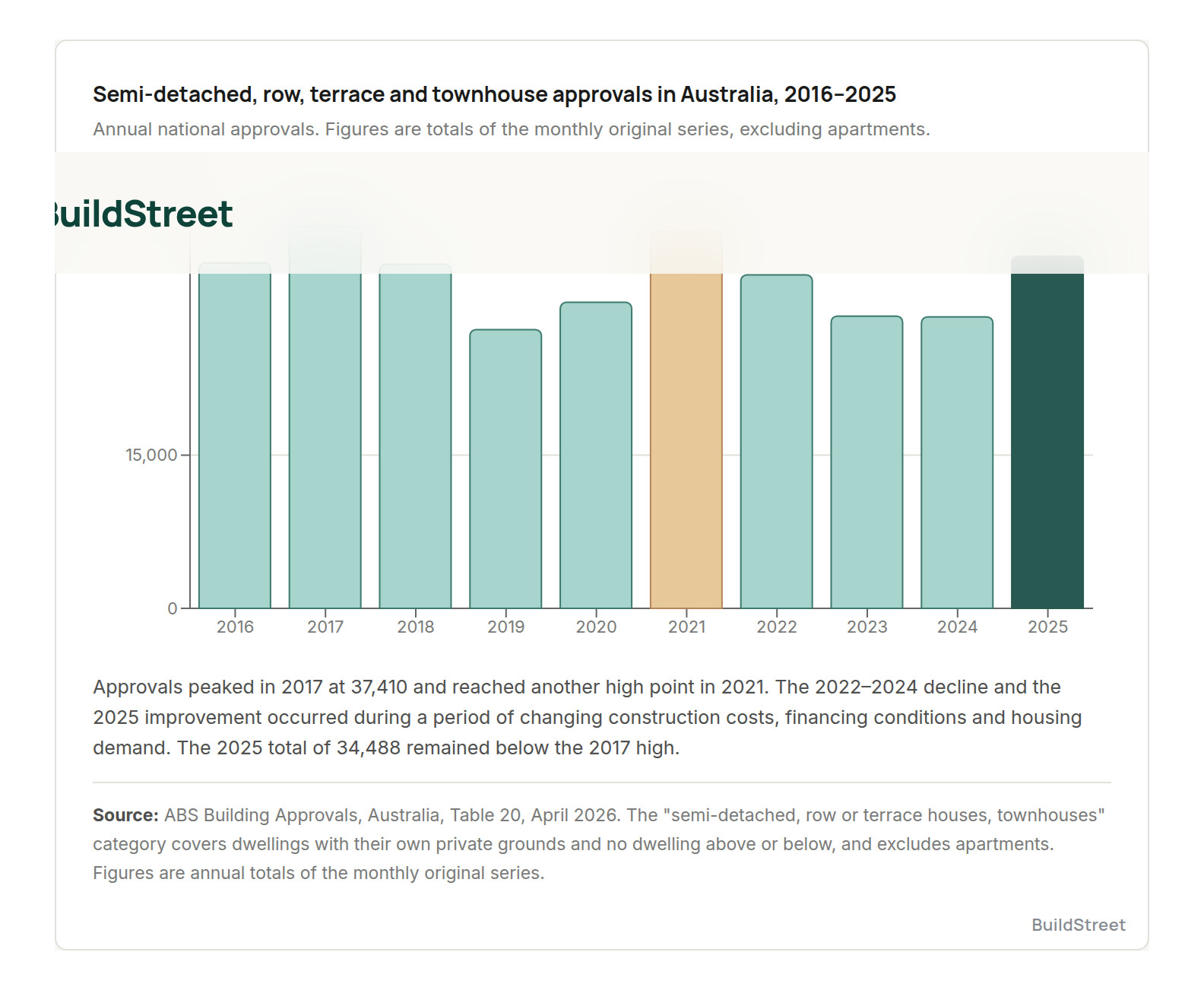
Australia approved 34,488 semi-detached, row and terrace houses and townhouses in 2025, up 20.5% from 28,619 in 2023. This ABS category is used as the closest national proxy for dual occupancy and attached low-rise activity, but it is broader than dual occupancy under state planning law.
That was the highest annual total since 2021 and the first increase after three consecutive years of lower approvals. The 2017 peak of 37,410 has not been reached again.
The 2021 figure of 36,877 coincided with the HomeBuilder period, while the pre-pandemic low was 27,294 in 2019.
Semi-detached, row, terrace and townhouse approvals in Australia, 2016–2025
Annual national approvals. Figures are totals of the monthly original series, excluding apartments.
Approvals peaked in 2017 at 37,410 and reached another high point in 2021. The 2022–2024 decline and the 2025 improvement occurred during a period of changing construction costs, financing conditions and housing demand. The 2025 total of 34,488 remained below the 2017 high.
Source: ABS Building Approvals, Australia, Table 20, April 2026. The "semi-detached, row or terrace houses, townhouses" category covers dwellings with their own private grounds and no dwelling above or below, and excludes apartments. Figures are annual totals of the monthly original series.
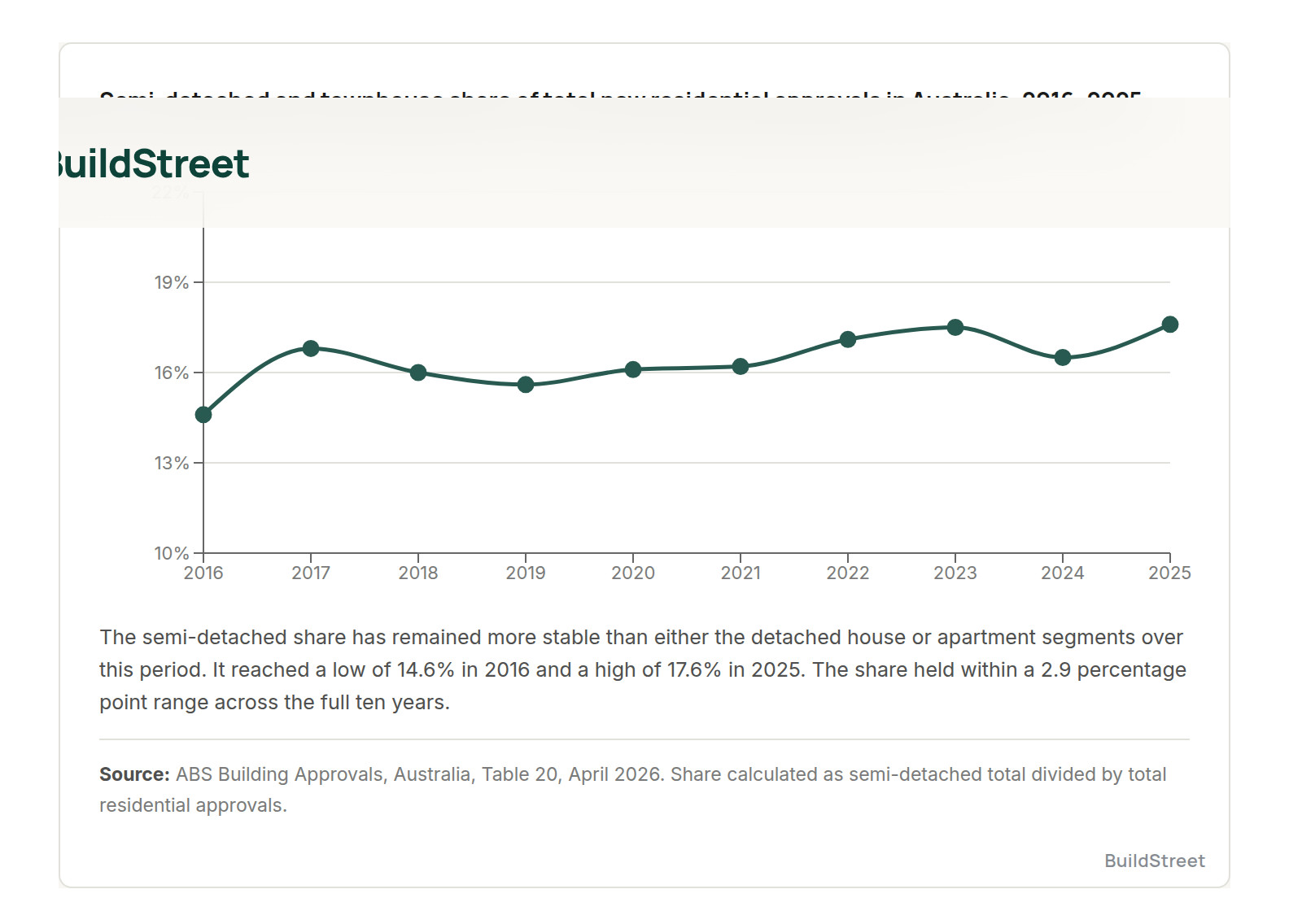
As a share of all new residential approvals, semi-detached and townhouses have stayed between 15% and 18% since 2016. They reached 17.6% in 2025, the highest proportion since 2022.
Approved construction value for this category in 2025:
- Total value: $15.2 billion, up from $12.1 billion in 2024
- Average per approval: around $439,000
Source: ABS Building Approvals, Australia, value of building approved, April 2026. Average per approval is total approved value divided by the number of approvals.
Semi-detached and townhouse share of total new residential approvals in Australia, 2016–2025
Semi-detached and townhouse approvals as a percentage of all national residential approvals.
The semi-detached share has remained more stable than either the detached house or apartment segments over this period. It reached a low of 14.6% in 2016 and a high of 17.6% in 2025. The share held within a 2.9 percentage point range across the full ten years.
Source: ABS Building Approvals, Australia, Table 20, April 2026. Share calculated as semi-detached total divided by total residential approvals.
SECTION 03 · STATE COMPARISON
Which states lead in dual occupancy-style approvals?
NSW recorded 11,677 semi-detached and townhouse approvals in 2025, up 22% from 9,573 in 2024 and the highest total of any state. Victoria recorded 10,408 in 2025, after falling from its 2021 peak of 14,166 and lifting slightly from 9,928 in 2024.
These rankings compare the ABS semi-detached, row, terrace and townhouse category. They do not measure dual occupancy approvals directly.
The NSW increase followed the July 2024 Stage 1 planning reform, which extended dual occupancy permissions across all R2 zones statewide. The approval data does not isolate the effect of that reform from other factors such as construction costs, financing conditions and project feasibility.
WA and SA both recorded percentage increases from low starting points. WA reached 2,232 approvals in 2025, up from 605 in 2022. SA reached 3,370, up 79% from 1,886 in 2024. In absolute terms, both states approved fewer attached low-rise dwellings than NSW or Victoria.
Western Australia, 2022–2025
WA semi-detached approvals rose 269% over three years from a low base. The increase occurred during a period of broader residential planning reform and stronger housing activity in WA. The data does not show how much of the lift was due to R-Codes changes, market demand or construction feasibility.
Semi-detached, row, terrace and townhouse approvals in Australia by state, 2020–2025
Annual semi-detached and townhouse approvals for the five largest states, 2020 to 2025.
NSW and Victoria have recorded the highest volumes throughout the period. Victoria peaked in 2021 and recorded lower figures in each subsequent year to 2024, before a slight increase in 2025. NSW fell from 2021 to 2023, then rose in 2024 and 2025. WA and SA both recorded increases from 2023 onwards, with SA's 2025 total higher than any prior year in the series shown.
Source: ABS Building Approvals, Australia, Table 20, April 2026.
Semi-detached and townhouse share of total residential approvals in Australia, by state, 2025
Each state's semi-detached and townhouse approvals as a percentage of its own total residential approvals.
SA records the highest share at 22.6%, ahead of NSW at 22.2%, despite NSW approving more semi-detached dwellings in total. SA's higher share partly reflects lower apartment approval volumes relative to other states. WA's share of 9.3% is the lowest of the five states shown, though it has increased from 4.0% in 2022.
Source: ABS Building Approvals, Australia, Table 20, April 2026.
SECTION 04 · RULES BY STATE
How dual occupancy rules differ by state
Dual occupancy rules are set at the state or territory level and vary by jurisdiction. The main differences are the planning term used, which zones the dwellings are permitted in, whether the site can be subdivided, and which assessment pathway applies.
- Planning permission is generally required, usually as a development application or complying/accepted development, depending on the state.
- Site area, setbacks, private open space and off-street parking are commonly regulated through the planning scheme or design code.
- In most states, both dwellings remain on one title unless a separate strata, community title or subdivision application is approved.
- NSW is the main exception: an attached dual occupancy can be subdivided into two semi-detached homes on separate lots through a further development application.
Source: NSW Planning dual occupancy guide, December 2025; Queensland Planning Regulation 2017; WA Residential Design Codes Volume 1, May 2026; PlanSA Planning and Design Code; ACT Territory Plan 2023 and ACT Missing Middle Housing Reforms; Tasmanian Planning Scheme; NT Planning Scheme 2020; Planning Victoria, Townhouse and Low-Rise Code.
SECTION 05 · PLANNING REFORMS
How planning reforms relate to dual occupancy-style approvals
NSW semi-detached approvals rose 22% between 2024 and 2025, from 9,573 to 11,677.
The increase followed the Stage 1 low-rise housing reform, which started on 1 July 2024 and permitted dual occupancies and semi-detached homes in all R2 low-density residential zones across NSW, subject to planning standards and exclusions.
NSW semi-detached approval counts by period:
- First half of 2024 (before reform): 4,574
- Second half of 2024 (after reform): 4,999
- First half of 2025: 6,055
Planning rule changes can take time to appear in building approvals. A reform that starts in July may lead to development applications later that year, with building approvals appearing from late in the year or into the following year.
Timeline of recent housing and planning reforms
August 2023
National Housing Accord agreed
Federal, state and territory governments committed to 1.2 million new well-located homes by June 2029. Planning reform was identified as one lever for increasing housing supply.
April 2024
WA Residential Design Codes revised
WA's revised R-Codes took effect in April 2024. The R-Codes apply to single houses, grouped dwellings and some multiple dwellings, with provisions varying by density code and development type.
1 July 2024
NSW Stage 1 low-rise housing reform
NSW permitted dual occupancies and semi-detached homes in all R2 low-density residential zones statewide, subject to planning standards and exclusions. The complying development pathway under the Low-Rise Housing Diversity Code applies where a proposal meets the relevant standards.
28 February 2025
NSW Stage 2 low- and mid-rise housing reform
NSW expanded planning controls around nominated centres and train stations to include more low- and mid-rise housing types, alongside the Housing Delivery Authority pathway for eligible larger proposals.
March 2025
Victoria Clause 55 updates
Victoria updated its deemed-to-comply Clause 55 standards for townhouses and low-rise dwellings under the Townhouse and Low-Rise Code, streamlining assessment where proposals meet the standards.
1 July 2026
ACT Missing Middle Housing Reform (scheduled)
The ACT's Missing Middle Housing Reforms commence on 1 July 2026. The reforms change the Territory Plan to allow more low-rise housing options in RZ1 and RZ2 areas.
Source: NSW Planning, Low and Mid-Rise Housing Policy FAQ; WA Government, Revised R-Codes now in effect, April 2024; Planning Victoria, Townhouse and Low-Rise Code; ACT Legislation Register, Planning (Missing Middle Housing Reform) Major Plan Amendment 2026; NHSAC, State of the Housing System 2026.
The approval data alone cannot separate the effect of planning reforms from other factors. Interest rates, construction costs, land availability and project feasibility all influence how many projects proceed.
Under conditions prevailing in early 2026, Australia was on track to deliver around 980,000 gross new dwellings over the Accord period to June 2029, around 220,000 short of the 1.2 million target. Project feasibility at current construction costs was identified as a constraint across all dwelling types.
SECTION 06 · GENTLE DENSITY
How dual occupancy supports gentle density and infill housing
Scenario modelling published in December 2025 estimated that redeveloping one in four standalone homes across Australia's five largest cities as dual occupancies could increase housing supply by approximately 9%, close to one million additional homes.
That figure is a theoretical scenario, not a forecast or government target. It assumes no feasibility or financing constraints apply. Annual approval volumes for the ABS semi-detached and townhouse proxy have ranged from about 27,000 to 37,000 since 2016.
Scenario modelling, CEDA and Urbis, December 2025
The estimated supply uplift if one in four standalone homes across Sydney, Melbourne, Brisbane, Adelaide and Perth were redeveloped as dual occupancies, equivalent to a 9% increase in housing stock across those cities. This is a theoretical scenario, not a forecast or government target.
Dual occupancy projects require lot sizes that meet site area requirements, construction costs that support project feasibility and a planning framework that permits the outcome.
Established suburbs have existing access to schools, public transport, employment and services. Adding a second dwelling on an existing lot can make greater use of existing roads, utilities and services, although local upgrades may still be required.
Planning reform activity across NSW, Victoria, WA and the ACT since 2023 has focused on expanding or streamlining dual occupancy, townhouse, grouped dwelling and other low-rise housing pathways in established residential areas.
Factors constraining delivery in this period include:
- Construction costs have been rising since 2021, which may reduce margins on projects that require two dwellings on one lot.
- Financing for dual occupancy projects can be more specialised than standard detached-home construction.
- Some lots meet planning requirements but are still difficult to redevelop into two commercially viable dwellings.
SECTION 07 · 2026 SO FAR
Semi-detached approvals held steady in early 2026
In the first four months of 2026, Australia approved 10,759 semi-detached and townhouse dwellings, compared with 10,740 in the same period of 2025.
The two periods were almost unchanged, indicating that the 2025 lift had held steady rather than accelerated in early 2026. Semi-detached and townhouse approvals accounted for 16.8% of total residential approvals in April 2026, in line with the 2025 annual average of 17.6%.
Monthly semi-detached approvals by state, April 2026:
- NSW: 887
- Victoria: 880
- Queensland: 564
SA's approval figures rose in 2025 and remained above the weaker 2023 and 2024 annual totals into early 2026.
Semi-detached and townhouse approvals in Australia, monthly, 2024 to 2026
Monthly national approvals. The 2026 series covers January to April only.
The 2025 series ran above 2024 across most months, consistent with the higher annual total. The 2026 January-to-April series tracks close to 2025 levels, with individual months varying above and below. January consistently records the lowest monthly total in the series, a pattern that also appeared in 2024 and 2025.
Source: ABS Building Approvals, Australia, Table 20, April 2026 (original series). The 2026 data covers January to April only.
Across the three months from February to April 2026, total dwelling approvals were 12.1% higher than the same period in 2025 on a seasonally adjusted basis. Dwellings excluding houses were up 16.0% over the same period.
Source: ABS Building Approvals, Australia, April 2026, seasonally adjusted series. Percentage changes compare February to April 2026 with February to April 2025.
Data notes
The figures in this article come from ABS Building Approvals, Australia, Tables 20–29, April 2026. The ABS does not publish a separate national dual occupancy approval series, so the article uses "semi-detached, row or terrace houses, townhouses" as the closest available proxy. This proxy is broader than dual occupancy because it can include row terraces and townhouse developments of three or more dwellings. It does not provide a direct count of dual occupancies approved each year.
Approvals are not completions. Construction may occur months after approval, and some approved projects may not proceed. The CEDA/Urbis figure of approximately one million additional homes is scenario modelling, not a forecast or government target. Information is current as at June 2026.
General information only
This article draws on publicly available sources, including ABS Building Approvals, state and territory planning legislation, policy documents and third-party research. It is general information only and is not planning, legal or financial advice. Where no national dual occupancy dataset exists, the data gap is stated and the closest official proxy is labelled. Planning rules can change, and current requirements should be checked with the relevant planning authority.
References
- ABS: Building Approvals, Australia, April 2026
- ABS: Building Approvals methodology, April 2026
- NHSAC: State of the Housing System 2026
- NHSAC: Quarterly Report, March 2026
- NSW Planning: Applicant Guide to Dual Occupancies
- NSW Planning: Low and Mid-Rise Housing Policy FAQs
- Planning Victoria: Townhouse and Low-Rise Code
- Queensland Government: Planning Regulation 2017
- WA Government: Residential Design Codes Volume 1
- PlanSA: Planning and Design Code
- ACT Planning: Missing Middle Housing Reforms
- ACT Revenue Office: RZ1 Unit Duty Exemption Scheme
Chart Snapshots