Are Australians still a detached-house nation?
Separate houses still dominate Australia's housing stock, accounting for 72.3% of occupied private dwellings in 2021. But the share has been steadily declining, down from 76.6% in 2006. At the same time, non-house dwellings accounted for 42.2% of all residential building approvals in 2025, up from 36.2% a year earlier.
The existing housing stock remains overwhelmingly detached, but new construction is shifting more rapidly toward townhouses and apartments, reshaping affordability, density and urban growth patterns.
Separate houses (2021 Census)
72.3%
Of occupied private dwellings nationally
Non-house approvals (2025)
42.2%
Up from 36.2% in 2024
Total occupied dwellings (2021)
9.28M
Three in four remain separate houses
SECTION 01 · DWELLING STOCK
Separate houses still make up most Australian dwellings
Separate houses remain the dominant dwelling type in Australia, although their share has been gradually declining. In the 2021 Census, the ABS recorded 9,275,217 occupied private dwellings nationally. Around three in four were separate houses, while flats and apartments accounted for roughly one in seven.
When unoccupied dwellings are included, the ABS recorded 10,852,208 private dwellings in total. Separate houses made up 70% of all private dwellings, compared with 13% for townhouses and 16% for apartments.
The overall picture
The shift away from separate housing is real but gradual. After 15 years of change, Australia remains firmly a country of separate houses. What has changed is the margin: townhouses and apartments are both larger parts of the stock than they were, and the new supply pipeline is accelerating that shift.
What the numbers don't show
National averages mask extreme local variation. The apartment story is concentrated in a handful of inner-city statistical areas. In Sydney's City and Inner South, apartments are a majority — 69.4% — but that area is the exception, not the rule. At the national level, almost three in four occupied dwellings are still separate houses.
SECTION 02 · CENSUS TRENDS
How the dwelling mix has changed since 2006
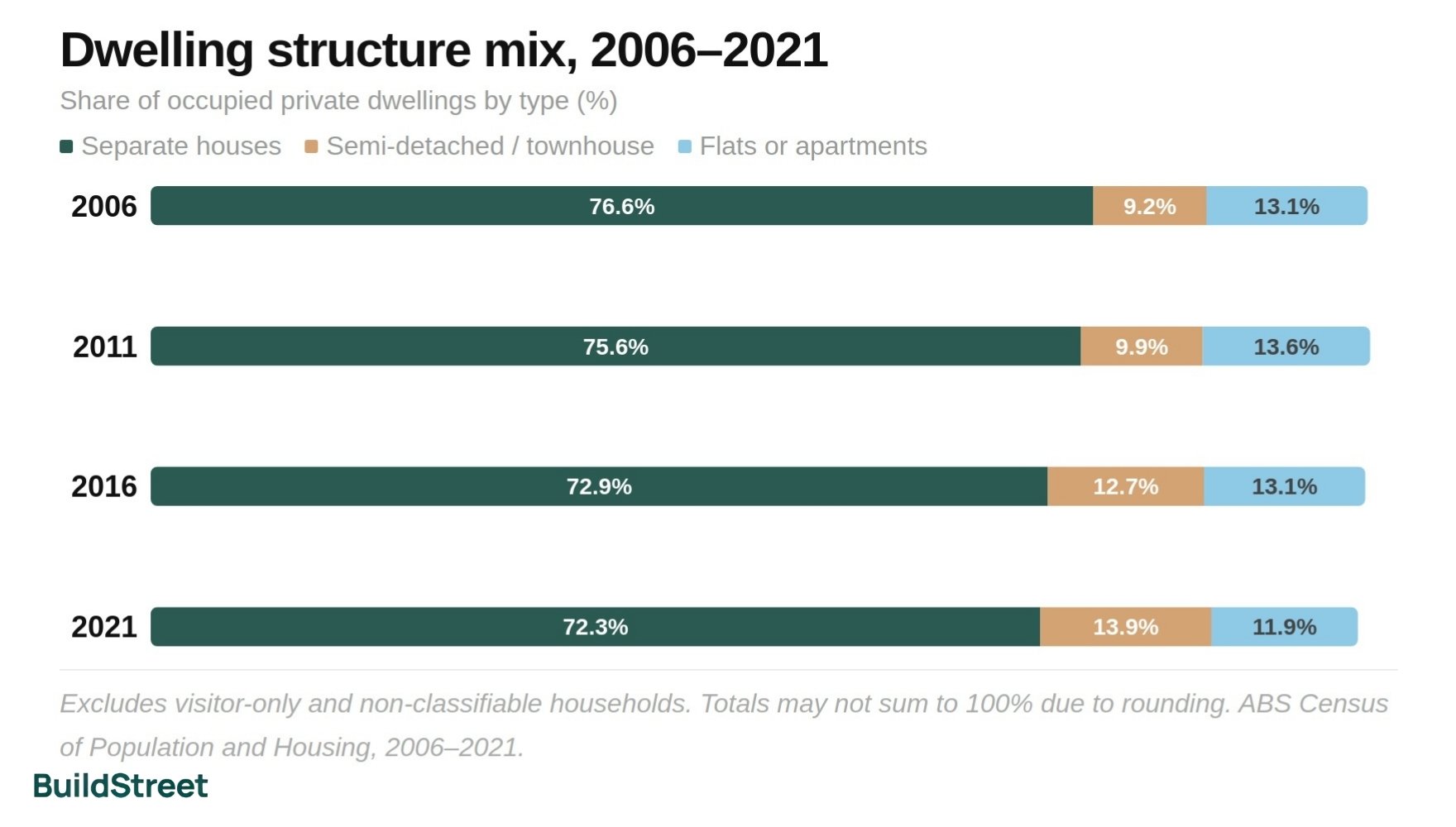
Census data shows a gradual shift away from separate houses, but not a broad move to apartment living. Separate houses fell from 76.6% of occupied private dwellings in 2006 to 72.3% in 2021. Over the same period, semi-detached homes and townhouses rose from 9.2% to 13.9%, while flats and apartments remained broadly stable before falling to 11.9% in 2021.
That matters because the change is not mainly being driven by apartments. It points to a broader middle-density shift, with more townhouses and semi-detached dwellings becoming part of Australia's housing mix.
Dwelling structure mix, 2006–2021
Share of occupied private dwellings by type (%).
- Separate houses
- Semi-detached / townhouse
- Flats or apartments
Excludes visitor-only and non-classifiable households. Totals may not sum to 100% due to rounding. Source: ABS Census of Population and Housing, 2006–2021.
Australia's housing mix is changing, but the shift is clearer in percentages than in total dwelling numbers. Separate houses are taking up a smaller share of the national housing stock, yet the actual number of separate houses has continued to grow.
In dwelling numbers, separate houses still increased, rising from 5.47 million in 2006 to 6.71 million in 2021, a gain of about 22.6%. Flats and apartments grew by 41.4%, while semi-detached homes and townhouses recorded the strongest growth at 77.4%, although from a smaller starting point.
Census dwelling stock by type, 2006–2021
Occupied private dwellings, absolute numbers and shares.
| Census year | Total occupied | Separate houses | Semi / townhouse | Flats or apartments |
|---|---|---|---|---|
| 2006 | 7,144,093 | 5,472,527 76.6% | 658,858 9.2% | 932,862 13.1% |
| 2011 | 7,760,320 | 5,864,574 75.6% | 765,980 9.9% | 1,056,237 13.6% |
| 2016 | 8,286,079 | 6,041,787 72.9% | 1,055,016 12.7% | 1,087,441 13.1% |
| 2021 | 9,275,217 | 6,707,400 72.3% | 1,288,779 13.9% | 1,104,011 11.9% |
Source: ABS Census of Population and Housing, 2006–2021 QuickStats, national totals for occupied private dwellings.
SECTION 03 · APARTMENTS
Where apartments are most common in Australia
Apartments make up a larger share of housing in some parts of Australia, but they are still not the main dwelling type in any state or territory. Apartment living is concentrated in a small number of jurisdictions, particularly those with larger urban centres and higher-density housing.
In 2021, the highest apartment shares were in New South Wales at 21.7%, the Australian Capital Territory at 19.4% and the Northern Territory at 17.9%. No jurisdiction had a separate-house share below 63.2%. Tasmania had the highest share of separate houses at 87.7%, while apartments accounted for just 5.3% of dwellings.
Dwelling type by state and territory, 2021
Share of occupied private dwellings (%); apartment change since 2016 shown.
| State or territory | Houses % | Semi % | Apts % | Apt change since 2016 |
|---|---|---|---|---|
| New South Wales | 65.6% | 11.7% | 21.7% | +1.8 pp |
| Victoria | 73.4% | 13.9% | 12.1% | +0.5 pp |
| Queensland | 74.8% | 11.7% | 12.5% | +1.2 pp |
| South Australia | 78.0% | 14.6% | 6.8% | +0.2 pp |
| Western Australia | 79.7% | 13.0% | 6.5% | +0.8 pp |
| Tasmania | 87.7% | 6.7% | 5.3% | +0.1 pp |
| Northern Territory | 66.8% | 12.7% | 17.9% | +0.4 pp |
| Australian Capital Territory | 63.2% | 17.2% | 19.4% | +4.4 pp ★ |
Rows may not sum to 100% due to small "other dwelling" category. Source: ABS 2021 Census QuickStats, occupied private dwellings by state and territory.
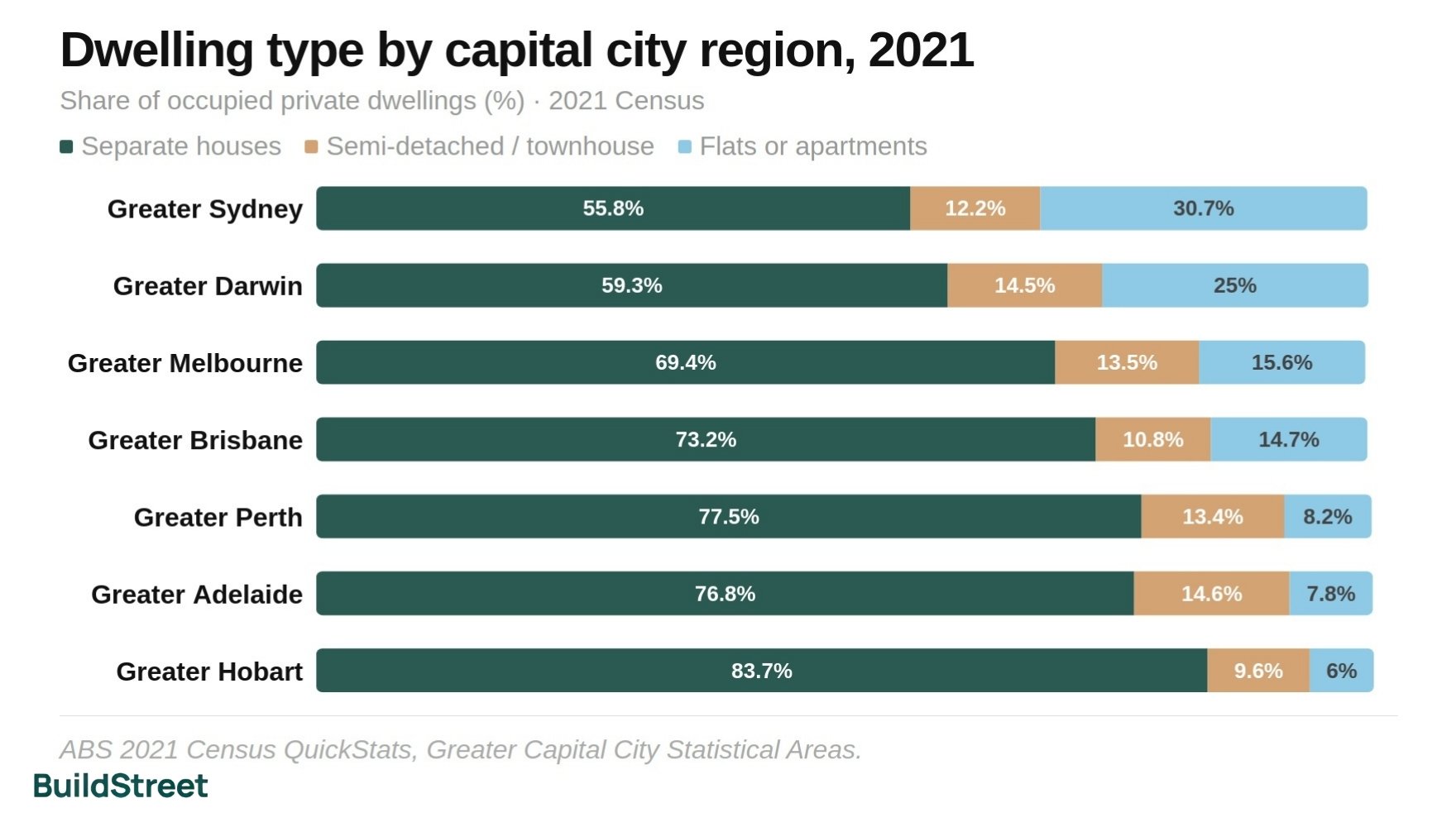
In major cities, the contrast is clearer. Greater Sydney had the highest apartment share in 2021, with apartments accounting for 30.7% of dwellings. Greater Darwin followed at 25.0%, ahead of Greater Melbourne at 15.6% and Greater Brisbane at 14.7%. Even in Greater Sydney, separate houses remained the largest dwelling category, accounting for 55.8% of dwellings.
Dwelling type by capital city region, 2021
Share of occupied private dwellings (%).
- Separate houses
- Semi-detached / townhouse
- Flats or apartments
Source: ABS 2021 Census QuickStats, Greater Capital City Statistical Areas.
The capital-city figures show where apartment living is more common at a broad regional level. The pattern becomes much stronger when the data is narrowed to inner-city statistical areas.
The sharpest concentration is in Sydney's City and Inner South, where apartments accounted for 69.4% of occupied private dwellings in 2021. In that area, apartments are the main form of housing, not a niche.
Inner-city areas with the highest apartment shares, 2021
Flats or apartments as a share of occupied private dwellings, selected SA4s.
Source: ABS 2021 Census QuickStats, SA4 regions.
SECTION 04 · NEW SUPPLY
What new housing approvals show about Australia's dwelling mix
New housing approvals suggest Australia's future housing supply is becoming less detached-house heavy, even though the existing stock is still mostly separate houses. In 2025, non-house dwellings made up 42.2% of all approvals, up from 36.2% in 2024.
Building approvals and construction data show the direction of change, not the homes Australians currently live in. They are best read as a pipeline signal rather than a measure of existing housing stock.
The long-run approvals data shows the non-house share has been volatile. It peaked at just over 50% in 2015 and 2016, then fell during the pandemic-era rise in detached-house approvals. Since then, the non-house share has been recovering. From 2024 to 2025, total approvals rose by about 12.4%, while non-house approvals rose by about 31.0%.
Non-house share of total dwelling approvals, 2011–2025
Non-house dwellings as a percentage of total approvals (%).
The ABS category "dwellings excluding houses" is broader than apartments and includes semi-detached dwellings, townhouses, and other attached forms. Approvals are a leading indicator of future building activity. Source: ABS Building Approvals, Australia, Table 06 (original series).
Under construction — Dec Qtr 2025
236,858
Total dwellings (original terms)
Feb 2026 monthly approvals
19,022
Seasonally adjusted total approvals
Source: ABS Building Activity, Australia, December Quarter 2025; ABS Building Approvals, Australia, February 2026.
Annual approvals, commencements and completions, 2011–2025
Original Australian series.
| Year | Total approved | Houses | Non-house | Non-house share | Commenced | Completed |
|---|---|---|---|---|---|---|
| 2011 | 153,755 | 95,635 | 58,120 | 37.8% | 154,801 | 154,374 |
| 2012 | 157,676 | 92,035 | 65,641 | 41.6% | 154,104 | 146,227 |
| 2013 | 183,275 | 102,967 | 80,308 | 43.8% | 171,934 | 153,827 |
| 2014 | 210,007 | 118,152 | 91,855 | 43.7% | 203,799 | 177,814 |
| 2015 | 239,735 | 119,644 | 120,091 | 50.1% | 227,495 | 197,253 |
| 2016 | 234,869 | 118,492 | 116,377 | 49.5% | 234,113 | 213,644 |
| 2017 | 224,609 | 119,302 | 105,307 | 46.9% | 216,640 | 213,181 |
| 2018 | 211,539 | 120,410 | 91,129 | 43.1% | 223,795 | 219,588 |
| 2019 | 176,611 | 104,756 | 71,855 | 40.7% | 175,263 | 202,467 |
| 2020 | 187,365 | 119,600 | 67,765 | 36.2% | 183,599 | 181,340 |
| 2021 | 228,995 | 148,867 | 80,128 | 35.0% | 229,289 | 178,560 |
| 2022 | 191,664 | 114,932 | 76,732 | 40.0% | 182,385 | 173,930 |
| 2023 | 164,332 | 102,362 | 61,970 | 37.7% | 165,445 | 176,085 |
| 2024 | 174,336 | 111,242 | 63,094 | 36.2% | 168,782 | 178,341 |
| 2025 | 196,033 | 113,354 | 82,679 | 42.2% | 195,979 | 172,796 |
Non-house includes semi-detached, row or terrace houses, townhouses, flats, units or apartments, and other attached dwellings. Source: ABS Building Approvals.
A note on the data The Census dwelling structure figures are based on occupied private dwellings, excluding visitor-only and non-classifiable households. The ABS headline figure of 70% houses, 13% townhouses and 16% apartments refers to all private dwellings counted in 2021, including 1,043,776 unoccupied dwellings on Census Night. Both figures are official, but they answer slightly different questions. In the Building Approvals data, "dwellings excluding houses" is broader than apartments. It includes semi-detached dwellings, townhouses and other attached housing, not only flats and apartments.
ABS Census of Population and Housing, 2006–2021 QuickStats — abs.gov.au
ABS Building Approvals, Australia, February 2026 — abs.gov.au
ABS Building Approvals, Australia, December 2025 — abs.gov.au
ABS Building Activity, Australia, June 2025 — abs.gov.au
ABS Snapshot of Australia, 2021 — abs.gov.au
Chart Snapshots