What construction cost trends mean for homebuyers in 2026
Building a new house in Australia now costs an average of $474,939, up 37.5% since 2019–20. Construction inflation has cooled since the 2022 peak, but build costs have not gone backwards. Homes are still getting more expensive to build, just at a slower pace.
Market conditions are more stable than they were in 2022 and 2023. Quotes are becoming more available, build times have improved, and approvals are rising again. The main cost risks identified in the data are trade shortages, builder insolvencies and tighter lending conditions. Contract terms also matter, with variations, provisional sums and prime-cost items still able to push final costs above the original quote.
Average house build cost, 2024–25
$474,939
Up 37.5% from $345,410 in 2019–20 · build cost only, excludes land. National private sector average.
House construction prices rising, year to March 2026
+4.1%
Still going up, including 1.1% in the March quarter alone.
Construction business insolvency reports, 2024–25
2,361
Initial external administrator reports · more than any other industry · about 1 in 4 of all business failures nationally.
Building material costs in Australia (latest data)
Covers the annual inflation rate for key construction inputs, fastest-rising materials, recent quarterly changes, and the near-term outlook for builder input costs.
Why builder insolvencies increased after 2020
Examines how fixed-price contracts exposed builders to margin compression, the escalation risk built into standard residential contracts, and how industry restructuring changed the risk profile for homebuyers.
Are building costs increasing in 2026?
Building costs rose after 2020, and the increase has not reversed. The ABS Producer Price Index shows house construction prices rose 40.8% between September 2020 and June 2024. Annual growth has slowed since then, but prices are still moving higher.
By March 2026, house construction prices were up 4.1% year-on-year. Input prices, which measure the materials and labour builders pay for, rose 2.5% over the same period.
There are two useful ways to read the data. The CPI measure tracks what homeowners pay for new dwellings, excluding land, and rose 4.5% in the year to March 2026. The ABS Producer Price Index tracks what builders receive for new house construction, making it a better guide to industry cost pressure. That rose 4.1%. Both measures are still increasing. Neither shows costs falling.
Key building materials: how much they changed in the year to March 2026
Material inflation has cooled since the pandemic peak, but not every input has moved in the same direction. Electrical equipment and other metal products rose 6.3% and 3.4% respectively over the year to March 2026. Copper-related products, including pipes, fittings, cable and conduit, recorded notable quarterly increases. Concrete, cement and sand remain elevated. Timber, board and joinery prices fell 0.2% in the March 2026 quarter, but remained 2.8% higher over the year.
Other metal products
+3.4%
Up 3.4% yr to Mar 2026. Driven mainly by copper pipes & fittings (+14.5% in qtr). Metal components used in frames, fixtures and plumbing.
Concrete, cement & sand
+2.8%
Up 2.8% yr to Mar 2026. Higher raw materials, labour, energy, freight and compliance costs. Used from foundations to render.
Electrical equipment
+6.3%
Up 6.3% yr to Mar 2026. Higher copper prices raised cost of cable and conduit. Used in wiring, switchboards and air conditioning.
Timber, board & joinery
+2.8% annual / −0.2% this quarter
Fell slightly in Mar 2026 qtr due to lower demand. Still up 2.8% over the year. One of few categories providing some relief.
Steel products
Falling
Steel product prices fell in the Mar 2026 qtr, partially offsetting rises in other materials.
Shipping & freight
Back to normal
Freight costs have returned to pre-pandemic levels, removing a major unpredictable variable from builder estimates.
Source: Australian Bureau of Statistics, Producer Price Indexes, March 2026 (Cat. 6427.0).
Builder prices are 36.8% higher than they were in early 2021
This official price index tracks what builders charge for a new house. It was 117.8 in March 2021. By March 2026, it had reached 161.1, up 36.8%. Even though annual increases have slowed, the starting point for every new quote is 36.8% higher than it was in March 2021.
New home starts are rising, but completions are still lagging
Australia's housing pipeline is improving, but the increase has not yet flowed through to finished homes. New dwelling approvals reached 17,363 in April 2026, up 10.2% on the same month a year earlier. This is the ABS trend estimate, which smooths month-to-month volatility; the seasonally adjusted figure for the same month was 16,710, reflecting a 3.4% monthly fall after a strong March.
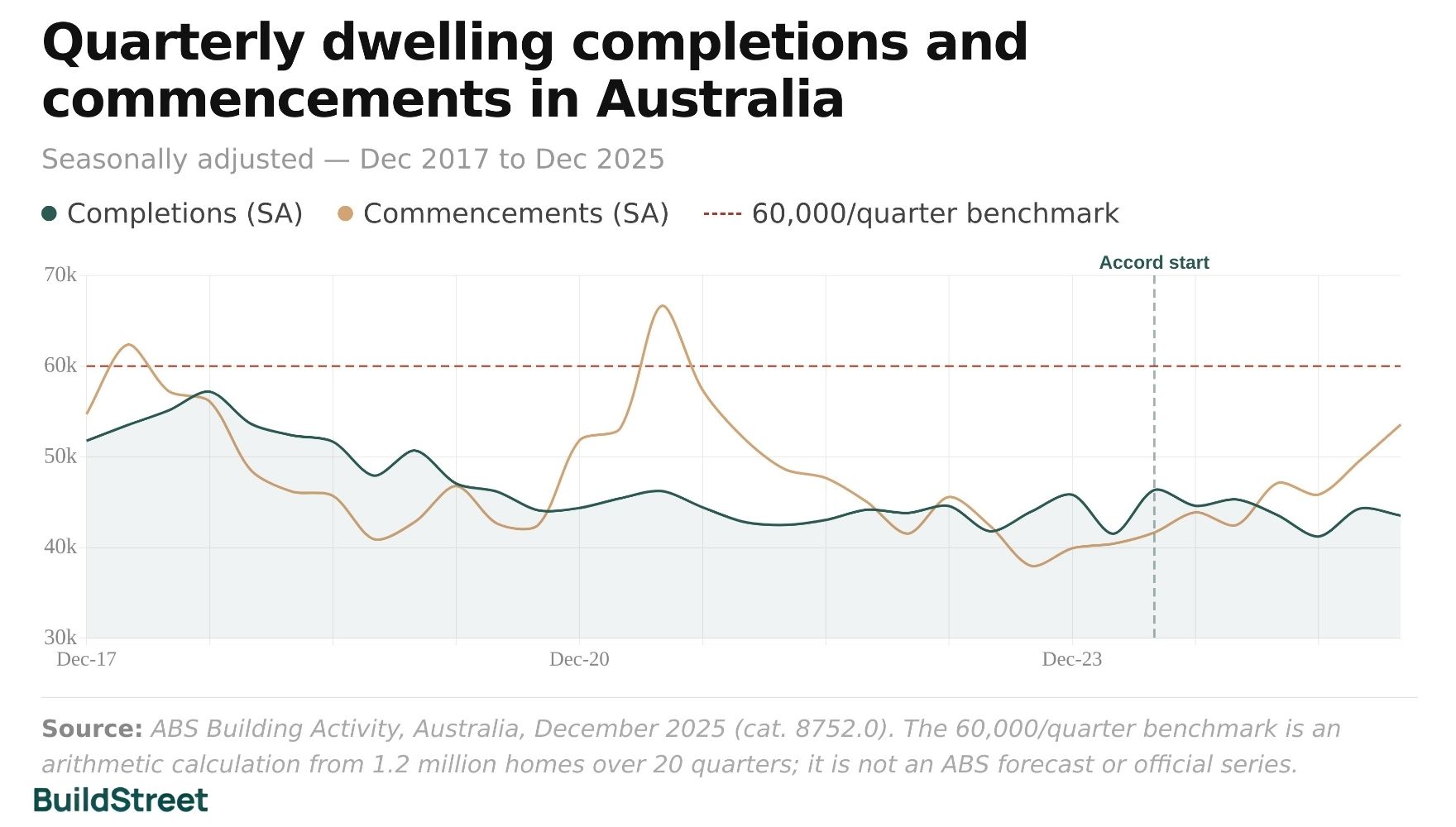
Commencements also rose, with 53,567 homes starting construction in the December quarter of 2025, up 8.0% on the previous quarter.
Since the National Housing Accord began in mid-2024, 219,000 new homes have been completed over five quarters, while real building costs have fallen 0.9% compared with the period immediately before the Accord.
The bottleneck is completions. Only 43,536 homes were finished in the December quarter of 2025, down 3.9% year-on-year. More homes are entering the construction pipeline than leaving it as completed dwellings. Until completions rise, finished housing supply will continue to lag demand.
Housing commencements vs completions, December quarter 2025
Seasonally adjusted. Shows the gap between homes starting and homes finishing construction.
New construction starts rose 8.0% in the December quarter of 2025, reaching 53,567 homes. Over the same period, completions fell 1.7% to 43,536. A large backlog of unfinished homes means completed supply has not kept pace with demand.
Source: ABS, Building Activity, Australia, December quarter 2025.
Housing starts are rising faster than completions
New construction starts rose 8.0% in the December quarter of 2025, reaching 53,567 homes. Completions over the same period fell to 43,536, leaving a large backlog of unfinished homes that means completed supply has not kept pace with demand.
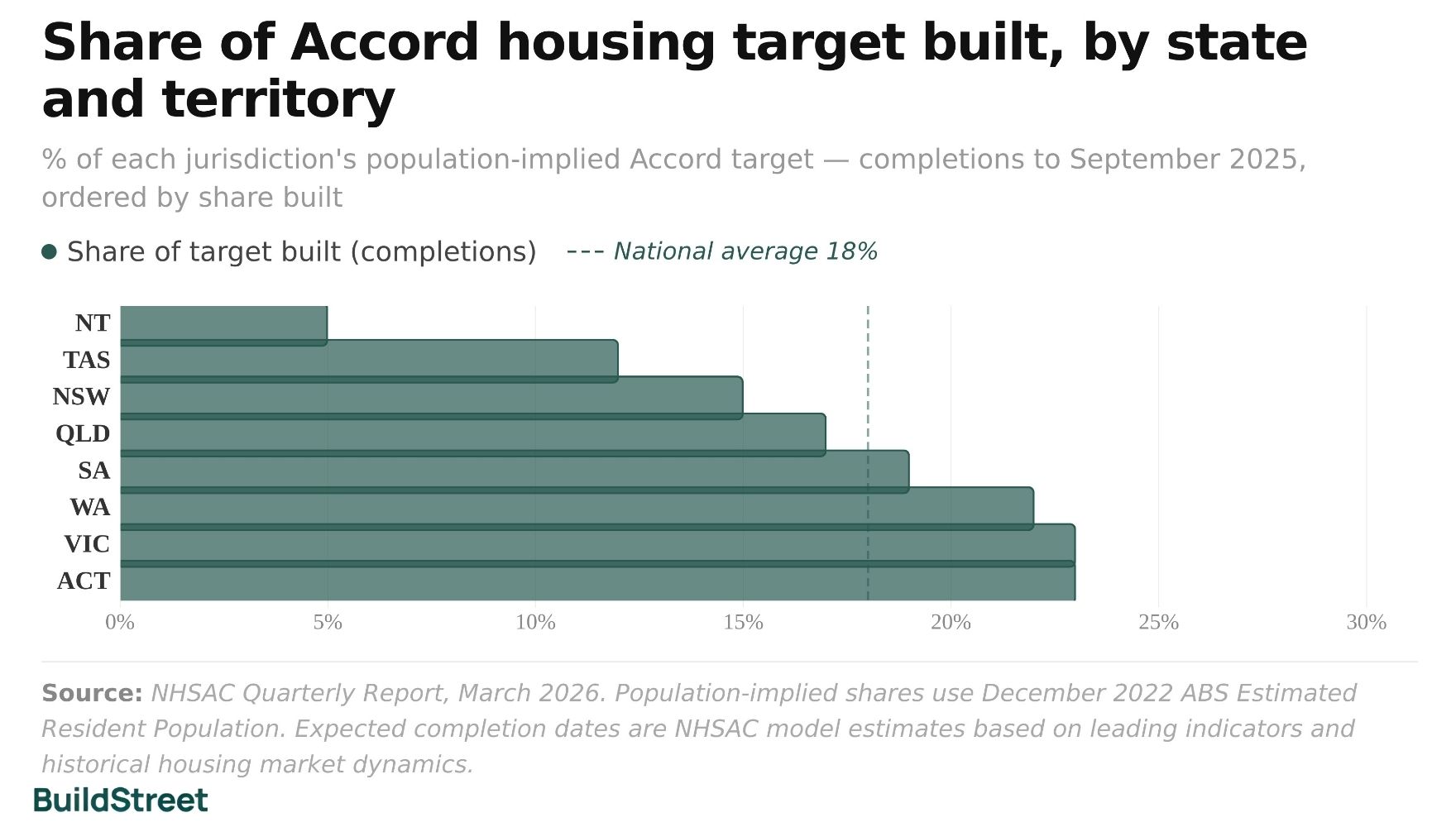
National Housing Accord: when each state is expected to meet its building target
The National Housing Accord aims to deliver 1.2 million new homes by 2029, but progress is uneven across Australia. Current projections suggest some states are broadly on track, while others are projected to miss the target by a wider margin.
Victoria and Western Australia
September 2029
On track to reach their share of the national target by the original deadline.
Queensland and South Australia
September 2030
Running about one year behind. People are moving to these states faster than homes are being built.
Australia (national)
June 2030
The country as a whole is projected to hit the target about one year late.
Northern Territory
After 2034
More than five years behind schedule. The worst housing supply shortfall of any state or territory.
Source: National Housing Supply and Affordability Council, Quarterly Report, March 2026.
Build times are longer than before the pandemic
The average new house took about nine-and-a-half months to build in 2024–25, or 3.07 quarters. That is an improvement on the 2023–24 peak of 3.47 quarters, but still 38% longer than the pre-pandemic average of around seven months, or 2.22 quarters.
Longer build times can add costs that are not included in the original building quote, depending on the buyer's housing and finance arrangements. Those costs include:
- rent paid while waiting to move into the new home
- interest charged on the construction loan during the build
- longer exposure to price increases while the project is still running
Average time to build a house — from start to finish
National averages for new private-sector houses. Apartment and townhouse build times are not included.
Source: Australian Bureau of Statistics, Building Activity (Cat. 8752.0).
Construction employment and job advertisements in Australia, 2026
Employment levels and job advertisement trends for the construction sector.
| Indicator | Latest figure | Period | Context |
|---|---|---|---|
| Construction employment | 1,371,500 | February 2026 | Highest on record |
| Job advertisements index | +25% vs 2019 avg | April 2026 | Labour demand still outpacing supply |
Source: Jobs and Skills Australia, Labour Force Trending, February 2026; Jobs and Skills Australia, Internet Vacancy Index, April 2026.
Construction employment reached 1,371,500 in February 2026, the highest on record. However, labour-market pressure remains elevated, with construction job advertisements still running 25% above the 2019 average. Infrastructure Australia has identified $242 billion worth of major public infrastructure projects planned or underway over the next five years, including roads, hospitals, stadiums and energy projects. These projects may compete with residential construction for some skilled trades, depending on location and trade type.
There is also a delay between when a build is approved and when it actually starts. In 2024–25, that gap was 10 weeks or 0.76 quarters on average, compared with 0.68 to 0.71 quarters before the pandemic. It is a smaller gap than the increase in build times, but it still adds weeks before work begins. As an illustration, someone paying $500 per week in rent during a 14-month build faces roughly $30,000 in extra housing costs that will never appear in the builder's quote. Actual costs will vary depending on rent, loan size and interest rate.
Fixed-price building contracts can still include extra costs
Fixed-price building contracts can still change because many residential contracts include allowances, provisional sums and variation clauses that allow some costs to be adjusted during construction.
Most residential building contracts are described as "fixed-price". In practice, many contracts do not lock in every possible cost. Some include clauses that allow the builder to pass certain extra costs on to the client. Three common contract items can increase the final build price: prime cost items, provisional sums and statutory variations.
In 2024–25, 2,361 construction businesses filed initial external administrator reports, which is the first formal step when a business can no longer pay its debts. This was roughly one in four of all such reports filed by businesses in Australia that year, the highest share of any industry.
Build times are also still running 38% longer than before the pandemic. In this environment, building contract terms can have a larger effect on the final cost paid by the client.
| Contract item | What it means | What to be aware of |
|---|---|---|
| Prime cost items | Things not yet chosen when the contract is signed, including taps, tiles, appliances, light fittings. The contract includes a set dollar allowance for each one. If the final selection costs more, the difference is added to the bill. | Allowances are often set too low. Check all against current retail prices before the contract is signed. |
| Provisional sum items | Work where the exact cost is not known upfront; excavation, rock removal, drainage, connecting services to the block. An estimate is included, but the final charge is based on actual cost. | The most common cause of cost overruns. On sloping or difficult blocks, actual cost may exceed estimate by tens of thousands of dollars. |
| Statutory variations | Most contracts allow the builder to pass on extra costs if laws change, building standards are updated, or unexpected site conditions are discovered during construction. | These clauses are legal and common. They mean the contract price is not the maximum amount that will be charged. |
Source: Standard residential building contract terms. Specific clauses vary by state and contract type.
How much cash should be kept aside for build overruns?
Industry professionals typically recommend holding 10–15% of the build cost as a cash reserve. On an average house build of $474,939, that works out to about $47,000 at 10% and about $71,000 at 15%. This is industry guidance, not a legal requirement. The money needs to be held as savings. Lenders will not extend extra credit mid-build when unexpected charges arrive.
If a builder goes bust mid-project, the client is left with an unfinished home. Getting a new builder to finish the job typically costs more, and any deposits already paid may be lost. Common pre-contract verification steps include:
- Check the builder's licence is current and valid
- Confirm the builder holds home warranty insurance
- Review recently completed projects
Which states have the fastest-rising building costs?
Tasmania recorded the highest building cost increases of any state, at +8.8% in the year to March 2026, followed by Western Australia at +6.3%. High costs and high demand are not always happening in the same place. Western Australia recorded both above-average house construction cost growth and strong population growth, while Queensland recorded strong population growth but below-average house construction cost growth in the ABS PPI data.
Western Australia
The only state with both high cost increases and high population growth. About 51,000 people moved to WA from overseas or other states in the year to Sep 2025. Avg home price: $1.104 million.
Tasmania
Highest building cost increase of any state in the year to Mar 2026. Tasmania has fewer builders and less capacity, so a rise in demand puts upward pressure on prices.
Queensland
About 76,000 people moved to Queensland in the year to September 2025. House construction prices rose 3.9% over the year to March 2026, below the national rise of 4.1%. SEQ may still face trade pressure from Olympics-related infrastructure work.
New South Wales
More people left NSW than arrived in the year to Sep 2025. Even so, NSW has the highest average home prices in the country at $1.325 million.
Victoria
Victoria is on track to meet its housing target by September 2029. New home approvals are still rising. The state recorded below-average building cost growth in the data cited.
Even within Queensland and Western Australia, there are differences between cities and regional areas.
In Queensland, the Olympics-related building work is mainly in South East Queensland — Brisbane, the Gold Coast and the Sunshine Coast. That is where competition for tradespeople is highest. In regional Queensland towns such as Townsville and Cairns, the pressure comes from defence and resources projects, and building costs in some of those areas are rising faster than the state average.
In Western Australia, large mining and energy projects in the Pilbara region and the north-west draw workers away from Perth through fly-in, fly-out arrangements. This pulls tradespeople out of the Perth housing market for extended periods, which affects pricing and availability across the whole state.
Building vs buying: which is cheaper in 2026?
Using national land, build-cost and established-home price measures, the estimated land-and-build cost has been lower than the established-home price measure each year since 2015. In 2025, the size of the gap depends on the land-price measure used.
The comparison combines a national land-price measure with the ABS average cost to build a new house, then compares that estimate with the ABS mean residential dwelling price. In the March quarter of 2026, the mean price of a residential dwelling in Australia was $1.111 million. The average cost to build a new house was $474,939 in 2024–25, excluding land. Land costs vary significantly by location, so the final land-and-build total cannot be represented by a single like-for-like national figure.
The gap needs careful reading. New land is often located 30 to 50 kilometres from the city centre, in outer suburban estates. Established homes are spread across inner and middle suburbs, where schools, public transport, shops and services are already in place. Part of the price difference is therefore a location difference, not just a build-cost difference.
Note: the established-home figure is a national mean dwelling price, while the land-and-build estimate uses a national land-price measure combined with an average build cost. These are not directly comparable measures, so the comparison should be read as an indicative national estimate rather than a like-for-like price comparison.
Stamp duty is often lower when tax applies to land only
Building can have a clear stamp duty advantage when land is purchased separately, and the home is built later. In that case, stamp duty is usually charged on the land value rather than the full completed property value. In New South Wales, that difference is roughly $33,000. Stamp duty on a typical Sydney block is about $24,800, compared with about $57,880 on a median established home at $1.325 million. First-home buyers may also be eligible for state grants. Queensland offers a first home owner grant of up to $30,000 for eligible new homes, subject to eligibility rules and property value caps, while South Australia offers up to $15,000 for eligible first home owners buying or building a new home, subject to eligibility and residency requirements.
| Factor | New build | Existing home |
|---|---|---|
| Is the price locked in from the start? | No, costs can change during the build | Usually agreed at contract, subject to settlement adjustments. |
| How long until move-in? | 12 to 24+ months from signing | 30 to 90 days from exchange |
| Stamp duty (NSW example) | About $24,800 on land only | About $57,880 on the full price |
| Costs while building | Ongoing rent plus loan repayments for 12–18 months | Usually no construction-period rent or construction-loan interest. |
| Energy efficiency | 7-star minimum rating for all new builds | Often 2 to 4 star, higher power bills |
| Location | Usually outer suburbs or new estates | Established areas with existing schools and services |
| Risk if builder fails | Unfinished-build and replacement-builder risk | No builder-completion risk after settlement |
Source: ABS Total Value of Dwellings; Revenue NSW stamp duty calculator.
One cost that rarely appears in comparisons is the cost of continuing to pay rent while waiting for a build to finish.
For example, someone paying $500 per week in rent during a 14-month build would spend roughly $30,000 to $50,000 in extra housing costs before moving in. Actual costs depend on rent amount, loan size and interest rate. In markets where building is only slightly cheaper than buying, such as Tasmania and Darwin, these extra costs can make building the more expensive option overall.
Average apartment construction value is up 50% since 2020 in NSW, Victoria and Queensland
Across NSW, Victoria and Queensland, the average construction value per completed apartment rose 50.6% between 2019–20 and 2024–25, reaching $567,947. This is a derived average based on ABS Building Activity construction value and completion data, not a direct apartment price index.
Despite this, the total value of apartment construction completed in 2024–25 was $20.7 billion, which is still below the 2017 peak of $21.2 billion, even though Australia's population has grown since then.
Average apartment build cost, 2024–25
$567,947
Up 50.6% from $377,200 in 2019–20 · derived from ABS Building Activity value and completion data · NSW, Victoria and Queensland only · excludes land
Apartment building value vs 2017 peak
Still below
$20.7B in 2024–25 vs $21.2B in 2017 · private sector · nominal dollars, not adjusted for inflation
Source: ABS, Building Activity, Australia, 2024–25 (annual); HIA and Centre for International Economics, Taxation of the Housing Sector, 2025.
Two factors are contributing to lower apartment construction activity.
Build costs are high. Mid-rise apartments often cost more per dwelling than the average suggests because the build includes shared spaces, lifts, fire safety systems and car parking. A 2025 independent housing feasibility review by the Centre for International Economics and HIA, Taxation of the Housing Sector, found that mid-rise apartment development could not achieve a standard profit margin in any Australian capital city at current prices.
Developers also usually need to sell a large share of apartments before a bank will release construction finance. This is known as a pre-sales requirement and is typically set at 60% to 80% of all units. With interest rates high and buyers more cautious about committing to a home that may be 18 months away, many projects are struggling to reach that threshold. When fewer projects meet pre-sales requirements, fewer projects move into construction.
Off-the-plan apartment purchases can carry construction and settlement risks
Buying off the plan means purchasing an apartment before construction is complete. In weaker development conditions, buyers can face additional risks, including delayed settlement dates, requests for price increases during construction, project redesigns or specification changes, and developer insolvency before completion. Off-the-plan contracts can also contain clauses that allow timelines, finishes or inclusions to change during construction.How borrowing conditions have changed since 2020
Higher interest rates have made new builds harder to finance. In the March quarter of 2026, the number of new home loans taken out by owner-occupiers fell 6.9% compared with the previous quarter. The total value of those loans fell 4.3% over the same period. This covers new lending only and does not include refinancing.
The RBA cut the cash rate to a pandemic low of 0.10% in 2020, then raised it sharply from May 2022, reaching a peak of 4.35% in November 2023. Three cuts followed in 2025, lowering the rate to 3.60% by August. Inflation then picked up materially in the second half of 2025, and the RBA responded with three consecutive hikes in February, March and May 2026, returning the cash rate to 4.35% by May 2026. Most mortgage rates have moved broadly in line with this path.
Borrowing conditions: 2020 versus 2026 ($500,000 loan example)
2020 Pandemic Low
2026 Current
Repayment figures are illustrative estimates based on principal-and-interest loans at mid-range variable rates for a $500,000 loan over 30 years. Actual repayments vary by lender, loan product and individual circumstances. Fees are excluded. Source: RBA, Cash Rate Target, media releases 2020–2026; APRA, Macroprudential Policy Settings, 2026; ABS, Building Activity, Australia, 2024–25 (annual).
The loan itself also needs to be larger. The average build cost has risen $129,529 since 2019–20. With APRA's 3 percentage point serviceability buffer, a borrower with a mortgage rate of 6.3% to 7.0% may be assessed at 9.3% to 10.0%. That assessment rate reduces the amount a lender will approve, independent of whether the actual rate seems affordable.
RBA cash rate, 2020–2026
Official cash rate target. Construction loan interest moves broadly in line with this rate.
The cash rate was held at 0.10% through most of 2020–21, then raised sharply from May 2022 to a peak of 4.35% in November 2023. Three cuts followed in 2025, bringing the rate to 3.60% by August 2025. Inflation picked up in the second half of 2025, prompting three consecutive hikes in February, March and May 2026, returning the rate to 4.35%.
Source: RBA, Cash Rate Target, media releases 2020–2026.
What the data shows about building conditions in 2026
New home approvals are up 10.2%, and construction starts rose 8.0% in the December quarter. Build times have improved from their 2023–24 peak, although they remain above pre-pandemic levels.
Build times still elevated
3.07 qtrs
Still 38% longer than before the pandemic, which can increase rent and construction-loan interest for some buyers.
Completions still lagging
43,536
Homes finished in the final quarter of 2025, down 3.9% year-on-year, even as new starts rose 8.0%.
Builder failures still high
2,361
Building companies that went insolvent in 2024–25. That is about 1 in 4 of all business failures in Australia.
The data cited for 2026 shows building costs were still rising, prices remained above pre-pandemic levels, and borrowing conditions were still tighter than in 2020. The costs most likely to affect project budgets are provisional sum items that exceed estimates, extended build timelines that add months of rent, and the financial exposure that comes with builder insolvency.
General information only
This article is based on publicly available data from government sources, including the ABS and the RBA. It is general information only and does not constitute financial advice. Readers seeking personal financial advice should consult a licensed financial adviser.
Australian Bureau of Statistics, Consumer Price Index, Australia, March 2026
Australian Bureau of Statistics, Producer Price Indexes, Australia, March 2026
Australian Bureau of Statistics, Building Activity, Australia, December 2025
Australian Bureau of Statistics, Building Approvals, Australia, April 2026
Australian Bureau of Statistics, Lending Indicators, Australia, March Quarter 2026
Australian Bureau of Statistics, Average dwelling completion times
Australian Bureau of Statistics, National, state and territory population, September 2025
Australian Bureau of Statistics, Total Value of Dwellings, March Quarter 2026
Reserve Bank of Australia, Cash Rate Target
Australian Prudential Regulation Authority, APRA maintains current macroprudential policy settings in highly uncertain environment
National Housing Supply and Affordability Council, Quarterly Report – March 2026
Infrastructure Australia, 2025 Infrastructure Market Capacity Report
Australian Securities and Investments Commission, Insolvency statistics: Series 3 external administrator reports
Jobs and Skills Australia, Internet Vacancy Index, April 2026
Jobs and Skills Australia, Labour Force Trending, February 2026
Housing Industry Association and Centre for International Economics, Taxation of the housing sector, 2025
Chart Snapshots